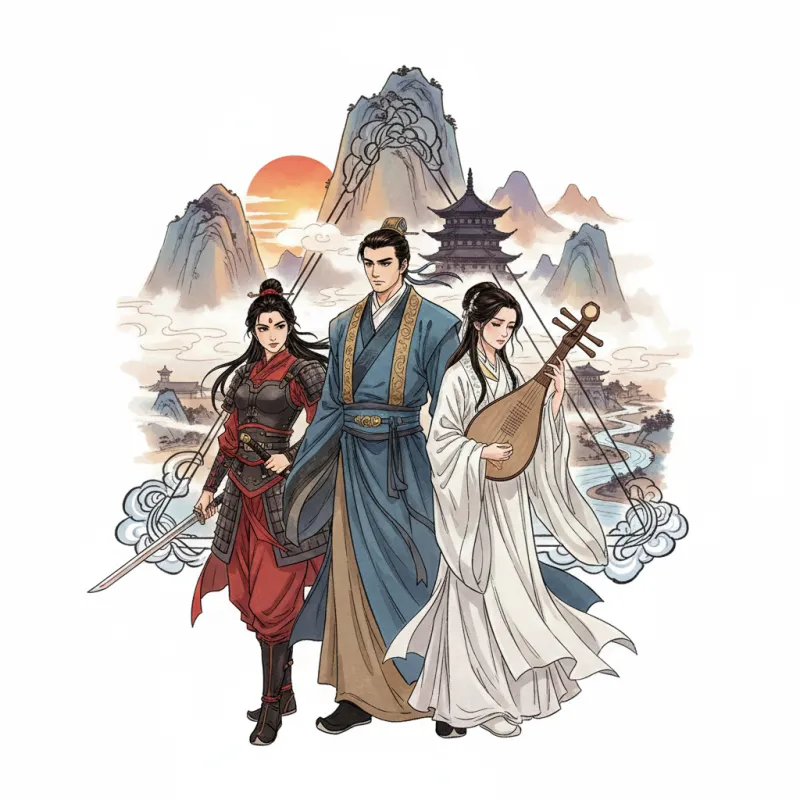
Love Triangles in Jin Yong: The Most Complicated Relationships
⏱️ 24 min read📅 Updated April 10, 2026⏱️ 24 min read📅 Updated April 10, 2026⏱️ 23 min read📅 Updated April 09, 2026Love Triangles in Jin Yong: The Most Complicated Relationships
Jin Yong (金庸, Jīn Yōng), the legendary wuxia novelist whose real name was Louis Cha, crafted some of the most intricate romantic entanglements in Chinese literature. While his novels are celebrated for their martial arts choreography and historical depth, it's the complicated love triangles that often leave readers emotionally devastated and endlessly debating. These relationships transcend simple romantic rivalry—they explore loyalty, destiny, moral duty, and the painful reality that love doesn't always conquer all.
The Eternal Debate: Guo Jing, Huang Rong, and Yang Kang
In The Legend of the Condor Heroes (《射雕英雄传》, Shèdiāo Yīngxióng Zhuàn), Jin Yong presents what initially appears to be a straightforward romance between the honest Guo Jing (郭靖) and the clever Huang Rong (黄蓉). However, the shadow of Yang Kang (杨康) creates a fascinating triangular dynamic that speaks to themes of destiny and choice.
While Yang Kang never truly competes for Huang Rong's affections, his relationship with Guo Jing forms the emotional core of a different triangle—one involving Mu Nianci (穆念慈). Yang Kang's betrothed, Mu Nianci, loves him despite his moral failings, creating a painful contrast with Guo Jing's unwavering righteousness. The real triangle here isn't romantic competition but rather a comparison of paths: Guo Jing represents what Yang Kang could have been, and Huang Rong's choice of Guo Jing over any possibility with the more sophisticated Yang Kang represents a choice of substance over style, loyalty over ambition.
What makes this triangle compelling is that Yang Kang and Guo Jing are sworn brothers, raised by different families after their fathers' deaths. Their parallel lives—one raised among the Mongols with simple values, the other among Jin nobility with corrupted morals—demonstrate how environment shapes character. Mu Nianci's tragic devotion to Yang Kang, even bearing his child after his death, adds layers of complexity to the question: can love redeem a flawed person, or does it merely enable their worst impulses?
The Heartbreak Triangle: Zhang Wuji, Zhao Min, and Zhou Zhiruo
Perhaps no love triangle in Jin Yong's works generates more passionate debate than the one in The Heaven Sword and Dragon Saber (《倚天屠龙记》, Yǐtiān Túlóng Jì). Zhang Wuji (张无忌), the indecisive protagonist, finds himself torn between two extraordinary women: the bold Mongol princess Zhao Min (赵敏) and his childhood companion Zhou Zhiruo (周芷若).
What elevates this beyond typical romantic rivalry is the moral complexity Jin Yong weaves into each relationship. Zhou Zhiruo begins as the innocent, gentle girl who grows up alongside Zhang Wuji, representing his past and his roots in the orthodox martial world (正派, zhèngpài). Their connection is built on shared trauma and mutual protection during their vulnerable youth. However, her transformation into a ruthless killer—driven by her master's dying command to retrieve the Yitian Sword (倚天剑, Yǐtiān Jiàn)—creates one of Jin Yong's most tragic character arcs.
Zhao Min, conversely, enters Zhang Wuji's life as an enemy. The daughter of the Ruyang Prince and a key figure in the Mongol court's efforts to suppress the Han Chinese resistance, she should be his natural opponent. Yet her intelligence, courage, and willingness to sacrifice everything—her status, her family, her identity—for love makes her irresistible both to Zhang Wuji and to readers.
The genius of this triangle lies in its moral ambiguity. Zhou Zhiruo commits terrible acts, including murdering innocent people and framing others, yet she does so out of filial duty (孝, xiào) to her deceased master. Zhao Min also has blood on her hands from her political machinations, yet she acts from a place of genuine love and personal choice. Zhang Wuji's inability to decisively choose between them—his constant waffling and promises to both women—makes him one of Jin Yong's most frustrating yet human protagonists.
The wedding scene remains one of the most emotionally devastating moments in wuxia literature: Zhou Zhiruo, dressed in her bridal finery, waiting for a groom who never arrives because Zhang Wuji has fled with Zhao Min. The image of the abandoned bride, having already lost everything else, captures the cruel reality that in love triangles, someone must suffer.
The Forbidden Triangle: Linghu Chong, Yue Lingshan, and Ren Yingying
The Smiling, Proud Wanderer (《笑傲江湖》, Xiào'ào Jiānghú) presents a love triangle that explores the pain of unrequited love and the difficulty of moving on. Linghu Chong (令狐冲), the carefree swordsman, spends much of the novel pining for his junior martial sister Yue Lingshan (岳灵珊), even as she falls for the ambitious Lin Pingzhi (林平之).
This triangle is particularly cruel because Yue Lingshan genuinely cared for Linghu Chong—their relationship as senior and junior martial siblings was filled with warmth and companionship. However, her attraction to Lin Pingzhi's refined manners and tragic background represents a young woman's romantic idealization, choosing passionate intensity over comfortable familiarity. The tragedy deepens when Lin Pingzhi, after learning the Evil-Resisting Sword Manual (辟邪剑谱, Bìxié Jiànpǔ) and castrating himself for power, becomes increasingly paranoid and abusive, ultimately killing Yue Lingshan in his madness.
Meanwhile, Ren Yingying (任盈盈), the daughter of the Sun Moon Holy Cult's leader, falls deeply in love with Linghu Chong. What makes this triangle fascinating is that it's not really a competition—Ren Yingying never directly competes with Yue Lingshan. Instead, she patiently waits, supports Linghu Chong through his heartbreak, and proves her worth through actions rather than words. She represents mature love: understanding, sacrificial, and unconditional.
The resolution of this triangle is bittersweet. Linghu Chong only truly opens his heart to Ren Yingying after Yue Lingshan's death, raising the uncomfortable question: would he have ever moved on if Yue Lingshan had lived? Ren Yingying's willingness to be second choice, to love someone who loves another, speaks to both her strength and the painful compromises love sometimes demands.
The Tragic Quadrangle: Duan Yu, Wang Yuyan, Murong Fu, and Zhong Ling
Demi-Gods and Semi-Devils (《天龙八部》, Tiānlóng Bābù) features multiple overlapping love triangles, but none more complex than the relationship between Duan Yu (段誉), Wang Yuyan (王语嫣), and Murong Fu (慕容复). This actually extends into a quadrangle when considering Zhong Ling (钟灵) and other women who love Duan Yu.
Duan Yu's obsessive love for Wang Yuyan borders on the pathological—he falls for her at first sight and remains devoted despite her complete indifference. Wang Yuyan, in turn, dedicates her entire existence to Murong Fu, memorizing martial arts manuals to help him achieve his political ambitions of restoring the Yan kingdom. Murong Fu, however, cares only for his imperial dreams, viewing Wang Yuyan as a useful tool rather than a beloved partner.
This triangle brilliantly illustrates the futility of one-sided devotion. Wang Yuyan's encyclopedic knowledge of martial arts, cultivated entirely to please Murong Fu, becomes meaningless when he abandons her for political advantage. Her eventual turn toward Duan Yu feels less like genuine love and more like exhausted resignation—choosing the person who actually values her after years of being taken for granted.
The complexity deepens with the revelation that Duan Yu and Murong Fu share a complicated family connection, and that Wang Yuyan is actually Duan Yu's cousin. Jin Yong uses this triangle to critique the destructive nature of obsession—whether Duan Yu's romantic obsession, Wang Yuyan's devotional obsession, or Murong Fu's political obsession. None of these characters achieve happiness through their single-minded pursuits.
The Generational Echo: Yang Guo, Xiao Longnu, and Lu Wushuang
The Return of the Condor Heroes (《神雕侠侣》, Shéndiāo Xiálǚ) features one of Jin Yong's most controversial relationships in Yang Guo (杨过) and his master Xiao Longnu (小龙女), but the triangle involving Lu Wushuang (陆无双) adds fascinating dimensions.
Lu Wushuang's unrequited love for Yang Guo represents the pain of loving someone completely devoted to another. What makes this triangle particularly poignant is that Lu Wushuang is a fully realized character with her own story, not merely a romantic obstacle. Her eventual acceptance and moving on demonstrates emotional maturity rare in wuxia fiction.
The real triangle, however, might be Yang Guo, Xiao Longnu, and society itself. Their relationship—between master and student, with a significant age gap—violates Confucian propriety and martial world conventions. The entire jianghu (江湖, the martial arts world) becomes the third point in this triangle, constantly pressuring them to separate. Their sixteen-year separation and eventual reunion represents a victory not just over physical obstacles but over social expectations and moral judgment.
The Subtle Triangle: Wei Xiaobao, Ah Ke, and the Seven Wives
The Deer and the Cauldron (《鹿鼎记》, Lùdǐng Jì) subverts traditional love triangles entirely. Wei Xiaobao (韦小宝), Jin Yong's most unconventional protagonist, doesn't choose between women—he marries seven of them. Yet his obsessive pursuit of Ah Ke (阿珂), who despises him for most of the novel, creates a triangle between Wei Xiaobao, Ah Ke, and his other wives who actually love him.
This triangle satirizes the very concept of romantic destiny. Ah Ke represents everything Wei Xiaobao thinks he wants: beauty, refinement, and unattainability. His other wives—particularly Shuang'er (双儿), who loves him unconditionally—represent what he actually needs: loyalty, acceptance, and genuine affection. The comedy lies in Wei Xiaobao's inability to recognize that his happiest moments come not from conquering Ah Ke's heart but from the companionship of women who see past his flaws.
Why Jin Yong's Love Triangles Endure
Jin Yong's love triangles transcend the genre because they're never simple romantic competitions. Each triangle explores deeper themes: the conflict between duty and desire, the pain of unrequited devotion, the question of whether love can redeem or merely enables, and the reality that timing matters as much as compatibility.
His characters make realistic, flawed choices. They stay with the wrong person out of loyalty, choose ambition over love, or remain paralyzed by indecision. Unlike Western romance where love conquers all, Jin Yong's universe acknowledges that sometimes love isn't enough—that circumstances, timing, personal growth, and moral choices all shape romantic outcomes.
The triangles also reflect Chinese philosophical concepts: the Buddhist idea of attachment causing suffering, the Daoist acceptance of natural flow rather than forced outcomes, and the Confucian tension between personal desire and social duty. Characters who cling too tightly to their romantic obsessions (like Duan Yu or Yang Kang) suffer, while those who learn to accept and adapt (like Ren Yingying or Shuang'er) find contentment if not perfect happiness.
Conclusion
Jin Yong's love triangles remain compelling because they refuse easy answers. Readers still debate whether Zhang Wuji made the right choice, whether Zhou Zhiruo deserved redemption, whether Linghu Chong truly loved Ren Yingying or merely settled. These discussions continue decades after the novels' publication because Jin Yong understood that love—especially complicated, messy, triangular love—reveals character in ways that sword fights never can.
In the end, these triangles teach us that love in the jianghu, like love in life, rarely follows the script we imagine. The most memorable relationships aren't the perfect ones but the complicated ones—the loves that challenge us, change us, and sometimes break us. That's why Jin Yong's romantic entanglements, with all their heartbreak and moral complexity, continue to resonate with readers across generations and cultures.
About the Author
Jin Yong Scholar — A literary critic and translator dedicated to the works of Jin Yong, with deep expertise in character analysis and martial arts world-building.
Related Articles
The Greatest Love Stories in Jin Yong's Novels
The Greatest Love Stories in Jin Yong's Novels...
Tragic Romances in Jin Yong: Love That Could Never Be
Love That Could Never Be...
Exploring the Love Stories in Jin Yong's Wuxia Novels: Romance Amidst Adventure
Discover the intricate love stories woven into Jin Yong's captivating wuxia novels....