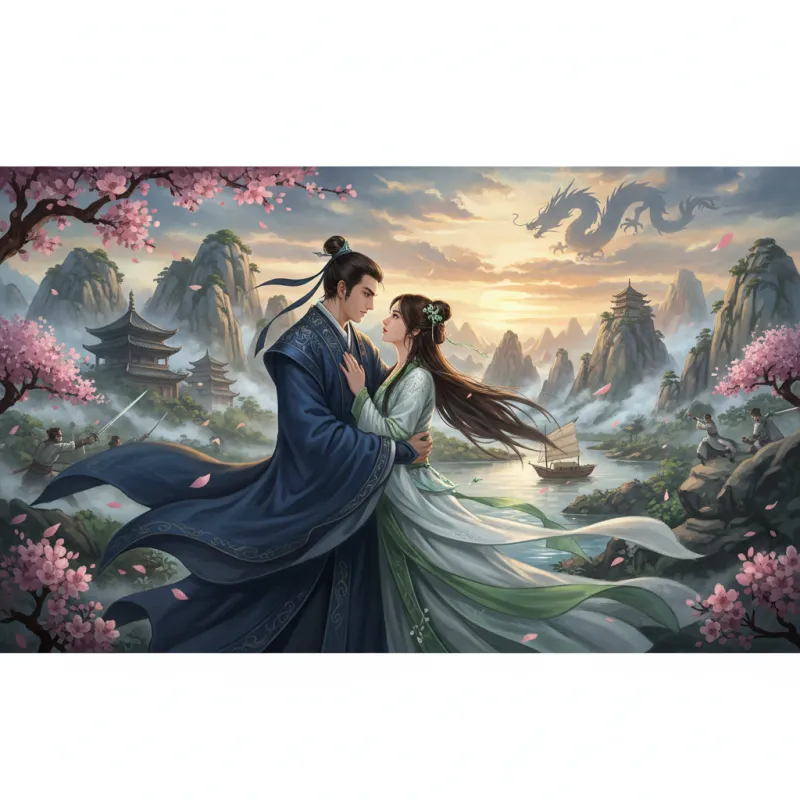
When Guo Jing first meets Huang Rong on the streets of Zhangjiakou, he's a simple-minded Mongolian youth who can barely string together a coherent sentence around women. She's disguised as a filthy beggar, testing his character. He buys her the most expensive meal in town without hesitation. This moment—humble, unexpected, transformative—captures everything essential about romance in Jin Yong's (金庸, Jīn Yōng) wuxia novels. Love doesn't announce itself with poetry and moonlight. It arrives in dirty streets, during desperate escapes, and between sword strikes, fundamentally altering the trajectory of both personal destiny and historical events.
Romance as the Engine of Narrative Consequence
Jin Yong understood something most action writers miss: love stories aren't decoration for martial arts plots—they're the structural foundation. In The Legend of the Condor Heroes (射雕英雄传, Shèdiāo Yīngxióng Zhuàn), Guo Jing's relationship with Huang Rong doesn't just provide emotional texture; it directly shapes the Song Dynasty's resistance against Mongol invasion. Their romance produces strategic alliances, betrayals, and the moral framework that defines heroism throughout the trilogy. When Yang Guo and Xiaolongnü reunite after sixteen years in The Return of the Condor Heroes (神雕侠侣, Shéndiāo Xiálǚ), it's not merely satisfying on an emotional level—it represents the resolution of generational trauma and the reconciliation of orthodox and unorthodox martial arts philosophies.
This integration runs deeper than plot mechanics. Jin Yong's romances generate the ethical dilemmas that test his characters' martial virtue. Linghu Chong's love for Yue Lingshan in The Smiling, Proud Wanderer (笑傲江湖, Xiào'ào Jiānghú) forces him to choose between personal desire and loyalty to his martial arts sect. His eventual relationship with Ren Yingying emerges only after he's learned to distinguish between possessive attachment and genuine partnership—a distinction that mirrors his journey from orthodox disciple to free-spirited wanderer.
The Taxonomy of Jin Yong's Romantic Archetypes
Jin Yong crafted distinct romantic patterns across his fifteen novels, each exploring different facets of love's complexity. The "childhood sweethearts" archetype appears repeatedly but never identically. Guo Jing and Huang Rong represent complementary opposites—his moral simplicity balances her cunning intelligence. Zhang Wuji's relationships in The Heaven Sword and Dragon Saber (倚天屠龙记, Yǐtiān Túlóng Jì) complicate this pattern by giving him four potential love interests, each representing different values: Zhou Zhiruo embodies ambition corrupted by trauma, Zhao Min represents pragmatic nobility, Zhu'er offers innocent devotion, and Xiaozhao provides selfless sacrifice.
The "forbidden love" category reaches its apex with Yang Guo and Xiaolongnü, whose student-teacher relationship and sixteen-year separation created one of Chinese literature's most iconic romantic narratives. Their love violates Confucian propriety, yet Jin Yong frames it as spiritually pure—more authentic than socially acceptable relationships. This subversive stance reflects the 1960s Hong Kong context in which Jin Yong wrote, when traditional values were colliding with modernization.
Then there's the "tragic devotion" pattern, exemplified by A'Zhu and Qiao Feng in Demi-Gods and Semi-Devils (天龙八部, Tiānlóng Bābù). Their relationship lasts barely a quarter of the novel, yet A'Zhu's accidental death at Qiao Feng's hands becomes the emotional fulcrum of the entire narrative. Jin Yong understood that romantic tragedy derives power not from duration but from specificity—the particular way A'Zhu disguises herself to protect Qiao Feng, the exact moment he realizes what he's done, the precise manner in which this personal catastrophe intersects with ethnic conflict between Han Chinese and Khitan peoples.
Women Who Refuse to Be Rescued
Jin Yong's female characters evolved dramatically across his writing career. Early novels like The Book and the Sword (书剑恩仇录, Shūjiàn Ēnchóu Lù, 1955) feature relatively conventional heroines. By the time he wrote The Deer and the Cauldron (鹿鼎记, Lùdǐng Jì, 1969-1972), he'd created characters like Shuang'er, who possesses greater emotional intelligence than protagonist Wei Xiaobao despite his superior cunning.
Huang Rong remains the template for Jin Yong's most compelling female characters—brilliant, manipulative, fiercely loyal, and utterly uninterested in conforming to feminine ideals. She's the daughter of Huang Yaoshi, the "Heretical Eastern Master," and inherits his contempt for orthodox morality. When she falls for Guo Jing, it's not because he rescues her but because his moral simplicity offers something her brilliant, cynical mind cannot generate alone. Their relationship works because she chooses him, repeatedly, despite having countless other options.
Zhao Min in The Heaven Sword and Dragon Saber takes this agency further. As a Mongolian princess, she begins as Zhang Wuji's enemy, captures him multiple times, and pursues him with shameless directness that scandalized 1960s readers. She doesn't wait to be chosen—she chooses, manipulates circumstances, and ultimately wins through a combination of strategic brilliance and genuine emotional transformation. The novel's controversial ending, where Zhang Wuji abandons Zhou Zhiruo for Zhao Min, works because Zhao Min has consistently demonstrated greater emotional honesty and compatibility.
The Geography of Romantic Revelation
Jin Yong's romances unfold in carefully chosen landscapes that mirror emotional states. The Mongolian steppes where Guo Jing and Huang Rong's relationship deepens represent openness and possibility—a stark contrast to the claustrophobic politics of the Song court. The Ancient Tomb where Yang Guo and Xiaolongnü live together for years becomes a womb-like space outside normal time, allowing their forbidden relationship to develop away from society's judgment.
Dali Kingdom in Yunnan province serves as Jin Yong's recurring setting for romantic complexity. In Demi-Gods and Semi-Devils, Duan Yu's journey through Dali involves falling in love with multiple women, each encounter revealing different aspects of desire, duty, and delusion. The region's historical position as a semi-independent kingdom between Chinese and Southeast Asian cultures makes it the perfect metaphor for romantic relationships that exist in the liminal space between social categories.
The Shaolin Temple, appearing across multiple novels, represents the opposite pole—a space where romance is forbidden but therefore becomes more intense. Xuzhu's accidental loss of virginity in Demi-Gods and Semi-Devils occurs in a dark cave where he cannot see his partner, creating a relationship based purely on physical and emotional connection rather than social identity. This encounter, which violates his Buddhist vows, ultimately leads to his greatest happiness—a characteristically subversive Jin Yong commentary on the relationship between religious orthodoxy and human fulfillment.
Love Across Ethnic and Political Boundaries
Jin Yong wrote during a period of intense Chinese nationalism, yet his romances consistently cross ethnic boundaries in ways that complicate simplistic patriotism. Qiao Feng's discovery that he's Khitan rather than Han Chinese destroys his social identity, but his love for A'Zhu transcends ethnic categories—until he accidentally kills her while pursuing revenge against her Han Chinese father. The tragedy emerges from the impossibility of separating personal relationships from collective ethnic conflict.
Chen Jialuo's love for Princess Fragrance (Xiangxiang) in The Book and the Sword follows a similar pattern. As leader of the Red Flower Society fighting Manchu rule, he falls for a Uyghur Muslim princess whose people are being oppressed by the same Qing Dynasty he opposes. Their relationship should be natural allies united against common enemies, but cultural differences and political complications make their love impossible. Princess Fragrance's death represents the failure of romantic idealism to overcome historical forces—a pessimistic conclusion that Jin Yong would revisit throughout his career.
The most successful cross-cultural romance appears in The Deer and the Cauldron, where Wei Xiaobao marries seven wives from different ethnic backgrounds—Han, Manchu, Mongol, Tibetan, and Russian. This comedic resolution works because Wei Xiaobao lacks the rigid identity that dooms more serious heroes. He's a trickster figure who succeeds precisely because he refuses to take ethnic and political boundaries seriously. Jin Yong seems to suggest that romantic harmony across cultural divides requires either tragic sacrifice or a fundamental unseriousness about identity itself.
The Martial Arts of Intimacy
Jin Yong's genius lies in making martial arts practice itself an expression of romantic connection. When Linghu Chong learns the "Dugu Nine Swords" technique, he's simultaneously learning to let go of his attachment to Yue Lingshan—the sword style's emphasis on formlessness and adaptation mirrors the emotional flexibility required for mature love. His relationship with Ren Yingying deepens through musical performance rather than combat, their duets on qin (琴, seven-string zither) and xiao (箫, vertical bamboo flute) creating harmony that their martial arts sects cannot achieve.
The "Jade Maiden Swordplay" that Yang Guo and Xiaolongnü practice together requires perfect synchronization between partners—a physical manifestation of their emotional bond. When they're separated, neither can perform the technique effectively, making their martial arts prowess literally dependent on their romantic connection. This integration of combat and intimacy appears throughout Jin Yong's work, suggesting that the highest martial arts achievement requires the vulnerability and trust that only love provides.
Even sexual intimacy gets coded through martial arts language. When characters practice "dual cultivation" techniques (双修, shuāngxiū), they're engaging in Daoist practices that channel sexual energy into martial power. These scenes, while never explicit, acknowledge the connection between physical desire and spiritual development—a sophisticated treatment of sexuality rare in Chinese popular fiction of the 1960s.
Why These Romances Still Matter
Jin Yong's love stories endure because they refuse easy resolutions. Unlike Western romance novels that typically end with marriage, his romances continue into the complications of long-term partnership. The Legend of the Condor Heroes concludes with Guo Jing and Huang Rong's wedding, but the sequel trilogy shows their relationship tested by parenthood, political responsibility, and the eventual death defending Xiangyang against Mongol invasion. Romance doesn't solve life's problems—it creates new, more complex ones.
This realism extends to his treatment of romantic failure. Zhang Wuji's inability to choose between Zhou Zhiruo and Zhao Min until circumstances force his hand reflects genuine emotional paralysis rather than heroic decisiveness. Duan Yu's serial infatuations in Demi-Gods and Semi-Devils reveal how romantic obsession can become a form of spiritual delusion. Even successful relationships like Guo Jing and Huang Rong's require constant negotiation between different values and temperaments.
For readers exploring the philosophical depths of Jin Yong's work, his romances provide the emotional laboratory where abstract principles become lived experience. The question isn't whether love conquers all—it's how love transforms individuals while being simultaneously constrained by history, culture, and human limitation. That tension, never fully resolved, keeps readers returning to these stories decades after their initial publication.
The love stories in Jin Yong's wuxia novels matter because they insist that romance and adventure aren't separate genres but different aspects of the same human struggle for meaning. When Guo Jing defends Xiangyang, he's protecting not just a city but the life he's built with Huang Rong. When Yang Guo waits sixteen years for Xiaolongnü, he's practicing a form of martial discipline more demanding than any combat technique. These stories suggest that the greatest adventure is learning to love another person fully—with all the danger, transformation, and ultimate uncertainty that entails.
Related Reading
- Wine Culture in Jin Yong's Wuxia World
- Jin Yong's Quotes That Every Chinese Person Knows
- The Best TV Adaptations of Jin Yong's Novels