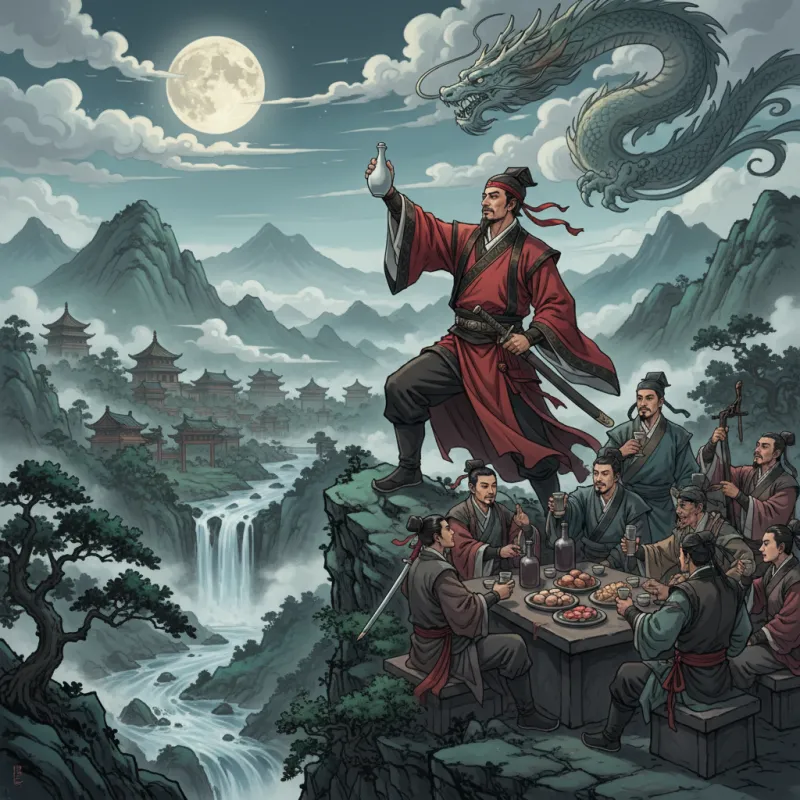
Xiao Feng slams his palm on the table, and three bowls of wine leap into the air. He catches them one by one and drains each in a single gulp, never breaking eye contact with the men who just insulted the Khitans. This isn't showing off — this is a declaration of identity. In Jin Yong's (金庸 Jīn Yōng) martial arts universe, how you drink reveals everything about who you are, and Xiao Feng drinks like a man with nothing to hide and nothing to fear.
Wine (酒 jiǔ) permeates every corner of Jin Yong's wuxia (武侠 wǔxiá) world, but it's never just alcohol. It's a social contract, a weapon, a truth serum, and occasionally a shortcut to martial enlightenment. While food reveals social status and regional identity, wine exposes the soul. The way a character handles their drink tells you more than a thousand words of description ever could.
The Heroic Drinker: Xiao Feng's Philosophy
Xiao Feng (萧峰 Xiāo Fēng), the Khitan hero of Demi-Gods and Semi-Devils (《天龙八部》Tiānlóng Bābù), embodies the ideal of heroic drinking. He doesn't sip — he drains entire jars. He doesn't drink alone — he shares with beggars and princes alike. When he drinks at the Apricot Forest gathering, he's not trying to get drunk; he's demonstrating that he has nothing to hide, no schemes to protect, no face to save.
This style of drinking has deep roots in Chinese literary tradition, particularly the Tang Dynasty (618-907 CE) poet Li Bai (李白 Lǐ Bái), who allegedly drowned while drunkenly trying to embrace the moon's reflection. But Jin Yong adds a martial dimension: Xiao Feng's drinking is an extension of his martial philosophy. His Eighteen Dragon-Subduing Palms (降龙十八掌 Jiàng Lóng Shíbā Zhǎng) are straightforward, powerful, and honest — exactly like his drinking style.
The contrast with other characters is deliberate. When Xiao Feng drinks with Duan Yu (段誉 Duàn Yù) and Xu Zhu (虚竹 Xū Zhú), the three sworn brothers represent three approaches to life and wine. Xiao Feng drinks with passion, Duan Yu drinks with refinement, and Xu Zhu drinks with innocent confusion. Their drinking scenes aren't filler — they're character studies in liquid form.
The Drunken Master: Wine as Martial Arts
The Drunken Fist (醉拳 Zuì Quán) appears throughout Jin Yong's novels, but it's more than a fighting style — it's a philosophy about losing control to gain control. In The Legend of the Condor Heroes (《射雕英雄传》Shèdiāo Yīngxióng Zhuàn), Zhou Botong (周伯通 Zhōu Bótōng) uses wine to break through martial arts bottlenecks, achieving a state where technique becomes instinct.
The historical Drunken Fist tradition dates back to the Song Dynasty (960-1279 CE), but Jin Yong transforms it from mere technique into metaphor. True mastery, he suggests, requires abandoning rigid control. The drunk fighter moves unpredictably because they've stopped trying to move correctly. This parallels Daoist (道家 Dàojiā) concepts of wu wei (无为 wú wéi) — effortless action achieved by not forcing.
Linghu Chong (令狐冲 Línghú Chōng) from The Smiling, Proud Wanderer (《笑傲江湖》Xiào'ào Jiānghú) takes this further. His relationship with wine isn't about martial arts enhancement — it's about emotional survival. After being expelled from the Huashan Sect, wine becomes his companion, his escape, and paradoxically, his path to clarity. When he's drunk, he stops caring about sect politics and reputation, which allows him to see the jianghu (江湖 jiānghú, the martial world) for what it really is: a cesspool of hypocrisy dressed in righteous language.
Wine as Social Currency
In Jin Yong's world, refusing to drink is often more significant than drinking. When someone offers wine, they're offering trust, friendship, or at minimum, temporary truce. Rejection carries weight. This reflects actual Chinese drinking culture, where ganbei (干杯 gānbēi, "dry cup" or bottoms up) isn't just a toast — it's a social obligation.
The Beggar Clan (丐帮 Gàibāng) elevates this to institutional level. Their hierarchy is partly determined by drinking capacity. A leader who can't drink with the lowest-ranking member loses legitimacy. When Xiao Feng becomes clan leader, his first act is drinking with every member who challenges him — not to prove superiority, but to prove equality. The wine bowl becomes a leveling mechanism in a world obsessed with hierarchy.
Compare this with the aristocratic drinking in The Book and the Sword (《书剑恩仇录》Shū Jiàn Ēnchóu Lù), where Chen Jialuo (陈家洛 Chén Jiāluò) and his Red Flower Society members drink with elaborate etiquette. Same beverage, completely different social meaning. The Beggar Clan drinks to erase distinctions; the Red Flower Society drinks to reinforce them.
The Poisoned Cup: Wine as Weapon
Not all wine in Jin Yong's novels is innocent. The poisoned cup appears repeatedly, and it's always a betrayal of the social contract that wine represents. When Yue Buqun (岳不群 Yuè Bùqún) in The Smiling, Proud Wanderer poisons wine, he's not just attempting murder — he's violating the fundamental trust that sharing wine implies.
The most devastating poisoned wine scene occurs in Demi-Gods and Semi-Devils when Kang Min (康敏 Kāng Mǐn) uses wine and seduction to destroy Qiao Feng's (乔峰 Qiáo Fēng, Xiao Feng's Han name) life. She doesn't poison the wine literally, but she poisons the social bonds that wine is supposed to cement. Her manipulation during drinking sessions sets off the chain of revelations that transforms Qiao Feng from respected hero to hunted outcast.
Jin Yong understands that in Chinese culture, the shared cup creates obligation. When you drink someone's wine, you enter a relationship with them. Poisoning that wine — literally or metaphorically — is therefore the ultimate betrayal, worse than open combat. At least in a fight, everyone knows where they stand.
Wine and Women: The Gendered Cup
Jin Yong's female characters have a complicated relationship with wine. In traditional Chinese society, women drinking openly was often considered improper, but wuxia fiction operates by different rules. Huang Rong (黄蓉 Huáng Róng) from The Legend of the Condor Heroes drinks when she wants to, but she's also strategic about it — she'll pretend to be more drunk than she is to gather information or avoid unwanted attention.
The most interesting female drinker might be Ren Yingying (任盈盈 Rèn Yíngyíng) from The Smiling, Proud Wanderer. As the daughter of the Sun Moon Holy Cult leader, she drinks with the same authority as male characters, but she also uses wine as a tool of seduction and manipulation. When she drinks with Linghu Chong, it's simultaneously genuine connection and calculated strategy. Jin Yong suggests that for women in the jianghu, wine can never be purely social — it's always also tactical.
This reflects historical reality. During the Tang Dynasty, women of certain classes could drink relatively freely, but by the Song and Ming Dynasties (1368-1644 CE), Confucian restrictions had tightened. Jin Yong's novels, set in various historical periods, reflect these changing attitudes. His female characters who drink openly are almost always transgressive in some way — which is precisely what makes them interesting.
The Monk Who Drinks: Breaking Precepts for Truth
Buddhist monks in Jin Yong's novels face a dilemma: the precepts forbid alcohol, but the jianghu demands it. Xu Zhu in Demi-Gods and Semi-Devils accidentally breaks his vow of abstinence and discovers that the world doesn't end. In fact, drinking wine becomes part of his journey toward understanding that rigid adherence to rules can be its own form of attachment.
This isn't Jin Yong being irreverent toward Buddhism — it's him engaging with genuine Buddhist philosophy. The Vimalakirti Sutra (《维摩诘经》Wéimójié Jīng) features a lay Buddhist who drinks wine and visits courtesans while being more enlightened than the monks who follow every rule. The point isn't that rules don't matter; it's that attachment to rules can become an obstacle to enlightenment.
The "wine and meat pass through the intestines, but the Buddha remains in the heart" (酒肉穿肠过,佛祖心中留 jiǔ ròu chuān cháng guò, Fózu xīn zhōng liú) saying, attributed to the monk Jigong (济公 Jìgōng), captures this paradox. Jin Yong uses wine-drinking monks to explore the difference between following the letter of religious law and understanding its spirit. Sometimes the most enlightened characters are the ones who break the rules for the right reasons.
The Taste of Memory: Wine and Nostalgia
Jin Yong rarely describes what wine actually tastes like — he's more interested in what it means. But when he does mention specific wines, they're always tied to memory and place. The Shaoxing wine (绍兴酒 Shàoxīng jiǔ) that appears throughout his novels isn't just a beverage; it's a connection to Jiangnan (江南 Jiāngnán), the cultured southern region that Jin Yong himself came from.
When characters drink Shaoxing wine far from home, they're not just drinking — they're remembering. This connects to the broader theme in Jin Yong's work about displacement and belonging. Many of his heroes are exiles or wanderers, and wine becomes one of the few constants in their unstable lives. You can't take your home with you, but you can drink the same wine your father drank, your teacher drank, your sworn brothers drank.
The most poignant drinking scene in all of Jin Yong's novels might be in The Deer and the Cauldron (《鹿鼎记》Lù Dǐng Jì), when Wei Xiaobao (韦小宝 Wéi Xiǎobǎo) drinks with the Kangxi Emperor. They're friends, but they're also on opposite sides of history — one Han, one Manchu, in an era when that distinction could mean life or death. The wine they share can't erase that divide, but for a few hours, it makes it bearable. That's perhaps the most honest thing Jin Yong says about wine: it doesn't solve problems, but it makes them easier to face.
The Last Cup: Wine and Mortality
Jin Yong's heroes often face death with a cup in hand. Xiao Feng's final scene in Demi-Gods and Semi-Devils doesn't involve wine, but it echoes every drinking scene that came before — the same directness, the same refusal to hide or scheme, the same tragic honesty. He lived like he drank: openly, generously, and without regret.
This connects wine to the broader wuxia theme of living fully in the present moment. The jianghu is dangerous, and tomorrow is never guaranteed. Drinking wine — really drinking it, not sipping cautiously while plotting — is an act of faith that this moment matters, that this company matters, that being fully present is worth the vulnerability it requires.
In the end, Jin Yong uses wine the way he uses martial arts: as a lens to examine what it means to be human. The techniques and the beverages are just the surface. Underneath is the eternal question of how to live with honor in a dishonorable world, how to maintain humanity in inhuman circumstances, and how to find connection in a life defined by violence and separation. Sometimes the answer is at the bottom of a wine bowl. Sometimes it's in the act of sharing that bowl with someone else. And sometimes, like Linghu Chong discovered, it's in accepting that there are no answers — only the next cup, and the next moment, and the choice to face both with open eyes.
Related Reading
- The Food and Drink of Jin Yong: What Heroes Eat Between Sword Fights
- Tea and Martial Arts: The Quiet Moments Between Fights
- Food in Jin Yong's Novels: When Cooking Is a Martial Art
- Love and Sacrifice in Jin Yong's World
- Exploring the Rich Tapestry of Jin Yong's Wuxia Novels: Characters and Martial Arts
- The Best TV Adaptations of Jin Yong's Novels