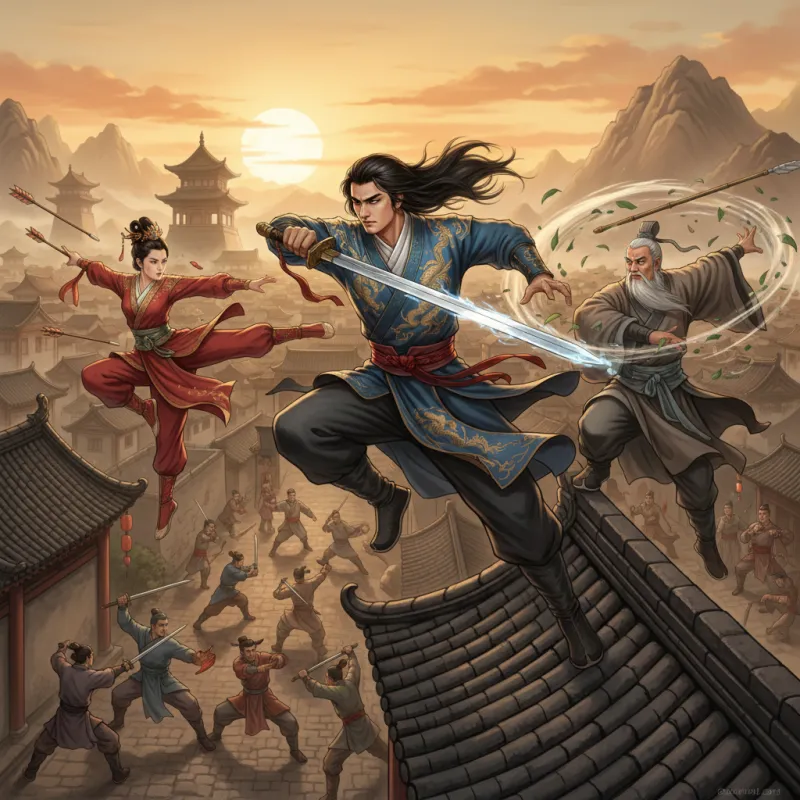
Picture this: A blind swordsman deflects a thousand needles with nothing but sound. A beggar chief commands an army of outcasts through sheer moral authority. A young man learns the universe's secrets from tadpole-shaped characters carved into stone. These aren't fever dreams—they're Tuesday afternoon in a Jin Yong novel. Louis Cha (查良鏞, Chá Liángyōng), writing under the pen name Jin Yong (金庸, Jīn Yōng), didn't just write martial arts fiction between 1955 and 1972. He created a parallel universe so detailed, so philosophically rich, that generations of readers treat it like alternate history.
The Architecture of Jin Yong's Universe
What separates Jin Yong from pulp wuxia writers is architectural ambition. His fifteen novels form an interconnected cosmos spanning from the Song Dynasty (960-1279) through the Qing Dynasty (1644-1912), with each era's martial arts world (江湖, jiānghú—literally "rivers and lakes") reflecting its political realities. The Legend of the Condor Heroes (射鵰英雄傳, Shèdiāo Yīngxióng Zhuàn) unfolds during the Mongol invasions, making patriotism and resistance central themes. The Deer and the Cauldron (鹿鼎記, Lùdǐng Jì), set during the Manchu conquest, questions whether heroism even exists in morally compromised times.
This isn't window dressing. Jin Yong researched obsessively, weaving real historical figures like Genghis Khan and Emperor Kangxi into his narratives. When Guo Jing defends Xiangyang in The Return of the Condor Heroes (神鵰俠侶, Shéndiāo Xiálǚ), readers know the city actually fell to the Mongols in 1273—the tragedy feels inevitable, earned. The historical authenticity in Jin Yong's novels grounds even the most fantastical martial arts in recognizable human struggle.
Characters Who Refuse Simplicity
Jin Yong's protagonists frustrate anyone seeking straightforward heroes. Guo Jing is loyal, righteous, and—let's be honest—kind of dim. His wife Huang Rong is brilliant but manipulative. Yang Guo, their successor in The Return of the Condor Heroes, is arrogant and self-destructive, yet capable of profound devotion. Linghu Chong from The Smiling, Proud Wanderer (笑傲江湖, Xiào'ào Jiānghú) drinks too much and refuses leadership despite being the most qualified person in the room.
This psychological complexity extends to antagonists. Ouyang Feng isn't evil—he's traumatized by unrequited love and driven mad by practicing reversed martial arts manuals. Yue Buqun appears as a righteous sect leader for 80% of The Smiling, Proud Wanderer before revealing himself as a power-hungry hypocrite who castrated himself to learn forbidden techniques. That's not a plot twist; it's a meditation on how ideology corrupts.
The women in Jin Yong's novels deserve special mention because they demolish the "damsel in distress" trope. Huang Rong outsmarts everyone. Zhao Min from The Heaven Sword and Dragon Saber (倚天屠龍記, Yǐtiān Túlóng Jì) is a Mongol princess who pursues the man she wants with strategic brilliance. Ren Yingying orchestrates political maneuvers while pretending to be a helpless maiden. These aren't "strong female characters" in the performative modern sense—they're fully realized people whose gender informs but doesn't limit their agency.
The Martial Arts as Philosophy
Here's where Jin Yong transcends genre fiction: his martial arts systems embody competing philosophies. The martial arts techniques in Jin Yong's world aren't just cool moves—they're arguments about how to live.
Take the Nine Yin Manual (九陰真經, Jiǔyīn Zhēnjīng), the most coveted text in the Condor trilogy. It contains devastating techniques, but its true power lies in Taoist principles about balancing yin and yang energies. Practitioners who focus only on the combat applications (like Ouyang Feng) go insane. Those who understand the philosophy (like Zhou Botong) achieve transcendence. The manual itself warns: "The highest martial arts is no martial arts"—a very Taoist paradox about achieving mastery through non-striving.
Contrast this with the Sunflower Manual (葵花寶典, Kuíhuā Bǎodiǎn) from The Smiling, Proud Wanderer. To practice it, men must castrate themselves, literalizing the Buddhist concept of severing earthly attachments. But does it work? Dongfang Bubai becomes nearly invincible yet loses his humanity, obsessing over embroidery and a pretty boy. Jin Yong asks: What's the point of ultimate power if you destroy yourself to get it?
The Eighteen Dragon-Subduing Palms (降龍十八掌, Xiánglóng Shíbā Zhǎng) represents Confucian righteousness—straightforward, powerful, requiring moral character to master. The Nine Swords of Dugu (獨孤九劍, Dúgū Jiǔjiàn) embodies Daoist spontaneity—no fixed forms, only principles for exploiting opponents' weaknesses. Even the names carry meaning: "Dugu" means "solitary" because true mastery isolates you from ordinary concerns.
The Jianghu as Alternate Society
The jianghu in Jin Yong's novels functions as a shadow government with its own rules, hierarchies, and moral codes. The Beggar's Sect (丐幫, Gàibāng) is a nation-spanning intelligence network disguised as homeless people. The Ming Cult (明教, Míngjiào) operates as a revolutionary organization. Sects like Shaolin (少林, Shàolín) and Wudang (武當, Wǔdāng) wield influence rivaling imperial courts.
What makes this fascinating is how Jin Yong explores power dynamics within the jianghu. Sect leaders aren't necessarily the strongest fighters—they're politicians. The Huashan Sect (華山派, Huàshān Pài) splits into "Sword" and "Qi" factions, ostensibly over martial philosophy but really over control. The Mount Heaven Sect (天山派, Tiānshān Pài) uses religious ideology to justify authoritarianism. Sound familiar? Jin Yong wrote these novels during the Cultural Revolution, and the parallels aren't subtle.
The concept of wulin (武林, "martial forest")—the collective martial arts community—operates on reputation and face-saving rituals. Challenging someone requires following protocols. Betraying your master is the ultimate sin. These unwritten rules create dramatic tension because characters must navigate social expectations while pursuing personal goals. When Linghu Chong refuses to become sect leader despite being the obvious choice, he's not being modest—he's rejecting the entire system's legitimacy.
Romance That Complicates Everything
Jin Yong's love stories refuse easy resolutions. Yang Guo and Xiao Longnü have a sixteen-year age gap (she raised him), making their romance deeply uncomfortable by modern standards—yet Jin Yong makes you root for them by depicting genuine emotional connection that transcends social taboos. Zhang Wuji in The Heaven Sword and Dragon Saber can't choose between four women who each represent different values: duty, passion, innocence, and ambition. His indecisiveness isn't a character flaw; it's the human condition.
The most devastating romance might be in Demi-Gods and Semi-Devils (天龍八部, Tiānlóng Bābù), where nearly every character loves someone who loves someone else. Duan Yu loves Wang Yuyan, who loves Murong Fu, who loves only power. A Zi loves Xiao Feng, who loved A Zhu (A Zi's sister), whom he accidentally killed. It's a cascade of unrequited feelings that mirrors Buddhist teachings about attachment causing suffering. The novel's title references Buddhist cosmology—even the gods suffer from desire.
The Late-Career Subversion
Jin Yong's final novel, The Deer and the Cauldron (1969-1972), demolishes everything he built. Protagonist Wei Xiaobao can't do martial arts. He's a con artist, a coward, and morally flexible to the point of spinelessness. He succeeds through luck, charm, and shameless opportunism. After fifteen novels celebrating martial virtue, Jin Yong asks: What if the real survivor isn't the righteous hero but the clever fraud?
This wasn't cynicism—it was evolution. Wei Xiaobao navigates the Qing Dynasty's ethnic tensions, court intrigues, and secret societies by refusing ideological purity. He's friends with both the Manchu emperor and Han Chinese rebels. He marries seven women from different backgrounds. In a world where everyone else is trapped by their principles, Wei Xiaobao's lack of principles becomes a superpower. Jin Yong suggests that in corrupt times, traditional heroism might be a luxury—or a delusion.
Why Jin Yong Still Matters
Jin Yong's novels have sold over 300 million copies, been adapted into countless films and TV series, and inspired video games like Sword and Fairy. But numbers don't capture the cultural penetration. Chinese speakers quote his novels like Westerners quote Shakespeare. "Where there are Chinese people, there are Jin Yong's novels" isn't marketing—it's demographic reality.
What makes his work endure isn't the fight choreography (though it's spectacular) or the plot twists (though they're earned). It's that Jin Yong used martial arts fantasy to explore timeless questions: How do we balance personal desire with social duty? When does loyalty become complicity? Can love survive ideological differences? Is power worth the price of obtaining it?
His characters feel real because they're contradictory. His martial arts systems feel meaningful because they're philosophical. His jianghu feels lived-in because it's built on recognizable human institutions—ambition, hierarchy, reputation, betrayal. Reading Jin Yong isn't escapism; it's encountering the human condition in a funhouse mirror that somehow makes everything clearer.
The blind swordsman, the beggar chief, the young man learning from tadpole characters—they're not just entertaining. They're asking you to reconsider what strength means, who deserves power, and whether the pursuit of mastery is enlightenment or madness. Jin Yong knew the answer is always "both," and that's why his wuxia universe remains the gold standard fifty years later.
Related Reading
- Exploring the Rich Tapestry of Jin Yong's Wuxia Novels and Their Enduring Legacy
- Jin Yong's Locations: The Real Places Behind the Fictional Battles
- The Allure of Jin Yong's Wuxia: Exploring Martial Arts, Characters, and Legendary Storylines