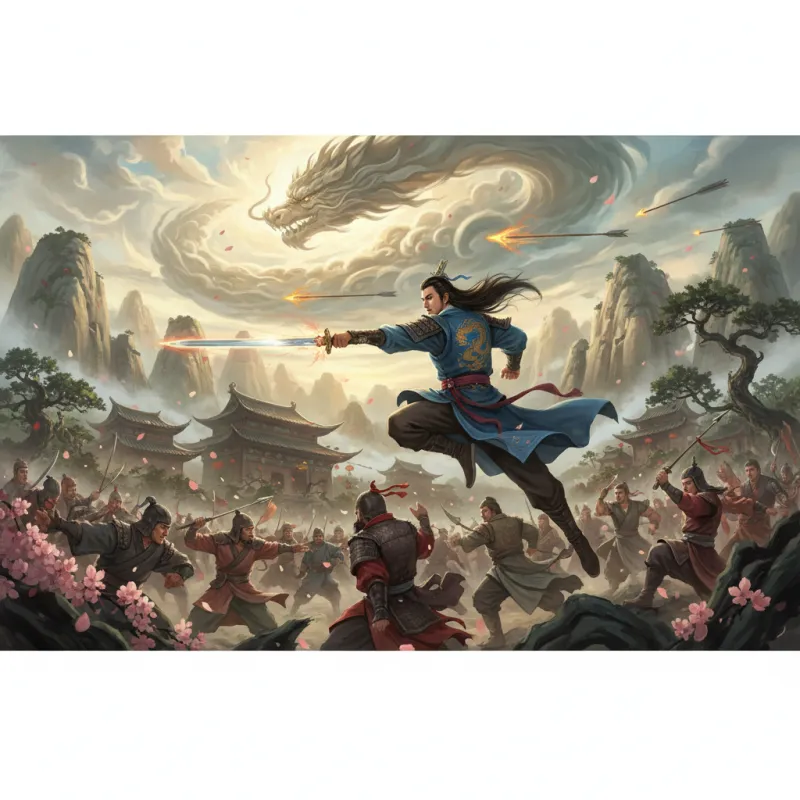
When Guo Jing stood atop the walls of Xiangyang, watching the Mongol hordes mass on the horizon, he embodied a paradox that would define Jin Yong's entire literary universe: a simple-minded hero whose moral clarity outshone the cunning of a thousand strategists. This scene from The Legend of the Condor Heroes (射雕英雄传, Shèdiāo Yīngxióng Zhuàn) captures what makes Jin Yong's wuxia novels so enduring—they're not really about martial arts at all. They're about what happens when ordinary people are thrust into extraordinary circumstances and forced to choose between competing loyalties, loves, and versions of righteousness.
The Man Who Reinvented Chinese Heroism
Louis Cha (查良镛, Chá Liángyōng), writing under the pen name Jin Yong (金庸, Jīn Yōng), didn't just write martial arts novels—he created a parallel universe where Chinese history and mythology collided with philosophical depth that would make Confucius nod approvingly. Between 1955 and 1972, he published fifteen novels that sold over 300 million copies worldwide, a feat that places him alongside literary giants like Tolkien in terms of cultural impact. But unlike Western fantasy, Jin Yong's works are deeply rooted in actual Chinese history, weaving fictional heroes into real events like the Song-Jin wars, the Mongol invasion, and the Ming-Qing transition.
What set Jin Yong apart from earlier wuxia writers like Huanzhulouzhu or his contemporary Gu Long was his ability to marry popular entertainment with literary sophistication. His characters weren't cardboard cutouts performing impossible feats—they were psychologically complex individuals whose martial arts abilities reflected their inner development. The martial arts systems in his novels function as extended metaphors for different philosophical approaches to life.
Characters Who Refuse to Be Heroes
Jin Yong's genius lies in his subversion of the traditional hero archetype. Take Wei Xiaobao from The Deer and the Cauldron (鹿鼎记, Lùdǐng Jì)—a lying, gambling, womanizing scoundrel with zero martial arts ability who somehow becomes the most successful character in Jin Yong's entire corpus. Wei Xiaobao succeeds precisely because he lacks the rigid moral code that dooms more "heroic" characters. He's a trickster figure who exposes the absurdity of both the Qing court and the anti-Qing resistance, suggesting that perhaps the real wisdom lies in refusing to take any ideology too seriously.
Then there's Yang Guo from The Return of the Condor Heroes (神雕侠侣, Shéndiāo Xiálǚ), who falls in love with his teacher Xiaolongnü in what should be a scandalous relationship but instead becomes one of literature's most moving romances. Yang Guo spends sixteen years waiting for his beloved, transforming from an angry, resentful youth into a mature hero—but one who remains fundamentally an outsider, never quite fitting into orthodox society. His signature martial art, the Dismal Ecstasy Palm (黯然销魂掌, Ànrán Xiāohún Zhǎng), literally draws power from heartbreak, turning emotional vulnerability into strength.
Even Guo Jing, who seems like a straightforward righteous hero, reveals complexity upon closer reading. His famous declaration that "a great hero serves the country and the people" (侠之大者,为国为民, xiá zhī dà zhě, wèi guó wèi mín) sounds noble, but the novel shows how this principle leads him to sacrifice his own happiness and eventually his life. Jin Yong asks: is this heroism or tragedy? The answer, characteristically, is both.
The Jianghu as Moral Laboratory
The jianghu (江湖, jiānghú)—literally "rivers and lakes," but meaning the martial arts underworld—functions in Jin Yong's novels as a space where normal social rules are suspended and characters must navigate by their own moral compass. It's a libertarian fantasy in some ways, where individual skill and virtue matter more than birth or official position. Yet Jin Yong never lets his readers forget that the jianghu is also a place of violence, betrayal, and moral ambiguity.
The martial arts sects in his novels mirror Chinese society's complex web of obligations and hierarchies. The Beggar Clan (丐帮, Gàibāng) operates as a kind of alternative government for the dispossessed. The Shaolin Temple represents Buddhist orthodoxy but also political power. The various sword sects of The Smiling, Proud Wanderer (笑傲江湖, Xiào'ào Jiānghú) become stand-ins for political factions, their disputes over martial arts orthodoxy clearly paralleling ideological purges in Chinese history.
What makes Jin Yong's jianghu so compelling is that he refuses to romanticize it. Yes, there's freedom from conventional society, but there's also endless feuding, revenge cycles that span generations, and the constant threat of violence. The philosophy of martial arts in his works suggests that true mastery requires transcending the jianghu itself—the highest level martial artists like Dugu Qiubai or Sweeping Monk have moved beyond the need to prove themselves.
Women Who Refuse to Be Rescued
Jin Yong's female characters deserve special attention because they systematically demolish the damsel-in-distress trope. Huang Rong from The Legend of the Condor Heroes is smarter than every man around her, using her intelligence to solve problems that brute force cannot. Zhao Min from The Heaven Sword and Dragon Saber (倚天屠龙记, Yǐtiān Túlóng Jì) is a Mongol princess who pursues the man she loves with a directness that would scandalize traditional Chinese society—and she gets him, despite competing against the ethereal Zhou Zhiruo.
Xiaolongnü lives alone in an ancient tomb, practices martial arts that require emotional detachment, and initially has no interest in romance whatsoever. When she does fall in love, she pursues it on her own terms, unconcerned with social judgment. Ren Yingying from The Smiling, Proud Wanderer runs an intelligence network and repeatedly saves the male protagonist, inverting the expected gender dynamics.
These women aren't just "strong female characters" in the superficial sense—they're fully realized individuals with their own desires, flaws, and character arcs. Jin Yong wrote them in the 1950s-70s, decades before Western popular fiction caught up to this level of female characterization in genre fiction.
History as Living Memory
Jin Yong's decision to set his novels during specific historical periods wasn't just window dressing—it was central to his artistic vision. The Legend of the Condor Heroes trilogy takes place during the Southern Song Dynasty's struggle against the Jin Dynasty and later the Mongol invasion. The historical Yue Fei, the patriotic general who was betrayed and executed, haunts the narrative as a symbol of loyalty and tragedy. Guo Jing's ultimate fate—dying in the defense of Xiangyang when it finally falls to the Mongols in 1273—connects the fictional hero to actual historical events.
Demi-Gods and Semi-Devils (天龙八部, Tiānlóng Bābù) is set during the Song-Liao-Dali period of the 11th century, exploring the ethnic tensions between Han Chinese, Khitan, and other groups. The novel's three protagonists each represent different ethnic backgrounds, and their intertwined fates suggest that ethnic identity is less important than individual character—a bold statement in any era.
The Deer and the Cauldron, set during the early Qing Dynasty, directly engages with the question of Han Chinese identity under Manchu rule. Wei Xiaobao serves both the Qing Emperor Kangxi and the anti-Qing resistance, ultimately loyal to neither ideology but to his personal relationships. The novel suggests that the grand narratives of history—resistance, loyalty, ethnic purity—matter less than individual human connections.
The Martial Arts as Metaphor
Jin Yong's martial arts systems are elaborate metaphors for different approaches to life and philosophy. The Nine Yang Divine Skill (九阳神功, Jiǔyáng Shéngōng) represents pure, yang energy—straightforward, powerful, but potentially rigid. The Nine Yin Manual (九阴真经, Jiǔyīn Zhēnjīng) contains both orthodox and unorthodox techniques, suggesting that knowledge itself is neutral—it's the practitioner's intent that matters.
The Dugu Nine Swords (独孤九剑, Dúgū Jiǔjiàn) taught by Feng Qingyang has no fixed forms—it's entirely reactive, based on exploiting the opponent's weaknesses. This reflects Daoist philosophy about flowing with circumstances rather than imposing rigid patterns. Meanwhile, the Eighteen Dragon-Subduing Palms (降龙十八掌, Xiánglóng Shíbā Zhǎng) represents Confucian righteousness—powerful, direct, and unyielding.
The most profound martial arts in Jin Yong's universe often require personal sacrifice or transformation. The Sunflower Manual (葵花宝典, Kuíhuā Bǎodiǎn) grants incredible power but requires self-castration, becoming a metaphor for the price of obsession. The Beiming Divine Skill (北冥神功, Běimíng Shéngōng) absorbs others' internal energy, raising questions about whether power gained by taking from others can ever be righteous.
Legacy Beyond Literature
Jin Yong's influence extends far beyond the page. His novels have been adapted into countless films, television series, comics, and video games. Actors like Tony Leung, Andy Lau, and Brigitte Lin built their careers on Jin Yong adaptations. The 1983 TVB adaptation of The Legend of the Condor Heroes starring Felix Wong and Barbara Yung became a cultural phenomenon that defined a generation's image of these characters.
But more importantly, Jin Yong's works have shaped how Chinese people think about their own history and values. His novels are quoted in everyday conversation, his characters referenced in political discourse, his moral dilemmas debated in philosophy classes. When Hong Kong was returned to China in 1997, Jin Yong's vision of Chinese identity—complex, inclusive, skeptical of rigid orthodoxy—offered a framework for understanding what it meant to be Chinese in a modern context.
The cultural impact of Jin Yong's works continues to resonate because he understood something fundamental: the best popular fiction doesn't just entertain—it helps readers make sense of their own lives and times. His heroes struggle with the same questions we all face: How do we balance personal desires against social obligations? When do we compromise our principles, and when do we stand firm? How do we love in a world that often punishes vulnerability?
Reading Jin Yong Today
For contemporary readers, especially those outside the Chinese cultural sphere, Jin Yong's novels offer a gateway into Chinese philosophy, history, and values that's far more engaging than any textbook. Yes, the novels are long—Demi-Gods and Semi-Devils runs to over a million characters in Chinese—and yes, they require some cultural context to fully appreciate. But they reward the effort with stories that are simultaneously thrilling adventures and profound meditations on the human condition.
The best entry point is probably The Legend of the Condor Heroes, which establishes the foundational world and introduces readers to Jin Yong's style. From there, The Return of the Condor Heroes deepens the emotional complexity, while The Heaven Sword and Dragon Saber completes the trilogy with a more ambiguous, morally complex narrative. For readers who want something different, The Smiling, Proud Wanderer offers political allegory, while The Deer and the Cauldron provides satirical comedy.
What makes Jin Yong's novels endure isn't just the exciting fight scenes or the intricate plots—it's the way he uses the wuxia genre to explore timeless questions about loyalty, love, justice, and identity. His heroes aren't perfect, his villains aren't entirely evil, and his endings rarely provide simple closure. Like life itself, Jin Yong's jianghu is messy, contradictory, and utterly compelling. Seventy years after he began writing, his novels remain as relevant as ever, reminding us that the greatest adventures happen not in the external world of martial arts and heroic deeds, but in the internal landscape of moral choice and human connection.
Related Reading
- The Enduring Legacy of Jin Yong’s Wuxia Novels: Characters, Martial Arts, and Cultural Influence
- How Jin Yong Changed Chinese Pop Culture Forever
- Exploring the Enigmatic Worlds of Jin Yong's Wuxia Novels