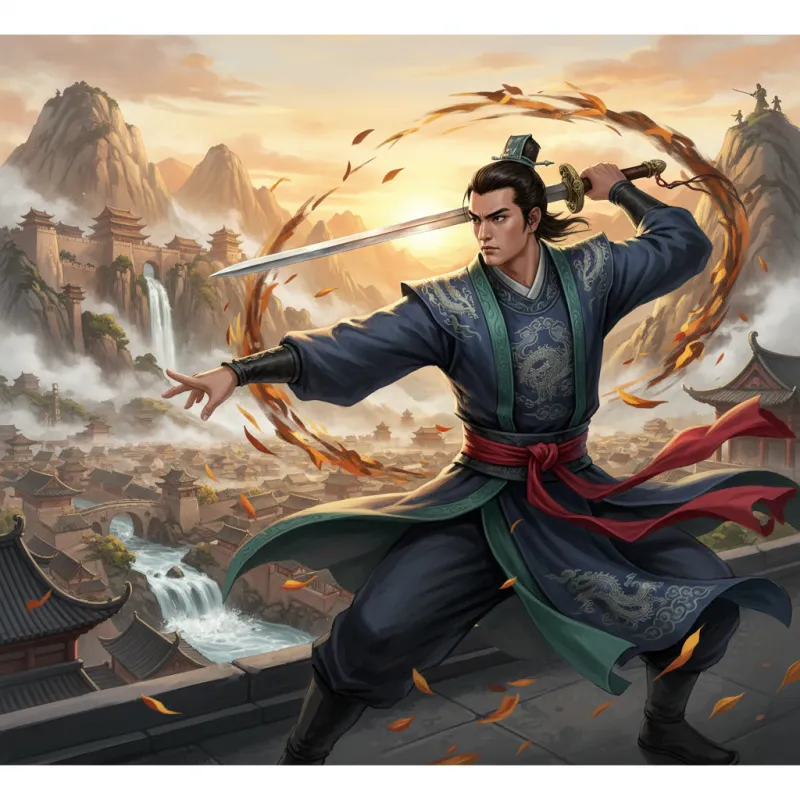
Picture this: A young beggar with a photographic memory stumbles upon the world's most powerful martial arts manual hidden inside a corpse. Across the empire, a blind swordsman perfects techniques that make him unbeatable despite his disability. Meanwhile, a lovesick hero spends decades frozen in ice, only to wake up and discover his beloved has aged while he remains young. This isn't fantasy for fantasy's sake—this is Jin Yong's wuxia universe, where every impossible scenario carries weight, consequence, and a mirror to human nature that cuts deeper than any sword technique.
Louis Cha Leung-yung (查良鏞, Chá Liángyōng), writing under the pen name Jin Yong (金庸, Jīn Yōng), didn't just write martial arts novels between 1955 and 1972—he created an entire mythology that rivals anything Tolkien accomplished for Western fantasy. His fifteen novels have sold over 300 million copies worldwide, spawned countless film and television adaptations, and fundamentally shaped how Chinese-speaking audiences understand heroism, morality, and their own cultural identity. Yet what makes his work endure isn't the spectacular fight choreography or the exotic setting. It's that Jin Yong understood something essential: the best adventure stories are really about who we are when everything we believe gets tested.
The Jianghu: More Than Just a Setting
The jianghu (江湖, jiānghú)—literally "rivers and lakes"—functions as Jin Yong's primary stage, but calling it merely a setting misses the point entirely. The jianghu represents a parallel society existing alongside imperial China, governed not by laws but by unwritten codes of honor, martial prowess, and personal reputation. It's where outcasts, rebels, monks, beggars, and aristocrats all operate under the same brutal meritocracy: your kung fu determines your status, and your word determines your worth.
What Jin Yong does brilliantly is populate this world with competing martial sects that feel like fully realized institutions. The Shaolin Temple represents Buddhist orthodoxy and disciplined technique. The Wudang Sect embodies Taoist philosophy and internal cultivation. The Beggars' Sect—despite its name—operates as one of the most powerful organizations in the jianghu, with intelligence networks that would make modern spy agencies jealous. Each sect has its signature martial arts, its political allegiances, and its own interpretation of what righteousness (義, yì) actually means.
The genius lies in how Jin Yong uses these factions to explore moral complexity. In "The Heaven Sword and Dragon Saber" (倚天屠龍記, Yǐtiān Túlóng Jì), the so-called "orthodox" sects unite to destroy the Ming Cult, which they label as evil. Yet as the story unfolds, we discover the Ming Cult fights against Mongol oppression while the orthodox sects collaborate with foreign invaders to maintain their power. Suddenly, the lines between hero and villain blur in ways that feel uncomfortably relevant to any era's political landscape.
Characters Who Refuse to Be Heroes
Jin Yong's protagonists consistently subvert the traditional hero archetype, and that's precisely why they resonate. Take Guo Jing (郭靖, Guō Jìng) from "The Legend of the Condor Heroes" (射鵰英雄傳, Shèdiāo Yīngxióng Zhuàn)—he's honest, loyal, and brave, but also slow-witted and naive. His martial arts mastery comes not from natural talent but from stubborn persistence and excellent teachers. He succeeds because he embodies simple virtues in a complicated world, not because he's the smartest person in the room.
Contrast that with Yang Guo (楊過, Yáng Guò) from "The Return of the Condor Heroes" (神鵰俠侶, Shéndiāo Xiálǚ), who's clever, rebellious, and emotionally volatile. He falls in love with his teacher, violating one of society's deepest taboos, and spends the entire novel fighting against everyone's expectations of how a hero should behave. His journey isn't about conforming to righteousness—it's about defining righteousness on his own terms, even when that means standing alone against the entire martial world.
Then there's Wei Xiaobao (韋小寶, Wéi Xiǎobǎo) from "The Deer and the Cauldron" (鹿鼎記, Lùdǐng Jì), Jin Yong's final and most subversive protagonist. Wei doesn't know any martial arts. He's a liar, a con artist, and an opportunist who succeeds through luck, charm, and shameless manipulation. Yet he's also fiercely loyal to his friends, genuinely kind to those weaker than himself, and ultimately more honest about his flaws than the hypocritical "heroes" around him. Jin Yong wrote this character as a deliberate deconstruction of everything wuxia traditionally celebrates—and somehow made him the most beloved protagonist in his entire catalog.
Martial Arts as Philosophy Made Physical
The kung fu in Jin Yong's novels operates on a level that transcends mere fight choreography. Each martial art system embodies a philosophical worldview, and mastering it requires understanding that philosophy, not just memorizing moves. The Eighteen Dragon-Subduing Palms (降龍十八掌, Jiàng Lóng Shíbā Zhǎng) channels overwhelming yang energy and requires a straightforward, righteous heart to execute properly—which is why the honest Guo Jing masters it while more cunning characters struggle.
Meanwhile, the Nine Yin Manual (九陰真經, Jiǔ Yīn Zhēnjīng) contains techniques so powerful they can corrupt practitioners who lack proper moral foundation. The manual itself becomes a recurring MacGuffin across multiple novels, representing the dangerous allure of power without wisdom. Characters who pursue it for selfish reasons inevitably suffer—not because of some cosmic justice, but because the techniques themselves require mental discipline and selflessness that selfish people simply don't possess.
Jin Yong's most sophisticated martial arts philosophy appears in "The Smiling, Proud Wanderer" (笑傲江湖, Xiào'ào Jiānghú), where the protagonist Linghu Chong (令狐沖, Línghú Chōng) learns the Dugu Nine Swords (獨孤九劍, Dúgū Jiǔ Jiàn). This technique has no fixed forms—it's entirely about perceiving and exploiting weaknesses in your opponent's style. The philosophy is pure Daoist spontaneity: the more you try to control the fight, the more rigid and vulnerable you become. True mastery means responding naturally to whatever arises, without preconception or attachment to specific outcomes. It's Bruce Lee's "be like water" concept, written decades earlier and embedded in a narrative context that makes the philosophy feel earned rather than preached.
Romance That Actually Hurts
Jin Yong writes love stories that refuse to follow romance novel conventions, and the results are often devastating. The central relationship in "The Return of the Condor Heroes" between Yang Guo and Xiaolongnü (小龍女, Xiǎolóngnǚ) violates the teacher-student taboo so thoroughly that the entire martial world condemns them. They spend sixteen years separated, with Yang Guo waiting at the bottom of a valley for Xiaolongnü to return, not knowing if she's even alive. When they finally reunite, Jin Yong doesn't give us a triumphant happy ending—he gives us two people who've been so damaged by their separation that their love has transformed into something more complex than simple happiness.
The love triangle in "Demi-Gods and Semi-Devils" (天龍八部, Tiānlóng Bābù) between Duan Yu (段譽, Duàn Yù), Wang Yuyan (王語嫣, Wáng Yǔyān), and Murong Fu (慕容復, Mùróng Fù) operates as a meditation on unrequited love and the difference between loving someone and loving your idea of them. Duan Yu pursues Wang Yuyan with single-minded devotion, but she only has eyes for her cousin Murong Fu, who's too obsessed with restoring his family's lost kingdom to notice her. By the novel's end, Duan Yu gets the girl—but only after she's been so thoroughly broken by Murong Fu's betrayal that their relationship feels more like mutual consolation than romantic triumph.
Perhaps most brutally, "The Book and the Sword" (書劍恩仇錄, Shūjiàn Ēnchóu Lù) ends with the protagonist Chen Jialuo (陳家洛, Chén Jiāluò) losing everything—his political cause fails, his brotherhood fractures, and the woman he loves chooses to stay with the Qing Emperor rather than flee with him. Jin Yong offers no consolation, no silver lining. Sometimes love isn't enough, and sometimes heroes fail. That willingness to deny readers the comfort of conventional happy endings makes the genuine moments of joy in his other novels feel earned and precious.
Historical Fiction That Rewrites History
Jin Yong sets his novels across different Chinese dynasties—Song, Yuan, Ming, and Qing—and weaves fictional characters into real historical events with such skill that many readers genuinely believe some of his characters existed. The Mongol invasion in "The Legend of the Condor Heroes" provides the backdrop for Guo Jing's transformation from naive youth to defender of Xiangyang, a real city that historically held out against Mongol forces for decades. Jin Yong's fictional account of why Xiangyang resisted so long—because a martial arts master organized its defense—feels more emotionally true than the actual historical record.
"The Deer and the Cauldron" takes this approach even further, inserting the fictional Wei Xiaobao into the court of the Kangxi Emperor and making him instrumental in suppressing the Revolt of the Three Feudatories, capturing Taiwan from Zheng Keshuang, and negotiating the Treaty of Nerchinsk with Russia—all real historical events. The audacity of making a illiterate con artist the secret architect of early Qing dynasty successes operates as Jin Yong's commentary on how history actually works: not through the grand designs of brilliant leaders, but through accident, personality, and dumb luck dressed up as strategy after the fact.
What makes this historical revisionism work is Jin Yong's deep knowledge of actual Chinese history. He doesn't just drop characters into historical settings—he understands the political tensions, cultural attitudes, and material conditions of each era. When characters in "Demi-Gods and Semi-Devils" discuss the relationship between the Song Dynasty and the Liao Dynasty, they're engaging with real geopolitical complexities that shaped 11th-century China. The martial arts fantasy elements never feel like they're violating the historical reality; instead, they operate in the gaps where historical records fall silent, offering emotionally resonant explanations for why events unfolded as they did.
Why Jin Yong Still Matters
Jin Yong passed away in 2018, but his influence on Chinese popular culture remains inescapable. His novels continue to be adapted into new films, television series, video games, and even theme park attractions. Phrases from his books have entered everyday Chinese language. His characters serve as cultural touchstones—everyone knows what you mean when you compare someone to Guo Jing's honest simplicity or Yang Guo's rebellious passion.
But the deeper reason Jin Yong endures is that he wrote about timeless human struggles disguised as martial arts adventures. His novels ask: What do you do when your loyalty to friends conflicts with your duty to society? How do you maintain your principles in a corrupt world without becoming either a martyr or a hypocrite? Can love survive when the entire world opposes it? Is revenge ever justified, and if you achieve it, will it actually satisfy you? These questions don't have easy answers, and Jin Yong respects his readers enough not to pretend they do.
The jianghu he created offers something increasingly rare in modern entertainment: a fully realized alternate world with its own logic, history, and moral complexity. It's a place where actions have consequences, where power comes with responsibility, and where being a hero means making impossible choices with no guarantee of success. In an era of superhero movies where good guys always win and moral dilemmas get resolved in two hours, Jin Yong's willingness to let his heroes fail, suffer, and sometimes die for nothing feels almost radical.
For readers willing to dive into these sprawling narratives—and they are sprawling, with some novels running over a million Chinese characters—the reward is an experience that few other authors can match. You're not just reading adventure stories. You're entering a world that feels as rich and complex as our own, populated by characters who'll stay with you long after you've finished the final page. That's the real martial arts mastery Jin Yong achieved: not the ability to write spectacular fight scenes, but the skill to make readers care deeply about who wins, who loses, and what it all means.
Related Reading
- Eighteen Dragon-Subduing Palms: The Ultimate Technique
- Unveiling the Wisdom and Philosophy in Jin Yong's Wuxia Novels
- The Biggest Unsolved Mysteries in Jin Yong Novels