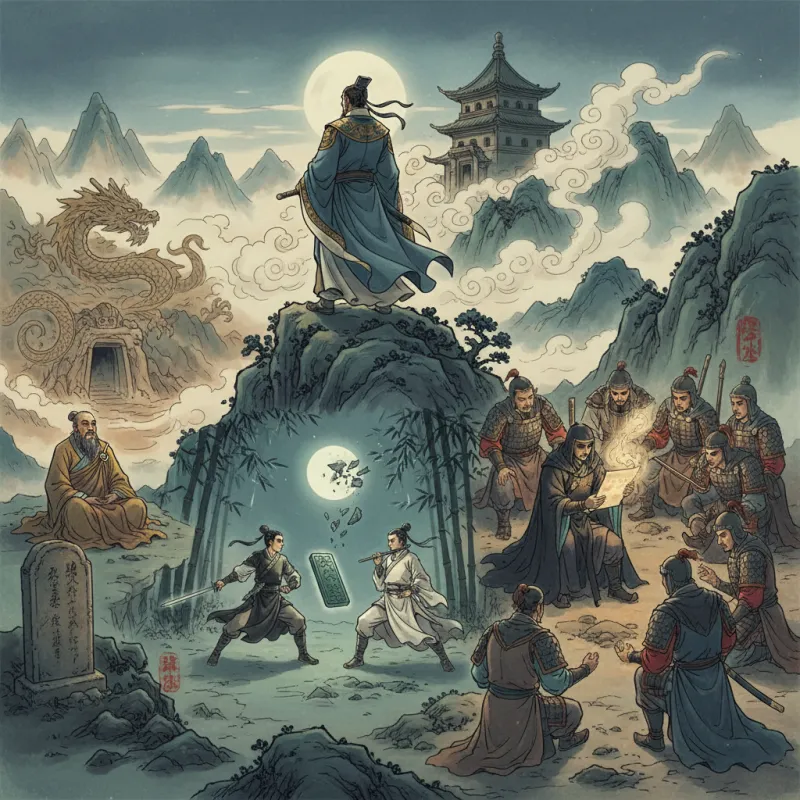
What if the most famous martial arts manual in wuxia literature was written by someone who never existed? Or what if the greatest swordsman in Jin Yong's universe died not from battle, but from a plot inconsistency? Jin Yong (金庸, Jīn Yōng) crafted fifteen novels over four decades, revising them obsessively, yet he left behind mysteries that have spawned countless forum debates, academic papers, and late-night arguments among fans. Some are deliberate ambiguities that enrich the narrative. Others are genuine contradictions that emerged from the pressures of newspaper serialization. And a few are questions so fundamental that they shake the foundations of entire novels.
The Nine Yin Manual's Impossible Origins
The Nine Yin Manual (九阴真经, Jiǔ Yīn Zhēnjīng) appears in multiple novels as the ultimate martial arts text, yet its origin story collapses under scrutiny. In The Legend of the Condor Heroes (射雕英雄传, Shèdiāo Yīngxióng Zhuàn), we learn that Huang Shang (黄裳, Huáng Shang), a Song dynasty scholar, wrote it after being tasked with compiling the Daoist canon. When Daoist and Buddhist masters attacked him for his work, he spent decades in hiding, eventually creating the manual from his understanding of their techniques.
But here's the problem: the manual contains martial arts from schools that shouldn't have existed yet. It references techniques that appear in later novels set centuries after Huang Shang's time. The internal energy cultivation methods described in the manual are more sophisticated than anything practiced during the Song dynasty according to Jin Yong's own timeline. Some fans argue that Huang Shang was simply a genius who invented techniques that others would later "discover" independently. Others suggest Jin Yong retrofitted the manual's importance as his universe expanded, creating contradictions he never fully resolved.
The deeper mystery is why Zhou Botong (周伯通, Zhōu Bótōng) could memorize the entire manual after reading it once, yet Wang Chongyang (王重阳, Wáng Chóngyáng), supposedly the greatest martial artist of his generation, never mastered it completely. Did Wang Chongyang deliberately avoid certain sections? Was there a version of the manual that contained dangerous techniques he feared? Jin Yong never clarified, leaving readers to wonder whether this was intentional characterization or an oversight born from serialization pressures.
Duan Yu's Impossible Martial Arts Journey
Duan Yu (段誉, Duàn Yù) from Demi-Gods and Semi-Devils (天龙八部, Tiānlóng Bābù) presents one of the most glaring power-scaling problems in Jin Yong's work. He begins the novel as a complete martial arts novice who refuses to learn fighting techniques due to his Buddhist beliefs. Through a series of accidents, he absorbs decades worth of internal energy from the Beiming Divine Art (北冥神功, Běimíng Shéngōng) and learns the Lingbo Microstep (凌波微步, Língbō Wēibù) footwork technique.
By the novel's end, Duan Yu can hold his own against some of the most fearsome martial artists in the jianghu (江湖, jiānghú) despite never training in combat applications. He defeats opponents through pure internal energy and evasion, never throwing a proper punch. This raises an uncomfortable question: if internal energy alone can make someone this powerful, why do other characters spend decades mastering specific techniques? The role of internal energy versus technique becomes a philosophical problem that Jin Yong never fully addressed.
The real mystery deepens when you compare Duan Yu to Xu Zhu (虚竹, Xū Zhú), who also receives massive internal energy transfers but remains relatively weak in combat. Both characters gain power through absorption rather than cultivation, yet their outcomes differ dramatically. Some readers argue this reflects their different temperaments and natural talents. Others see it as evidence that Jin Yong was making up power levels as he went, constrained by the weekly serialization format that didn't allow for careful long-term planning.
The Vanishing Sword Techniques of Dugu Qiubai
Dugu Qiubai (独孤求败, Dúgū Qiúbài), the legendary swordsman who never appears directly in any novel, casts a shadow across Jin Yong's entire universe. We know he left behind four swords representing different stages of martial arts mastery, from the sharp sword of youth to the wooden sword of middle age to the final stage where no sword is needed. Yang Guo (杨过, Yáng Guò) in The Return of the Condor Heroes (神雕侠侣, Shéndiāo Xiálǚ) finds these swords and learns from them, eventually creating his own Dismal Ecstasy Palm (黯然销魂掌, Ànrán Xiāohún Zhǎng).
But here's what doesn't make sense: if Dugu Qiubai was truly undefeated and his techniques were so profound, why don't they dominate the martial arts world? Yang Guo learns from his legacy and becomes formidable, yet the specific sword techniques Dugu Qiubai used are never described in detail. We know the philosophy—that true mastery transcends weapons—but not the actual moves. When Linghu Chong (令狐冲, Línghú Chōng) in The Smiling, Proud Wanderer (笑傲江湖, Xiàoào Jiānghú) learns the Nine Swords of Dugu (独孤九剑, Dúgū Jiǔjiàn), are these actually Dugu Qiubai's techniques, or did Feng Qingyang (风清扬, Fēng Qīngyáng) create them based on Dugu's philosophy?
The timeline makes this even murkier. Dugu Qiubai supposedly lived during the late Song or early Yuan dynasty, yet his influence appears in novels set during the Ming and Qing dynasties. How did his techniques survive? Who preserved them? Jin Yong hints that Dugu Qiubai's pet condor passed on some knowledge, but a bird cannot teach sword techniques. This mystery touches on the transmission of martial arts knowledge across generations, a recurring theme that Jin Yong explored but never fully explained.
Zhang Wuji's Forgotten Revenge
The Heaven Sword and Dragon Saber (倚天屠龙记, Yǐtiān Túlóng Jì) begins with Zhang Wuji (张无忌, Zhāng Wújì) witnessing his parents' deaths and swearing revenge against the six major sects responsible. His father Zhang Cuishan (张翠山, Zhāng Cuìshān) and mother Yin Susu (殷素素, Yīn Sùsù) commit suicide due to pressure from these sects, who want to know the location of the Dragon Saber. Young Zhang Wuji is poisoned, humiliated, and left for dead.
Then Jin Yong seems to forget about this revenge plot entirely. Zhang Wuji spends the rest of the novel becoming the leader of the Ming Cult (明教, Míngjiào), falling in love with multiple women, and fighting the Mongol Yuan dynasty. He occasionally encounters members of the six sects, but there's no systematic revenge, no confrontation where he makes them answer for his parents' deaths. By the novel's end, he's friendly with several people from these sects, and the revenge plot has evaporated like morning mist.
Some defenders argue this represents Zhang Wuji's Buddhist compassion and his growth beyond vengeance. Others point out that Jin Yong was juggling too many plot threads—the Ming Cult politics, the love quadrangle, the anti-Mongol resistance—and simply ran out of space for the revenge arc. The most cynical interpretation is that Jin Yong realized a revenge plot would make Zhang Wuji less sympathetic and quietly dropped it, hoping readers wouldn't notice. We noticed.
The Contradictory Ages of the Condor Trilogy Characters
Jin Yong's Condor Trilogy spans three novels and roughly a century of fictional time, but the character ages don't add up. Guo Jing (郭靖, Guō Jìng) and Huang Rong (黄蓉, Huáng Róng) appear as teenagers in The Legend of the Condor Heroes, set around 1200-1227 CE. They reappear in The Return of the Condor Heroes as middle-aged parents, set around 1239-1260 CE. So far, so good.
But then we get to the end of The Return of the Condor Heroes, where Guo Jing and Huang Rong die defending Xiangyang (襄阳, Xiāngyáng) against the Mongols in 1273 CE. If Guo Jing was born around 1200, he would be 73 years old at death—possible, but he's described as still being in his prime, personally fighting on the walls. Huang Rong would be around 70, yet she's portrayed as an active military strategist without any mention of advanced age.
The real problem emerges when you track their daughter Guo Xiang (郭襄, Guō Xiāng). She's born during The Return of the Condor Heroes and appears as a teenager at the end of that novel. Then she shows up in The Heaven Sword and Dragon Saber as an old woman who founded the Emei Sect (峨嵋派, Éméi Pài). The timeline suggests she lived well into her 90s, which is plausible, but Jin Yong never addresses how she survived the fall of Xiangyang or what happened to her during the intervening decades. It's as if he needed her to connect the trilogies but didn't want to write the actual connecting story.
Wei Xiaobao's Impossible Luck
The Deer and the Cauldron (鹿鼎记, Lùdǐng Jì) is Jin Yong's final and most unusual novel, featuring Wei Xiaobao (韦小宝, Wéi Xiǎobǎo), a protagonist with no martial arts skills who succeeds through cunning, luck, and shamelessness. The mystery isn't about plot holes—it's about whether Wei Xiaobao's success is even remotely plausible within the novel's own logic.
Wei Xiaobao, an illiterate brothel worker's son, becomes a trusted confidant of the Kangxi Emperor (康熙, Kāngxī), infiltrates the Heaven and Earth Society (天地会, Tiāndì Huì), marries seven wives, and accumulates vast wealth. He survives dozens of situations that should have killed him, often through coincidences so outrageous they strain credibility. When he's about to be exposed as a spy, someone conveniently dies or a distraction occurs. When he's cornered by martial arts masters, someone always arrives to save him.
Jin Yong was clearly writing satire, mocking the conventions of wuxia fiction and perhaps commenting on how real history is shaped by opportunists rather than heroes. But even satire needs internal consistency. At what point does Wei Xiaobao's luck become a supernatural force rather than mere fortune? Is Jin Yong suggesting that history itself is absurd, or did he simply enjoy writing a character who could escape any situation through authorial fiat? The novel works as comedy and social commentary, but as a coherent narrative, it's held together by luck so extreme it becomes its own mystery.
The Unexplained Power of the Sunflower Manual
The Sunflower Manual (葵花宝典, Kuíhuā Bǎodiǎn) from The Smiling, Proud Wanderer grants incredible martial arts power to those willing to castrate themselves first. The novel's antagonist, Dongfang Bubai (东方不败, Dōngfāng Bùbài), practices this manual and becomes nearly invincible, moving so fast that opponents can barely see him.
But why does castration lead to martial arts supremacy? Jin Yong offers vague explanations about redirecting sexual energy into martial cultivation, but this raises more questions than it answers. If sexual energy is so powerful, why don't other martial arts systems harness it without requiring castration? Why does the manual specifically require this sacrifice rather than celibacy or other forms of energy conservation?
The deeper mystery is whether the castration requirement is actually necessary or if it's a cruel joke by the manual's creator. Some characters in the novel practice incomplete versions of the manual without castrating themselves and still gain significant power, suggesting the requirement might be psychological rather than physiological. Did the original author of the Sunflower Manual include this requirement to limit the number of practitioners, or was Jin Yong using body horror to explore themes of ambition and sacrifice? He never clarified, leaving readers to debate whether this is profound commentary on the cost of power or simply a shocking plot device that he didn't think through completely.
Why These Mysteries Matter
Jin Yong revised his novels multiple times over decades, yet he left these mysteries intact. Some fans argue this was deliberate—that ambiguity enriches the stories and allows readers to engage more deeply with the text. Others believe these are genuine flaws that emerged from the constraints of newspaper serialization, where Jin Yong had to produce thousands of characters per week without the luxury of extensive planning.
The truth is probably both. Jin Yong was a masterful storyteller who understood that not every question needs an answer, but he was also a working writer who sometimes painted himself into corners. These mysteries don't diminish his achievement; they humanize it. They remind us that even the greatest works of popular fiction are created under pressure, with deadlines and commercial considerations that don't always allow for perfect consistency.
What makes Jin Yong's mysteries enduring is that they're embedded in stories people care about deeply. We argue about Duan Yu's power levels and Zhang Wuji's forgotten revenge because we're invested in these characters and their worlds. The mysteries frustrate us precisely because the novels are good enough to make us notice the inconsistencies. A lesser writer's plot holes would simply be ignored. Jin Yong's mysteries become part of the conversation, debated and analyzed for decades after the original serialization ended.
Perhaps that's the final mystery: whether Jin Yong left these questions unanswered because he couldn't resolve them, or because he knew that unresolved mysteries would keep readers engaged long after the final page. Either way, we're still talking about them, still arguing, still trying to make sense of the contradictions. And maybe that's exactly what he wanted.
Related Reading
- Fan Debates That Have Lasted Decades
- Jin Yong's Fan Theories: The Debates That Never End
- Alternative Endings Fans Wish Jin Yong Had Written
- Hidden Connections Between Jin Yong Novels
- Wine Culture in Jin Yong's Wuxia World
- The Most Famous Lines in Jin Yong's Novels
- Exploring the Rich Tapestry of Jin Yong's Wuxia Novels and Their Enduring Legacy