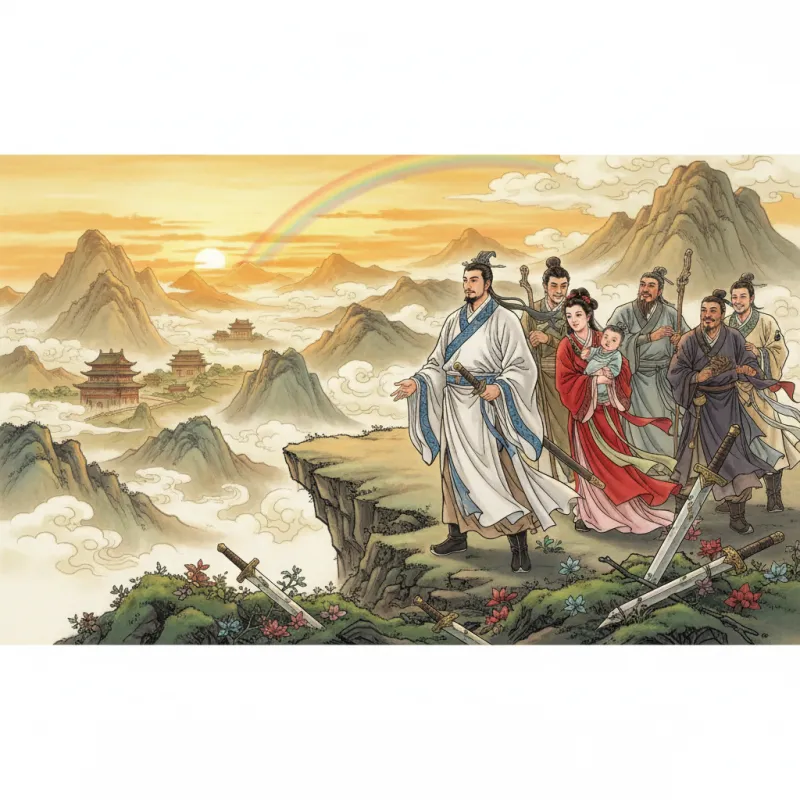
What if Xiao Feng had simply walked away from that cliff? The question has haunted Jin Yong readers since 1963, when Demi-Gods and Semi-Devils (天龍八部, Tiānlóng Bā Bù) concluded with its hero's suicide at Yanmen Pass. Xiao Feng — the Khitan warrior caught between two nations, the beggar chief who discovered his own identity was a lie — chose death as the only way to stop a war. Noble? Absolutely. Necessary? Fans have spent sixty years arguing otherwise.
Jin Yong's endings cut deep because they refuse comfort. He understood that great stories don't owe readers happiness — they owe readers truth. But truth has multiple faces, and the alternative endings that proliferate across Chinese forums aren't just wishful thinking. Some represent genuine narrative roads not taken, moments where the story's internal logic could have bent in a different direction without breaking.
Xiao Feng's Survival: The Ending That Breaks Hearts
The most debated alternative ending in Jin Yong's entire corpus centers on Xiao Feng's death at Yanmen Pass. In the original, after forcing the Liao Emperor to promise never to invade Song territory, Xiao Feng takes his own life — a Khitan who cannot raise arms against his blood people, a Song patriot who cannot betray his adopted homeland. It's devastating. It's perfect. And fans absolutely refuse to accept it.
The most popular alternative has Xiao Feng surviving and wandering into the western regions, perhaps to the lands beyond the Khitan and Song borders entirely. He could have become a legend in the grasslands, a warrior without a country who found peace in having no allegiance at all. Some fans argue this would have been more consistent with Xiao Feng's character — a man who spent the entire novel learning that ethnic identity is a construct, that brotherhood transcends bloodlines. Why should his final act reaffirm the very national boundaries he'd learned to see through?
The counterargument is equally compelling: Xiao Feng's death is the only ending that honors the novel's Buddhist themes. Demi-Gods and Semi-Devils takes its title from Buddhist cosmology, and every major character suffers from attachment — to love, to revenge, to identity itself. Xiao Feng's suicide isn't defeat; it's the ultimate release from the cycle of violence and belonging. He doesn't die for Song or Liao. He dies to transcend both.
Still, imagine the alternative: Xiao Feng in the Western Regions, perhaps encountering the descendants of characters from The Book and the Sword (書劍恩仇錄, Shūjiàn Ēnchóu Lù), living out his days teaching martial arts to nomadic tribes. It wouldn't have the same tragic grandeur, but it would have offered something Jin Yong rarely gave his heroes — a quiet happiness earned through wisdom rather than death.
Guo Jing and Huang Rong: The Siege That Didn't Have to End in Death
The Return of the Condor Heroes (神鵰俠侶, Shéndiāo Xiálǚ) ends with a flash-forward: Guo Jing and Huang Rong, the beloved protagonists of The Legend of the Condor Heroes (射鵰英雄傳, Shèdiāo Yīngxióng Zhuàn), die defending Xiangyang City against the Mongol invasion. We never see their deaths on page, but Jin Yong confirmed it in interviews. The city falls. The heroes die. History, as always in Jin Yong's work, is merciless.
Fans have proposed dozens of alternatives. The most common: Guo Jing and Huang Rong survive the siege by evacuating before the final assault, living in exile to fight another day. They could have joined the Southern Song resistance, or fled to the islands off the coast, or even — in more creative reimaginings — traveled to the West to seek allies against the Mongol expansion.
The problem with all these alternatives is that they misunderstand Guo Jing's character completely. This is a man whose defining trait is unwavering righteousness (俠義, xiáyì). He spent two entire novels learning that a hero's duty is to protect the common people, even unto death. For Guo Jing to abandon Xiangyang would be for him to abandon everything he is. It would be character assassination disguised as a happy ending.
But there's a more subtle alternative that some fans propose: what if Guo Jing and Huang Rong had successfully held Xiangyang, changing history itself? Jin Yong's novels exist in a semi-historical world where fictional martial artists brush against real events. What if the presence of these heroes had been enough to turn the tide? It's fantasy, yes, but it's fantasy that would have honored the characters' strength without betraying their principles.
The real tragedy isn't that they died. It's that Jin Yong never showed us their final stand. That absence haunts readers more than any described death could have.
Yang Guo and Xiao Longnü: Sixteen Years of Unnecessary Waiting
The sixteen-year separation in The Return of the Condor Heroes is either Jin Yong's most romantic gesture or his most sadistic narrative choice, depending on which fan forum you visit. Xiao Longnü, believing she's dying from poison, leaves Yang Guo with a promise to reunite in sixteen years at the bottom of Heartbreak Cliff. Yang Guo waits. For sixteen years, he waits.
The alternative ending fans crave is simple: what if Xiao Longnü had told Yang Guo the truth? What if they'd spent those sixteen years together, searching for a cure, living as a couple even under the shadow of death? The separation serves the plot's need for Yang Guo to mature into the Divine Eagle Knight, but it tortures readers who see it as artificial drama.
Some fans go further, arguing that Xiao Longnü should have died. Not out of cruelty, but because it would have been more consistent with the novel's themes about obsessive love and letting go. Yang Guo's character arc is about learning to exist beyond his attachment to Xiao Longnü. Having her return after sixteen years undercuts that growth, turning his wait into a reward rather than a lesson in acceptance.
The most interesting alternative comes from fans who suggest Xiao Longnü should have returned after just a few years, having found a cure quickly. This would have given Yang Guo and Xiao Longnü a chance to navigate married life, to show that their love could survive not just separation but the mundane challenges of daily existence. Jin Yong rarely showed his couples in domestic happiness — perhaps because he knew that happiness is harder to write than tragedy.
Linghu Chong and Ren Yingying: The Jianghu That Wouldn't Let Them Go
The Smiling, Proud Wanderer (笑傲江湖, Xiào'ào Jiānghú) ends with Linghu Chong and Ren Yingying retiring from the martial world, living in seclusion with the Heng Shan Sect nuns. It's a quiet ending for a novel full of political intrigue and martial arts chaos. Too quiet, some fans argue.
The alternative ending that gains the most traction: Linghu Chong becomes the leader of the Sun Moon Holy Cult (日月神教, Rìyuè Shénjiào) alongside Ren Yingying, reforming it from within. This would have been more consistent with the novel's themes about the arbitrary nature of orthodox versus unorthodox sects. Linghu Chong spent the entire novel learning that the "righteous" sects are often hypocritical and cruel, while the "demonic" cult contains honorable people. Why not have him bridge that divide as a leader rather than as a hermit?
Jin Yong's choice to have Linghu Chong retire reflects his Daoist influences — the wise person withdraws from worldly affairs. But it also feels like a cop-out to readers who wanted to see Linghu Chong actively reshape the jianghu (江湖, martial world) rather than simply escape it. The novel's title promises someone who laughs proudly at the martial world, not someone who runs away from it.
A darker alternative: Linghu Chong dies from his internal injuries, which plagued him throughout the novel. This would have been devastating but thematically appropriate. His body was destroyed by the power struggles he wanted no part of. His death would have been an indictment of the jianghu's violence, a final statement that some people are too good for the world they're born into.
Wei Xiaobao's Retirement: Too Perfect for a Trickster
The Deer and the Cauldron (鹿鼎記, Lùdǐng Jì) ends with Wei Xiaobao retiring to a life of luxury with his seven wives, having successfully navigated the treacherous politics of the early Qing dynasty. It's a happy ending for Jin Yong's most morally ambiguous protagonist — a con artist, a liar, a survivor who succeeded through cunning rather than martial prowess.
The alternative ending fans debate: Wei Xiaobao should have faced consequences. Perhaps betrayed by one of his wives, or caught in a final political trap, or simply unable to escape the web of lies he'd spent the entire novel spinning. This would have been more consistent with the novel's satirical tone, its mockery of both heroic virtue and political power.
But there's a reason Jin Yong gave Wei Xiaobao a happy ending. The Deer and the Cauldron was his final novel, published in 1972, and it reads like a farewell to the entire wuxia genre. Wei Xiaobao succeeds precisely because he's not a traditional hero. He doesn't believe in loyalty, righteousness, or any of the values that got Jin Yong's other protagonists killed. His happy ending is Jin Yong's final joke: in the real world, the tricksters win.
An alternative that some fans propose: Wei Xiaobao becomes a monk in his old age, seeking redemption for his countless lies and betrayals. This would have brought the novel full circle, connecting it to the Buddhist themes in Jin Yong's earlier works. But it would also have been deeply out of character. Wei Xiaobao is not a man who seeks redemption. He's a man who seeks comfort, and Jin Yong gave him exactly that.
The Endings Jin Yong Chose
These alternative endings reveal more about readers than about the novels themselves. We want Xiao Feng to live because we can't bear the thought of such nobility being extinguished. We want Guo Jing and Huang Rong to survive because we grew up with them, and their deaths feel like losing family. We want Yang Guo and Xiao Longnü to skip the sixteen-year separation because we're impatient for happiness.
But Jin Yong understood something crucial: the endings we want are not always the endings we need. His novels work because they refuse to comfort us, refuse to pretend that virtue is always rewarded or that love conquers all. The martial world he created is beautiful and terrible, and its greatest heroes are the ones who accept their fates without flinching.
That said, the persistence of these alternative endings proves that Jin Yong's stories are alive. Dead stories don't generate decades of debate. Dead stories don't inspire thousands of fan fiction rewrites, forum arguments, and late-night discussions about what should have happened. The fact that readers still argue about these endings sixty years later is the highest compliment a storyteller can receive.
Perhaps the real question isn't whether Jin Yong chose the right endings. It's whether any ending could have satisfied readers who loved these characters so deeply. The answer, like so much in Jin Yong's work, is probably no — and that's exactly as it should be. For more on how Jin Yong's narrative choices shaped his legacy, explore The Philosophy Behind Jin Yong's Tragic Heroes, or dive into Why Jin Yong's Villains Are More Complex Than His Heroes.
Related Reading
- Jin Yong's Fan Theories: The Debates That Never End
- Hidden Connections Between Jin Yong Novels
- The Biggest Unsolved Mysteries in Jin Yong Novels
- Fan Debates That Have Lasted Decades
- Exploring the Enigmatic Worlds of Jin Yong's Wuxia Novels
- Exploring Legendary Weapons in Jin Yong’s Wuxia Novels: Symbolism and Martial Arts Mastery
- Exploring the Love Stories in Jin Yong's Wuxia Novels: Romance Amidst Adventure