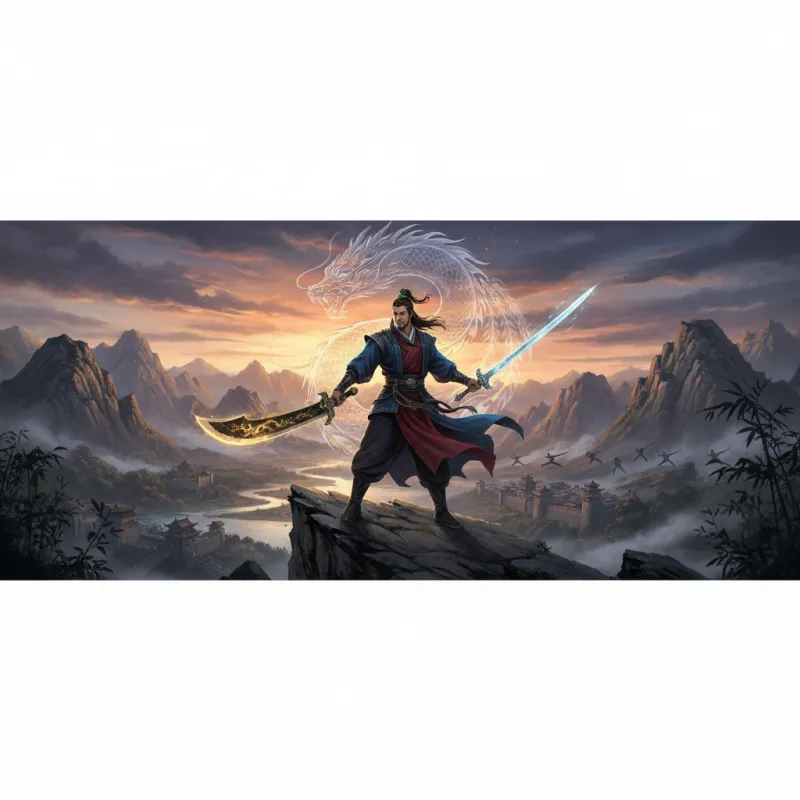
When Guo Jing first grasps the Heavy Iron Sword (玄铁重剑, xuántie zhòngjiàn) in The Return of the Condor Heroes, he's holding more than forty pounds of unadorned metal—he's inheriting a philosophy. "The heavy sword has no edge; great skill appears clumsy" (重剑无锋,大巧不工, zhòngjiàn wú fēng, dà qiǎo bù gōng), Dugu Qiubai's inscription declares. This single weapon encapsulates what makes Jin Yong's approach to legendary armaments so compelling: they're never just sharp objects. They're manifestations of martial philosophy, character development tools, and narrative devices that reveal deeper truths about power, mastery, and the human condition.
The Sword as Spiritual Journey: From Sharpness to Simplicity
Jin Yong understood something fundamental about martial arts progression that he encoded into Dugu Qiubai's five swords, discovered by Yang Guo in a cave alongside a giant eagle. The sequence isn't random—it's a complete map of martial evolution. The Sharp Sword (利剑, lìjiàn) represents youth and technical precision. The Soft Sword (紫薇软剑, zǐwēi ruǎnjiàn) embodies flexibility taken too far—Dugu abandoned it after accidentally killing an innocent, teaching us that adaptability without wisdom leads to tragedy.
Then comes the Heavy Iron Sword, which Yang Guo eventually masters. At this stage, technique gives way to internal force; the weapon's crudeness forces the wielder to develop genuine power rather than rely on clever tricks. The wooden sword (木剑, mùjiàn) stage represents further refinement—anything can be a weapon when internal energy reaches sufficient levels. Finally, the no-sword (无剑, wújiàn) stage: pure martial intent without physical form.
This progression mirrors the Daoist concept of returning to simplicity (返璞归真, fǎnpú guīzhēn). The greatest masters don't need legendary weapons because they've transcended the need for external tools. Yet Jin Yong's genius lies in recognizing that most practitioners never reach that final stage—and that's perfectly human. Yang Guo becomes formidable with the Heavy Iron Sword but never fully abandons physical weapons. Even Dugu Qiubai himself left behind swords, suggesting the journey matters more than the destination.
Paired Blades and Moral Complexity: The Heaven Reliant Sword and Dragon Slaying Saber
No weapons in Jin Yong's universe carry more narrative weight than the Heaven Reliant Sword (倚天剑, Yǐtiān jiàn) and Dragon Slaying Saber (屠龙刀, Túlóng dāo) from The Heaven Sword and Dragon Saber. Forged from Yang Guo's Heavy Iron Sword and the Gentleman Sword (君子剑, jūnzǐ jiàn), these paired weapons contain hidden martial arts manuals and the secret to military supremacy: "The supreme martial artist commands the world; none dare disobey. Relying on Heaven, who can compete?" (武林至尊,宝刀屠龙。号令天下,莫敢不从。倚天不出,谁与争锋, wǔlín zhìzūn, bǎodāo túlóng. Hàolìng tiānxià, mò gǎn bù cóng. Yǐtiān bù chū, shuí yǔ zhēng fēng).
What makes these weapons fascinating isn't their power but how they corrupt. The jianghu (江湖, jiānghú)—the martial artists' world—tears itself apart pursuing them. Families betray each other, sects wage war, and countless practitioners die for the mere possibility of possessing them. Zhang Wuji, the protagonist, eventually obtains both and discovers the irony: the weapons themselves matter far less than the knowledge hidden within them, and even that knowledge proves less valuable than wisdom and moral character.
Jin Yong uses these weapons to critique the pursuit of power for its own sake. The martial arts manuals hidden inside—the Nine Yang Manual and military strategies—represent different forms of power: personal martial supremacy and political control. Yet Zhang Wuji, who masters the Nine Yang Manual through other means, never needs to rely on the weapons' reputation. The real treasure was accessible through dedication and proper teaching all along.
The Gentleman's Weapon: Swords and Confucian Values
Jin Yong's swordsmen often embody Confucian ideals, and their weapons reflect this. The Gentleman Sword wielded by Yang Guo's father, Yang Kang, represents the weapon of the educated warrior-scholar. In The Legend of the Condor Heroes and its sequels, swords consistently appear as the weapons of choice for those who value honor, restraint, and technical excellence.
Consider the Dugu Nine Swords (独孤九剑, Dúgū jiǔ jiàn) technique taught by Feng Qingyang to Linghu Chong in The Smiling, Proud Wanderer. This isn't a physical weapon but a sword technique that emphasizes reading opponents and exploiting weaknesses—essentially, the martial equivalent of strategic thinking. Linghu Chong doesn't need a legendary blade because his technique allows him to defeat opponents regardless of their weapons. The method values intelligence over brute force, adaptability over rigid forms.
Yet Jin Yong complicates this Confucian ideal. Yue Buqun, the "Gentleman Sword" (君子剑, jūnzǐ jiàn) of the Huashan Sect, proves to be a hypocrite who castrates himself to learn the evil Sunflower Manual. The title "Gentleman Sword" becomes bitterly ironic—a reminder that carrying a sword and claiming virtue doesn't make one virtuous. The weapon doesn't determine the wielder's character; character determines how the weapon is used.
Sabers and Straightforward Power: The Weapon of Honest Warriors
While swords represent refinement and complexity, sabers (刀, dāo) in Jin Yong's novels often belong to more straightforward, emotionally direct characters. Hu Fei in Flying Fox of Snowy Mountain and The Young Flying Fox wields a saber, as does his father Hu Yidao. The Hu family's Cold Moon Saber (冷月宝刀, lěngyuè bǎodāo) technique emphasizes powerful, direct strikes—no deception, no hidden moves, just overwhelming force and commitment.
This distinction isn't accidental. Chinese martial culture traditionally associated swords with scholars and officials (文, wén) and sabers with soldiers and generals (武, wǔ). Jin Yong plays with these associations while respecting their cultural roots. Guo Jing, the straightforward hero of The Legend of the Condor Heroes, never becomes a sophisticated swordsman despite his eventual mastery of the Eighteen Dragon-Subduing Palms. His honest, direct nature suits techniques that emphasize power and determination over cunning.
The Dragon Slaying Saber embodies this principle taken to extremes. It's not elegant or refined—it's a brutal instrument of overwhelming force. When Xie Xun wields it while blind and half-mad, the saber becomes an extension of raw, uncontrolled power. Only when Zhang Wuji helps him find peace does Xie Xun stop defining himself through the weapon. The saber doesn't make the warrior; the warrior's internal state determines whether the weapon brings glory or tragedy.
Hidden Weapons and Moral Ambiguity: The Tang Sect's Arsenal
Not all legendary weapons in Jin Yong's universe are swords or sabers. The Tang Sect (唐门, Táng mén) from Sichuan specializes in hidden weapons and poisons, representing a morally ambiguous approach to martial arts. Their weapons—flying needles, sleeve arrows, and various toxins—don't allow for honorable face-to-face combat. They're tools of assassination and surprise attack.
Jin Yong uses the Tang Sect to explore uncomfortable questions about martial ethics. Is using poison inherently dishonorable, or is it simply another tool? The jianghu generally looks down on hidden weapons and poison, yet many "righteous" martial artists die to Tang Sect weapons wielded by practitioners who see themselves as defending their family and traditions. The martial arts sects in Jin Yong's novels often claim moral superiority while engaging in behavior just as questionable as those they condemn.
In Demi-Gods and Semi-Devils, the character Zhong Ling uses hidden weapons and poisons taught by her mother, yet she's portrayed sympathetically. The weapons don't determine morality—intent and context do. This nuanced approach reflects Jin Yong's broader philosophy: the jianghu's rigid categories of "righteous" (正, zhèng) and "evil" (邪, xié) often obscure more complex moral realities.
Weapons as Character Development: The Transformation Through Steel
Perhaps Jin Yong's most sophisticated use of legendary weapons comes in how they facilitate character transformation. When Yang Guo loses his arm and must relearn martial arts with the Heavy Iron Sword, the weapon forces him to abandon his previous techniques and develop something entirely new. The physical limitation combined with the weapon's unique properties creates the conditions for breakthrough.
Similarly, in The Smiling, Proud Wanderer, when Linghu Chong loses his internal energy and must rely purely on the Dugu Nine Swords technique, he becomes a different kind of martial artist—one who understands that true mastery transcends physical power. The absence of internal force, paradoxically, makes him more formidable because he must rely entirely on skill, timing, and reading opponents.
This pattern repeats throughout Jin Yong's works: legendary weapons or techniques appear at moments of crisis, forcing characters to evolve or perish. The weapons aren't shortcuts to power—they're catalysts for transformation that only work if the wielder possesses the character and determination to master them. Mediocre martial artists with legendary weapons remain mediocre; exceptional martial artists become legendary regardless of their weapons.
The Ultimate Lesson: Weapons Serve the Warrior, Not Vice Versa
Jin Yong's treatment of legendary weapons ultimately teaches a Daoist lesson wrapped in Confucian ethics: external tools matter far less than internal cultivation. The most powerful characters in his novels—Dugu Qiubai, Sweeping Monk, Zhang Sanfeng—either transcend the need for weapons or use ordinary objects with extraordinary skill. The weapons that cause so much conflict and bloodshed in the jianghu are revealed as distractions from genuine martial and spiritual development.
Yet Jin Yong never dismisses the weapons as meaningless. They serve crucial narrative functions, drive plot development, and provide concrete symbols for abstract concepts. The Heavy Iron Sword teaches that simplicity and internal power surpass technical complexity. The Heaven Reliant Sword and Dragon Slaying Saber demonstrate how the pursuit of power corrupts. The Dugu Nine Swords show that technique and understanding can overcome raw force.
For readers and martial arts enthusiasts, Jin Yong's legendary weapons offer a framework for understanding mastery in any field. The progression from relying on external tools to developing internal capability, from rigid technique to adaptive skill, from seeking power to cultivating wisdom—these patterns extend far beyond martial arts. The weapons are memorable not because they're magical or indestructible, but because they're perfectly calibrated teaching tools that reveal character, drive transformation, and illuminate the path from novice to master.
In the end, the greatest weapon in Jin Yong's universe isn't forged from steel at all—it's the cultivated mind and disciplined spirit of the true martial artist. The legendary weapons are simply mirrors that reflect whether their wielders have developed that internal mastery or remain trapped in the delusion that external power can substitute for genuine cultivation.
Related Reading
- 25 Most Famous Jin Yong Quotes That Every Chinese Person Knows
- The Most Complex Villains in Jin Yong Fiction
- The Art of Duels in Jin Yong's Wuxia Novels: A Journey Through Martial Valor