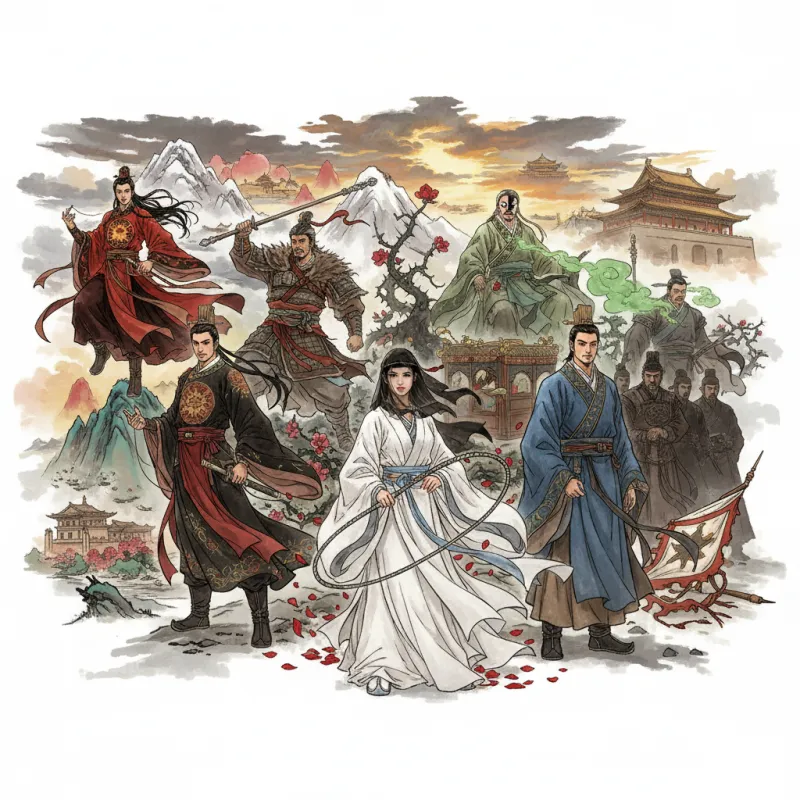
They say madness is the price of genius, but in Jin Yong's world, it's often the price of being almost right. The most haunting villains in his novels aren't the ones who embrace evil — they're the ones who reach for something noble and miss by inches. That microscopic deviation, that single wrong turn at a moral crossroads, transforms them from heroes into monsters. And the terrifying part? You can see exactly how it happened.
Ouyang Feng: When Pride Becomes Pathology
Ouyang Feng (欧阳锋, Ōuyáng Fēng) doesn't start as a villain in The Legend of the Condor Heroes (射雕英雄传, Shèdiāo Yīngxióng Zhuàn). He starts as the Western Poison, one of the Five Greats — already a morally ambiguous position, but not necessarily evil. He's proud, brilliant, and obsessed with martial supremacy. Standard wuxia fare. But Jin Yong does something unexpected: he shows us the exact moment Ouyang Feng's pride curdles into something darker.
The turning point isn't when he poisons people or schemes for the Nine Yin Manual (九阴真经, Jiǔ Yīn Zhēnjīng). It's when he realizes his nephew Ouyang Ke is actually his son — the product of an incestuous relationship with his sister-in-law. That revelation doesn't make him repent. It makes him double down. He becomes more ruthless, more desperate to prove his supremacy, as if martial achievement could somehow redeem or erase his personal failures.
By The Return of the Condor Heroes (神雕侠侣, Shéndiāo Xiálǚ), Ouyang Feng has lost his memory and his sanity, but gained something unexpected: humanity. The amnesiac Ouyang Feng, who believes himself to be a beggar and befriends the young Yang Guo, is more sympathetic than the sane version ever was. Jin Yong's message is clear — sometimes we need to lose ourselves to find our better nature. The tragedy is that when Ouyang Feng finally recovers his memory, he also recovers his pride, and dies on Peach Blossom Island having finally defeated Hong Qigong in their eternal rivalry. He gets what he wanted. It means nothing.
Yue Buqun: The Gentleman Sword Who Wasn't
If Ouyang Feng shows us how pride destroys, Yue Buqun (岳不群, Yuè Bùqún) from The Smiling, Proud Wanderer (笑傲江湖, Xiào'ào Jiānghú) demonstrates something more insidious: how righteousness can be a mask that eventually fuses to your face.
Yue Buqun is called the Gentleman Sword (君子剑, Jūnzǐ Jiàn), leader of the Huashan Sect, a pillar of orthodox martial arts. For most of the novel, he appears to be exactly that — stern but fair, principled, concerned with his sect's reputation and his daughter's future. The reveal that he's been scheming for the Evil-Resisting Sword Manual (辟邪剑谱, Bìxié Jiànpǔ) all along should feel like a twist. Instead, it feels inevitable.
Here's what makes Yue Buqun terrifying: he probably started out genuinely righteous. The Huashan Sect was in decline, threatened by rivals, hemorrhaging students and prestige. Everything Yue Buqun did — the political maneuvering, the careful cultivation of reputation, the strategic marriage alliances — could be justified as necessary for the sect's survival. When does pragmatism become corruption? When does "doing what's necessary" become "doing whatever it takes"?
The Evil-Resisting Sword Manual requires castration to practice. Yue Buqun castrates himself in secret, then continues playing the role of righteous sect leader, husband, father. The physical mutilation is just the external manifestation of what he's already done to himself spiritually. He's hollowed himself out in pursuit of power he claims to want for righteous purposes. By the end, even he probably can't remember where the performance ends and the real Yue Buqun begins — assuming there's anything real left.
Jin Yong wrote Yue Buqun during the Cultural Revolution's aftermath, and it shows. This is a villain who understands that the most effective tyranny wraps itself in the language of virtue, that the most dangerous people are those who commit atrocities while genuinely believing they're the good guys.
Li Mochou: When Love Becomes Poison
Li Mochou (李莫愁, Lǐ Mòchóu), the Scarlet Serpent Fairy (赤练仙子, Chìliàn Xiānzǐ) from The Return of the Condor Heroes, is what happens when romantic disappointment meets martial arts mastery and a complete absence of emotional regulation.
She's often dismissed as a "crazy ex-girlfriend" villain, which is both reductive and missing Jin Yong's point. Yes, Li Mochou was abandoned by her lover Lu Zhanyuan, who chose another woman. Yes, she responded by murdering his wife and hunting his family for years. But Jin Yong doesn't present this as simple vindictiveness. He shows us a woman whose entire identity was constructed around being loved, who had no other framework for understanding her worth, and who — when that love was withdrawn — had nothing left but rage.
The tragedy of Li Mochou is that she's genuinely talented. Her martial arts are formidable, her intelligence sharp. In another story, with different circumstances, she could have been a hero. Instead, she becomes a serial killer who sings a haunting song about love and betrayal as she murders people: "What is love in this world? It's a pledge of life and death" (问世间情为何物,直教人生死相许, Wèn shìjiān qíng wéi hé wù, zhí jiào rén shēngsǐ xiāng xǔ).
That song is the key to understanding her. Li Mochou isn't just killing out of revenge — she's trying to make the world acknowledge the validity of her pain. Every murder is a statement: "This is how much it hurt. This is what you did to me." She's trapped in the moment of her abandonment, unable to move forward, unable to imagine an identity beyond "woman who was wronged."
Jin Yong wrote her in the 1960s, but Li Mochou feels contemporary. She's a critique of a society that teaches women their value lies in being chosen by men, then offers them no script for what to do when they're unchosen. Her villainy is a distorted mirror of the romantic ideals that drive many of Jin Yong's heroes — the same intensity, the same absolutism, just pointed in a destructive direction.
Qiu Qianren: The Coward Who Played Villain
Not all of Jin Yong's complex villains are tragic. Some are almost comedic in their self-deception. Qiu Qianren (裘千仞, Qiú Qiānrèn) from The Legend of the Condor Heroes is a martial arts master who built his reputation on the Iron Palm technique (铁掌, Tiězhǎng) and his willingness to work for the Jin dynasty against the Song Chinese.
He's set up as a major antagonist — powerful, ruthless, politically connected. Then Jin Yong reveals the truth: Qiu Qianren is a coward. His martial arts are real, but his courage is fake. He's spent his entire life playing the role of a fearsome villain because it was easier than being a hero, because villains don't have to risk themselves for principles.
The complexity comes in his relationship with his brother Qiu Qianzhang, a beggar who pretends to be a martial arts master (the inverse of Qiu Qianren's situation). When Qiu Qianren is finally confronted with the consequences of his choices — the people he's hurt, the country he's betrayed — he doesn't fight back. He becomes a monk.
This conversion is played somewhat comedically, but there's something profound in it. Qiu Qianren represents everyone who's ever chosen the easy path, who's ever rationalized moral compromise as pragmatism, who's ever hidden behind a persona because their real self felt too vulnerable. His redemption isn't about becoming powerful enough to defeat his demons — it's about finally admitting he was running from them.
Ding Chunqiu: The Narcissist as Villain
Ding Chunqiu (丁春秋, Dīng Chūnqiū) from Demi-Gods and Semi-Devils (天龙八部, Tiānlóng Bābù) is Jin Yong's exploration of narcissistic personality disorder before that was a common term. The Old Freak of Xingxiu (星宿老怪, Xīngxiù Lǎoguài) surrounds himself with disciples who constantly praise him, has them sing songs about his greatness, and punishes any hint of criticism with death.
On the surface, he's almost a parody — the villain who needs constant validation, who can't tolerate anyone being better than him at anything. But Jin Yong shows us where this came from. Ding Chunqiu was once the disciple of Wu Yazi, a brilliant martial artist. He was talented but not the most talented. His senior, Su Xinghe, was more skilled. His master's lover, Li Qiushui, barely noticed him.
So Ding Chunqiu created a world where he could be supreme. He betrayed his master, stole his martial arts manuals, and built a cult of personality in the remote Xingxiu Sea. Every disciple who praises him is a refutation of the young man who wasn't good enough. Every demonstration of his poison techniques is proof that he's surpassed his master.
The horror of Ding Chunqiu isn't his cruelty — it's his emptiness. He's built an entire life around external validation because he has no internal sense of worth. When he's finally defeated, there's no dramatic redemption or tragic death. He just... diminishes. Without his disciples to tell him he's great, he's nothing.
Jiu Mozhi: The Monk Who Loved Martial Arts Too Much
Jiu Mozhi (鸠摩智, Jiūmózhì), the Tubo monk from Demi-Gods and Semi-Devils, is Jin Yong's meditation on how even spiritual practice can become corrupted by ambition. Named after the historical Buddhist translator Kumārajīva, Jiu Mozhi is a genuine monk with genuine Buddhist knowledge. He's also obsessed with collecting martial arts techniques, particularly those from the Dali Duan family.
The complexity is in the contradiction. Jiu Mozhi isn't a hypocrite who uses Buddhism as a cover for villainy. He genuinely believes in Buddhist principles. He quotes sutras accurately. He understands the dharma. But he's also convinced himself that mastering martial arts is a form of spiritual cultivation, that his obsession with the Six Meridians Divine Sword (六脉神剑, Liù Mài Shén Jiàn) is somehow compatible with Buddhist non-attachment.
This makes him more dangerous than a simple hypocrite. Jiu Mozhi has integrated his ambition into his spiritual framework. He's not fighting against his principles — he's reinterpreted his principles to accommodate his desires. It's a form of self-deception that's particularly insidious because it's so sophisticated.
His eventual redemption comes through complete breakdown. He pushes his internal energy too far, goes mad, and loses all his martial arts. Only then, stripped of everything he thought made him special, does he achieve actual enlightenment. Jin Yong's point is clear: sometimes we need to lose what we think we want to find what we actually need.
Murong Fu: The Man Who Lived in the Past
Murong Fu (慕容复, Mùróng Fù) from Demi-Gods and Semi-Devils might be Jin Yong's most tragic villain. He's not cruel by nature, not particularly ambitious for personal power. He's simply trying to restore his family's lost kingdom of Yan, a state that fell centuries ago.
Everything Murong Fu does — every alliance, every betrayal, every martial arts technique he masters — is in service of this impossible dream. He uses people, abandons his cousin Wang Yuyan who loves him, and eventually loses his sanity, all for a kingdom that no longer exists and never will again.
The tragedy is that Murong Fu is genuinely capable. He's intelligent, skilled, politically savvy. In another life, he could have built something new. Instead, he's trapped by his family's legacy, by the expectations of ancestors he never knew, by a historical grievance that has nothing to do with his actual life.
Jin Yong wrote Murong Fu as a critique of nationalist nostalgia — the dangerous fantasy that we can restore some imagined glorious past if we just try hard enough, sacrifice enough, hurt enough people. Murong Fu's madness at the end, where he plays at being emperor with children as his subjects, is both pathetic and pointed. This is where living in the past leads: to a fantasy kingdom with no real subjects, no real power, no real meaning.
The Pattern Behind the Complexity
What makes these villains complex isn't that they have sympathetic backstories or tragic motivations. Plenty of bad fiction gives villains sad childhoods and calls it depth. Jin Yong's villains are complex because they're almost right.
Ouyang Feng's pride in his abilities isn't wrong — he is genuinely skilled. Yue Buqun's concern for his sect isn't wrong — the Huashan Sect does need strong leadership. Li Mochou's pain isn't wrong — she was genuinely wronged. They become villains not by embracing evil, but by taking something legitimate — pride, duty, love, ambition — and refusing to balance it with anything else.
This is why Jin Yong's villains feel more real than most heroes in other wuxia fiction. They're not alien monsters with incomprehensible motivations. They're people who made understandable choices that led to terrible places. They're warnings about what we could become if we let one aspect of ourselves consume everything else.
The martial arts world Jin Yong created isn't divided into good people and evil people. It's full of people trying to navigate impossible situations with imperfect information and their own psychological baggage. Some of them become heroes. Some become villains. Most end up somewhere in between. And that ambiguity, that moral complexity, is what makes his work endure fifty years after it was written.
Related Reading
- Yue Buqun: The Most Terrifying Hypocrite in Chinese Literature
- Villains of Jin Yong's Wuxia Novels: Complexity, Motives, and Legacy
- The Greatest Villains in Jin Yong's Novels
- Jin Yong's Villains: Why the Bad Guys Are Often the Best Characters
- The Most Tragic Villains in Jin Yong's Novels
- The Smiling, Proud Wanderer: A Complete Guide
- Hidden Connections Between Jin Yong Novels
- Exploring Jin Yong's Wuxia Novels: Characters, Martial Arts, and Storylines