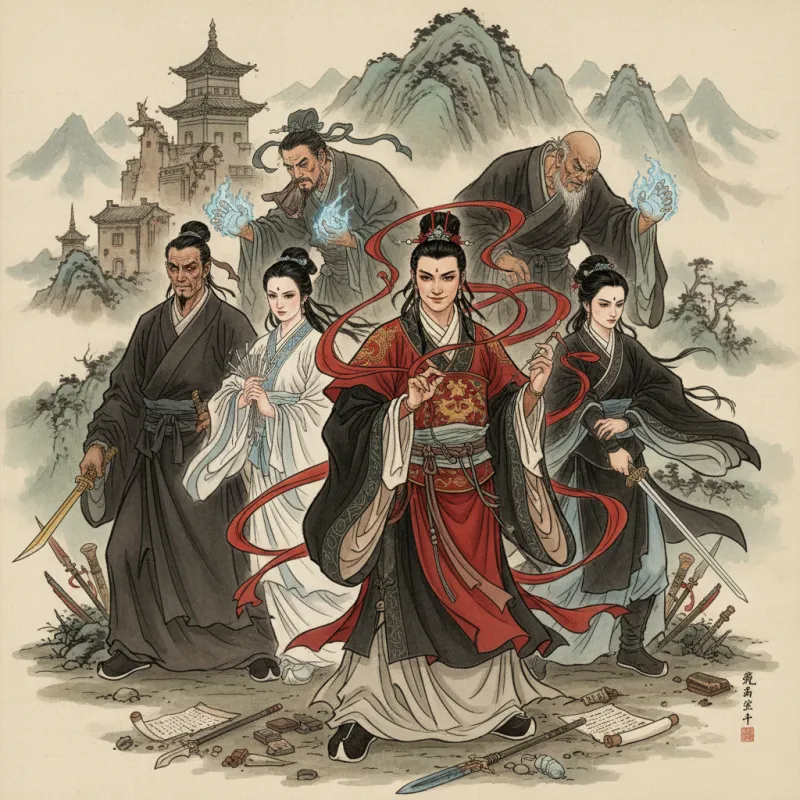
When Ouyang Feng stands alone in the desert, his mind shattered by reversed martial arts manuals and decades of obsession, you realize Jin Yong's villains aren't just obstacles for heroes to overcome—they're tragic mirrors reflecting what happens when ambition, pride, or love curdles into something monstrous. The Western Venom (西毒, Xīdú) from The Legend of the Condor Heroes embodies what makes Jin Yong's antagonists unforgettable: they're not evil for evil's sake, but broken people who made catastrophic choices at critical moments.
Beyond Black and White: The Moral Complexity of Jin Yong's Antagonists
Jin Yong revolutionized wuxia villainy by rejecting the simplistic good-versus-evil framework that dominated earlier martial arts fiction. His antagonists operate in moral gray zones that would make Western fantasy writers envious. Take Yue Buqun (岳不群, Yuè Bùqún) from The Smiling, Proud Wanderer—the "Gentleman Sword" who maintains a facade of Confucian righteousness while secretly practicing the evil-reputed Sunflower Manual (葵花宝典, Kuíhuā Bǎodiǎn). His descent isn't sudden; Jin Yong traces it across hundreds of pages, showing how the pressure to maintain his sect's reputation and compete with rivals gradually erodes his principles.
What distinguishes Jin Yong's approach is his willingness to humanize even the most despicable characters. Qiu Qianren (裘千仞, Qiū Qiānrèn), the Iron Palm Water Glider who appears irredeemably cruel in The Legend of the Condor Heroes, receives unexpected depth when we learn about his relationship with his brother and his eventual Buddhist redemption. This complexity reflects traditional Chinese philosophical concepts—particularly the Daoist notion that yin and yang exist within all people, and the Buddhist belief in the possibility of redemption through enlightenment.
The Psychology of Power: What Drives Jin Yong's Villains
Jin Yong understood that the most compelling villains believe they're justified. His antagonists rarely wake up deciding to be evil; instead, they pursue goals that seem reasonable from their perspective, using methods that gradually become more extreme. This psychological realism elevates his work above typical genre fiction.
Consider Ding Chunqiu (丁春秋, Dīng Chūnqiū), the "Star of Calamity" from Demi-Gods and Semi-Devils. His villainy stems from intellectual arrogance and the intoxication of being worshipped by sycophantic disciples. Jin Yong shows how surrounding yourself with yes-men can warp your moral compass—a lesson as relevant in modern corporate culture as in the jianghu (江湖, jiānghú, the martial arts world). Ding's toxic personality cult demonstrates Jin Yong's sharp social commentary disguised as martial arts adventure.
The pursuit of martial arts supremacy itself becomes a corrupting force in Jin Yong's universe. Jiu Mozhi (鸠摩智, Jiūmózhì) in Demi-Gods and Semi-Devils starts as a respected Tibetan monk but becomes consumed by his desire to master the Shaolin's 72 unique skills. His obsession with collecting martial arts techniques like trophies mirrors modern addiction—the dopamine hit of each new acquisition driving him to increasingly reckless behavior. When his internal energy finally goes berserk, it's both karmic justice and tragic inevitability.
Love, Betrayal, and Obsession: The Emotional Core of Villainy
Jin Yong's most memorable villains often emerge from romantic disappointment or familial betrayal. Li Mochou (李莫愁, Lǐ Mòchóu), the "Scarlet Serpent Deity" from The Return of the Condor Heroes, transforms from a passionate young woman into a mass murderer after her lover abandons her for someone else. Her signature move—poisoning entire families while singing a haunting love ballad—creates an unforgettable image of how romantic betrayal can metastasize into generalized misanthropy.
What makes Li Mochou particularly effective as a villain is that Jin Yong never lets us forget the woman she could have been. Her occasional moments of vulnerability, especially around her former junior martial sister, remind us that her cruelty is armor protecting a wounded heart. This emotional authenticity makes her more frightening than any supernatural demon—we recognize the human capacity for this kind of transformation.
The theme of obsessive love reaches its apex with Qiu Qianchi (裘千尺, Qiū Qiānchǐ) in The Return of the Condor Heroes. Betrayed by her husband and left crippled at the bottom of a valley for years, she becomes a grotesque embodiment of resentment. Her mastery of the "Date Stone Divine Skill" (枣核钉, zǎohé dīng)—spitting date stones with lethal force—symbolizes how she's weaponized her bitterness. Yet Jin Yong complicates our response by showing her genuine maternal love for her daughter, proving that even the most twisted hearts retain fragments of humanity.
The Seduction of Forbidden Knowledge
Jin Yong repeatedly explores how the pursuit of forbidden martial arts knowledge corrupts practitioners. The Sunflower Manual serves as his most potent symbol of this danger—a martial arts text so powerful that it requires self-castration to practice safely. Multiple characters across his novels are tempted by such forbidden techniques, and their choices reveal their true character.
Dongfang Bubai (东方不败, Dōngfāng Bùbài), the "Invincible East" from The Smiling, Proud Wanderer, represents the ultimate expression of this theme. After castrating himself to practice the Sunflower Manual, he becomes perhaps the most powerful martial artist in Jin Yong's universe—but at the cost of his identity, sanity, and humanity. His transformation into someone who dresses in women's clothing and becomes obsessed with embroidery isn't played for laughs; it's a disturbing portrait of how the pursuit of power can unmoor you from yourself.
The forbidden knowledge theme connects to classical Chinese warnings about the dangers of heterodox learning (旁门左道, pángmén zuǒdào). Jin Yong suggests that some knowledge comes with inherent corruption—not because the knowledge itself is evil, but because the mindset required to pursue it requires abandoning ethical constraints. This resonates with modern anxieties about technology and scientific advancement pursued without ethical guardrails.
Villains as Social Commentary
Jin Yong embedded sharp social criticism within his villain characterizations. Many antagonists represent specific social ills or historical patterns that plagued Chinese society. The various corrupt officials, hypocritical sect leaders, and power-hungry schemers in his novels reflect his observations about human nature and institutional decay.
The character of Murong Fu (慕容复, Mùróng Fù) from Demi-Gods and Semi-Devils embodies the dangers of living in the past. Obsessed with restoring his family's fallen kingdom of Great Yan, he sacrifices everything—friendship, love, honor—for a fantasy of past glory. Jin Yong wrote this character during a period when China was grappling with its own relationship to imperial history, making Murong Fu's eventual madness a cautionary tale about nationalist obsession. His fate—ending the novel insane, playing emperor with children—is one of Jin Yong's most devastating character arcs.
The Qing court officials and Han collaborators who appear as antagonists in novels like The Deer and the Cauldron reflect Jin Yong's nuanced view of the Manchu conquest. Rather than simple ethnic antagonism, he portrays a complex web of collaboration, resistance, and pragmatic accommodation. Characters like Oboi demonstrate how institutional power can corrupt even those who start with legitimate grievances.
The Redemption Question: Can Villains Change?
One of Jin Yong's most interesting narrative choices involves selective redemption for certain villains. Unlike Western superhero comics where villains rarely achieve genuine reformation, Jin Yong allows some antagonists to find peace or enlightenment—but only after they've fully confronted their crimes.
Qiu Qianren's Buddhist conversion in The Legend of the Condor Heroes works because Jin Yong doesn't make it easy or complete. Even after becoming a monk, Qiu struggles with his violent impulses and past actions. His redemption is a process, not a switch that flips. This reflects Buddhist concepts of gradual enlightenment and the long path to overcoming karma.
Conversely, Jin Yong denies redemption to villains who refuse self-reflection. Ouyang Feng dies without ever truly understanding how his obsessions destroyed him. Yue Buqun's final fate—killed by his own daughter after years of hypocrisy—represents Jin Yong's judgment that some betrayals are unforgivable. The selective nature of redemption in Jin Yong's universe suggests that change requires genuine remorse and self-awareness, not just suffering consequences.
Legacy and Influence: Why These Villains Endure
Jin Yong's villains have achieved iconic status in Chinese popular culture, spawning countless adaptations, reinterpretations, and homages. Characters like Dongfang Bubai and Li Mochou have been portrayed by dozens of actors across film, television, and stage productions, each interpretation adding new layers to these complex figures.
The enduring appeal of these antagonists lies in their psychological realism and moral complexity. Modern audiences recognize the human truths in their stories—how ambition can corrupt, how love can sour into obsession, how the pursuit of power can hollow you out. These aren't fantasy villains; they're cautionary tales about human nature dressed in martial arts clothing.
Contemporary Chinese writers continue to grapple with Jin Yong's legacy, attempting to create villains with similar depth and complexity. Few succeed because Jin Yong's antagonists emerged from his deep engagement with Chinese philosophy, history, and literature. His villains work because they're grounded in specific cultural contexts while exploring universal human weaknesses. They remind us that the line between hero and villain often depends on a few critical choices—and that any of us, given the wrong circumstances and temptations, might cross that line ourselves.
Related Reading
- The Most Tragic Villains in Jin Yong's Novels
- Yue Buqun: The Most Terrifying Hypocrite in Chinese Literature
- Jin Yong's Villains: Why the Bad Guys Are Often the Best Characters
- The Most Complex Villains in Jin Yong Fiction
- The Greatest Villains in Jin Yong's Novels
- Exploring the Enigmatic Worlds of Jin Yong's Wuxia Novels
- The Five Greats Explained: Understanding Jin Yong's Power Elite
- Jin Yong's Music: The Soundtracks That Made a Nation Cry