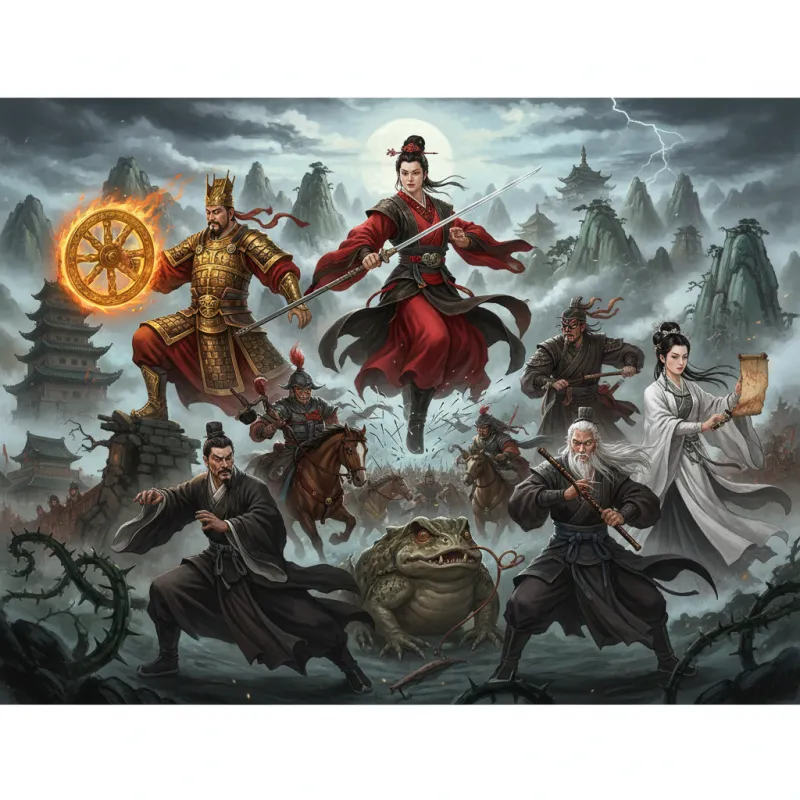
They say the measure of a hero is the villain who opposes them. But what happens when the villain is so compelling, so brilliantly crafted, that you find yourself rooting for them? Jin Yong (金庸 Jīn Yōng) didn't just write antagonists — he created characters whose complexity rivals any protagonist in world literature. These aren't mustache-twirling caricatures. They're people with histories, wounds, and motivations that make perfect sense from their perspective. Sometimes they're right. Sometimes they're more interesting than the heroes trying to stop them.
Ouyang Feng: Genius, Madman, Tragic Figure
Ouyang Feng (欧阳锋 Ōuyáng Fēng), the Western Poison (西毒 Xī Dú) from The Legend of the Condor Heroes and The Return of the Condor Heroes, represents Jin Yong's villain-craft at its finest. Here's a man who masters the Toad Stance (蛤蟆功 Hámá Gōng) — one of the Five Greats' signature martial arts — through sheer obsessive genius. He's ruthless, calculating, and willing to sacrifice anything for power.
But then Jin Yong does something unexpected: he breaks him. After practicing a corrupted version of the Nine Yin Manual (九阴真经 Jiǔ Yīn Zhēnjīng) backwards, Ouyang Feng loses his memory and his sanity. The second half of his story transforms him from calculating villain to tragic wanderer. He forgets his own name, forgets his nephew (who was actually his son), forgets everything except his rivalry with Hong Qigong (洪七公 Hóng Qīgōng). Their final duel — two old men, one mad and one dying, fighting on a mountaintop — is one of the most emotionally devastating scenes Jin Yong ever wrote.
What makes Ouyang Feng unforgettable isn't his villainy. It's that Jin Yong shows us what happens when ambition consumes everything else. The man who wanted to be the greatest martial artist in the world ends up not even knowing who he is.
Yue Buqun: The Gentleman Sword Who Wasn't
If Ouyang Feng is a tragic villain, Yue Buqun (岳不群 Yuè Bùqún) from The Smiling, Proud Wanderer is something far more disturbing: a hypocrite who believes his own lies. As the leader of the Huashan Sect (华山派 Huàshān Pài), he presents himself as the embodiment of orthodox righteousness. He's called the Gentleman Sword (君子剑 Jūnzǐ Jiàn). He lectures about morality and proper conduct. Parents in the 江湖 (jiānghú, the martial arts world) would be thrilled to have him as a son-in-law.
And he's been plotting, scheming, and murdering his way toward power for decades.
The brilliance of Yue Buqun is how long Jin Yong makes us wait for the reveal. For much of the novel, he seems like a flawed but fundamentally decent man. The truth emerges gradually: he's been orchestrating conflicts between sects, eliminating rivals, and manipulating his own disciples. When he finally obtains the Sunflower Manual (葵花宝典 Kuíhuā Bǎodiǎn) — the forbidden martial arts text he's been seeking — he doesn't hesitate to castrate himself to practice its techniques.
Yue Buqun represents something Jin Yong clearly despised: the person who uses righteousness as a weapon while committing atrocities in its name. He's more dangerous than an honest villain because he's convinced himself he's the hero. The orthodox sects in Jin Yong's novels are full of such men, but none as perfectly realized as Yue Buqun.
Ding Chunqiu: The Old Monster
Ding Chunqiu (丁春秋 Dīng Chūnqiū) from Demi-Gods and Semi-Devils is what happens when you give a narcissistic sociopath incredible martial arts skills and a cult of personality. The Old Monster of Xingxiu (星宿老怪 Xīngxiù Lǎoguài) surrounds himself with disciples who constantly praise him: "The Old Immortal of Xingxiu has divine powers! His virtue matches heaven and earth! His martial arts are unparalleled throughout history!"
It's absurd. It's also terrifying, because Ding Chunqiu has the power to back up the flattery. His Transforming Skill (化功大法 Huàgōng Dàfǎ) can dissolve other people's internal energy. His poison techniques are among the deadliest in the 江湖. And he achieved all this by betraying and crippling his own master, Wu Yazi (无崖子 Wú Yázǐ), decades earlier.
What makes Ding Chunqiu fascinating is how Jin Yong uses him to satirize authoritarianism and cult-like devotion. His disciples aren't just followers — they're performers in an endless theater of praise. They compete to flatter him most creatively. They attack anyone who doesn't acknowledge his greatness. It's darkly comic until you remember that Ding Chunqiu will casually murder anyone who displeases him.
Qiu Qianren: The Iron Palm Water Glider
Qiu Qianren (裘千仞 Qiū Qiānrèn) from The Legend of the Condor Heroes deserves mention for sheer martial arts prowess. His Iron Palm (铁掌 Tiězhǎng) technique is devastating — he can shatter stone and kill with a single strike. He's also a coward who hides behind his reputation and eventually becomes a monk to escape his guilt.
But his brother Qiu Qianzhang (裘千丈 Qiū Qiānzhàng) is the more interesting character: a con artist with no martial arts skills who impersonates his famous brother. Jin Yong loved these kinds of inversions — the fake who's more entertaining than the real thing.
Li Mochou: The Serpent Demoness
Li Mochou (李莫愁 Lǐ Mòchóu) from The Return of the Condor Heroes is what happens when romantic betrayal turns someone into a serial killer. The Serpent Demoness (赤练仙子 Chìliàn Xiānzǐ) was once a young woman in love. When her lover abandoned her for someone else, she didn't just move on — she spent years hunting down and murdering anyone connected to him, including innocent family members.
She's terrifying because her motivation is so human. Heartbreak doesn't justify mass murder, but Jin Yong makes us understand the progression from pain to obsession to atrocity. Li Mochou sings a haunting poem as she kills: "Ask what love is in this world / That it can make one pledge life and death to another" (问世间情为何物 直教人生死相许 Wèn shìjiān qíng wéi hé wù, zhí jiào rén shēngsǐ xiāng xǔ).
The tragedy is that she's trapped in her own narrative. She can't stop killing because that would mean confronting the emptiness of her revenge. By the time she dies — burned alive while trying to save a child — we see glimpses of the person she might have been.
Jiumozhi: The Warrior Monk
Jiumozhi (鸠摩智 Jiūmózhì) from Demi-Gods and Semi-Devils is a Tibetan monk who's supposed to have transcended worldly desires. Instead, he's obsessed with collecting martial arts techniques, particularly the 72 Unique Skills of Shaolin (少林七十二绝技 Shàolín Qīshí'èr Juéjì). He's charming, eloquent, and utterly ruthless in pursuing what he wants.
What's fascinating about Jiumozhi is how Jin Yong uses him to explore the contradiction between spiritual practice and worldly ambition. He's a monk who's mastered Buddhist texts and can debate philosophy with anyone. He's also willing to attack Shaolin Temple and kidnap people to get what he wants. The cognitive dissonance is the point — Jiumozhi represents the danger of using spiritual practice as just another form of power-seeking.
His eventual fate is appropriately ironic: he loses all his martial arts and becomes an actual monk, finally achieving the detachment he claimed to have all along.
What Makes a Great Jin Yong Villain?
Looking across these characters, patterns emerge. Jin Yong's best villains share certain qualities:
They're competent. These aren't bumbling antagonists who lose because they're stupid. Ouyang Feng is a genius. Yue Buqun is a master strategist. They lose because of character flaws, not incompetence.
They have understandable motivations. Even when their actions are monstrous, we understand why they're doing it. Li Mochou's pain is real. Jiumozhi's desire for mastery is relatable. The psychology of revenge runs deep in Jin Yong's work.
They're often right about something. Yue Buqun correctly identifies that the orthodox sects are hypocritical. Ouyang Feng isn't wrong that martial arts mastery requires obsessive dedication. Jin Yong doesn't give his villains easy-to-dismiss worldviews.
They change. Unlike static antagonists, Jin Yong's villains have arcs. Ouyang Feng goes mad. Qiu Qianren becomes a monk. Even in villainy, they're dynamic characters.
The Villain as Mirror
The greatest function of Jin Yong's villains is how they reflect the heroes. Yang Guo (杨过 Yáng Guò) could have become Li Mochou — both were betrayed and hurt. Linghu Chong (令狐冲 Línghú Chōng) could have become Yue Buqun if he'd valued power over integrity. The villains show us the paths not taken, the choices that lead to damnation instead of redemption.
This is why Jin Yong's villains remain compelling decades after these novels were written. They're not obstacles to overcome. They're warnings, mirrors, and sometimes tragic figures who deserved better than the choices they made. In the morally complex world of the 江湖, the line between hero and villain is thinner than we'd like to believe.
Related Reading
- Villains of Jin Yong's Wuxia Novels: Complexity, Motives, and Legacy
- The Most Complex Villains in Jin Yong Fiction
- The Most Tragic Villains in Jin Yong's Novels
- Yue Buqun: The Most Terrifying Hypocrite in Chinese Literature
- Jin Yong's Villains: Why the Bad Guys Are Often the Best Characters
- Gu Long vs. Jin Yong: The Great Wuxia Debate
- The Complete Timeline of Events Across Jin Yong's Novels
- Exploring Jin Yong's Wuxia Novels: Characters, Martial Arts, and Storylines