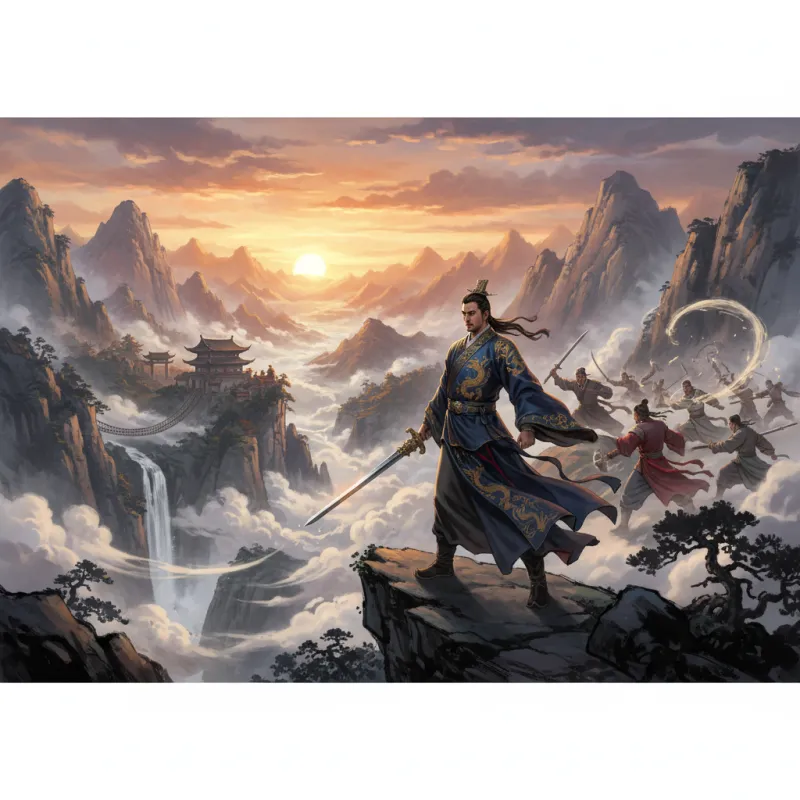
When Zhang Wuji stands paralyzed between three women he loves in The Heaven Sword and Dragon Saber (倚天屠龙记, Yǐtiān Túlóng Jì), unable to choose, unable to act, he embodies something Jin Yong understood better than perhaps any other wuxia writer: that the greatest martial artist in the jianghu (江湖, jiānghú) — the martial world — can still be utterly helpless before his own heart. This is the genius of Louis Cha's work. While other wuxia authors were content to write about heroes who could split mountains with their palms, Jin Yong wrote about heroes who could barely manage their own emotions.
The Evolution of Jin Yong's Character Archetypes
Jin Yong's fourteen novels, written between 1955 and 1972, showcase a deliberate evolution in how he conceived heroism. His early protagonists like Chen Jialuo from The Book and the Sword (书剑恩仇录, Shū Jiàn Ēnchóu Lù) are relatively straightforward — noble, skilled, destined for greatness. But as Jin Yong matured as a writer, his heroes became increasingly flawed, complex, and human.
Consider the progression: Guo Jing from The Legend of the Condor Heroes (射雕英雄传, Shèdiāo Yīngxióng Zhuàn) is honest to the point of stupidity, yet his unwavering moral compass makes him heroic. His son Guo Fu is spoiled and impulsive, causing tragedy through thoughtlessness. Then we get Yang Guo in The Return of the Condor Heroes (神雕侠侣, Shéndiāo Xiálǚ), who is rebellious, resentful, and willing to defy social conventions for love. By the time we reach Wei Xiaobao in The Deer and the Cauldron (鹿鼎记, Lùdǐng Jì), Jin Yong has completely deconstructed the wuxia hero — Wei can barely fight, lies constantly, and succeeds through cunning rather than righteousness.
This wasn't just artistic experimentation. Jin Yong was interrogating what heroism actually means in a morally complex world. His female characters underwent a similar transformation, from the relatively passive Mu Nianci to the fierce Huang Rong, and eventually to the tragic Azi, whose obsessive love leads to horrifying choices.
Martial Arts as Philosophy and Character Development
What separates Jin Yong's martial arts system from other wuxia fiction is that kung fu (功夫, gōngfu) in his novels is never just about fighting. Every martial art reflects a philosophy, and a character's choice of martial arts reveals their inner nature.
The Eighteen Dragon-Subduing Palms (降龙十八掌, Jiànglóng Shíbā Zhǎng) requires straightforward, honest force — perfect for Guo Jing's character but impossible for someone duplicitous to master. The Nine Yin Manual (九阴真经, Jiǔyīn Zhēnjīng) contains both orthodox and unorthodox techniques, and characters who study it must choose which path to follow, mirroring their moral choices. The Sunflower Manual (葵花宝典, Kuíhuā Bǎodiǎn) demands self-castration for ultimate power, a grotesque metaphor for the sacrifices ambition demands.
Jin Yong understood that martial arts training is character development made visible. When Linghu Chong learns the Dugu Nine Swords (独孤九剑, Dúgū Jiǔ Jiàn), he's not just learning techniques — he's learning to see through deception and respond with spontaneous creativity rather than rigid forms. This perfectly suits his free-spirited, wine-loving personality. Meanwhile, his rival Yue Buqun obsesses over the Sunflower Manual because he craves power above all else, even his own humanity.
The concept of neigong (内功, nèigōng) — internal energy cultivation — adds another layer. Characters don't just train their bodies; they cultivate their qi (气, qì) through meditation, moral cultivation, and sometimes sheer suffering. Duan Yu accidentally absorbs decades of internal energy, but he lacks the martial knowledge to use it effectively, creating a fascinating tension between raw power and refined skill.
The Jianghu as Moral Laboratory
The jianghu in Jin Yong's novels isn't just a setting — it's a parallel society with its own rules, hierarchies, and moral codes that often conflict with the official government world. This allows Jin Yong to explore questions about justice, loyalty, and righteousness in ways that wouldn't be possible in conventional society.
Take the concept of xia (侠, xiá) — the chivalrous hero who rights wrongs and helps the weak. Sounds simple, but Jin Yong constantly complicates it. In Demi-Gods and Semi-Devils (天龙八部, Tiānlóng Bābù), Qiao Feng is the epitome of xia, yet he's torn between his Chinese upbringing and his Khitan heritage. When he discovers his true identity, his entire moral framework collapses. What does it mean to be righteous when the people you've sworn to protect see you as the enemy?
The martial sects themselves function as microcosms of political systems. The Shaolin Temple represents Buddhist orthodoxy and institutional power. The Wudang Sect embodies Daoist principles of flexibility and natural harmony. The Mount Hua Sect's split between the Sword Sect and Qi Sect in The Smiling, Proud Wanderer (笑傲江湖, Xiào'ào Jiānghú) mirrors ideological conflicts about whether ends justify means.
Jin Yong also explores how jianghu justice differs from legal justice. Characters frequently take revenge into their own hands, but Jin Yong shows the moral costs. The cycle of revenge in Demi-Gods and Semi-Devils destroys multiple generations, suggesting that jianghu justice, for all its romantic appeal, perpetuates violence rather than resolving it.
Historical Settings and Political Commentary
Every Jin Yong novel is set during a specific historical period, and this isn't just window dressing. The Song Dynasty setting of The Legend of the Condor Heroes allows Jin Yong to explore themes of national identity and resistance against foreign invasion — the Mongols in the novel, but resonant for readers who lived through Japanese occupation and the Chinese Civil War.
The Deer and the Cauldron, set during the early Qing Dynasty, is perhaps his most overtly political work. Wei Xiaobao serves both the Qing Emperor Kangxi and the anti-Qing Heaven and Earth Society, unable to fully commit to either side. This reflects the complexity of Chinese identity during the Manchu rule — were the Qing legitimate rulers or foreign occupiers? Jin Yong, writing in the 1960s, was clearly thinking about contemporary questions of legitimacy and loyalty.
The Ming Dynasty setting of The Heaven Sword and Dragon Saber lets Jin Yong examine how revolutionary movements become corrupted. The Ming Cult starts with noble goals but descends into internal power struggles, a pattern Jin Yong witnessed in 20th-century Chinese politics. His historical settings provide safe distance to critique contemporary issues.
Romance and the Impossibility of Perfect Love
If there's one constant across Jin Yong's novels, it's that love is complicated, painful, and rarely works out the way characters hope. His romances aren't fairy tales — they're examinations of how desire, duty, and circumstance collide.
The Yang Guo and Xiaolongnü relationship in The Return of the Condor Heroes violates the master-student taboo and requires sixteen years of separation before resolution. Linghu Chong loves Yue Lingshan, who loves someone else, while Ren Yingying loves him — a triangle where everyone suffers. Duan Yu loves Wang Yuyan, who loves his cousin Murong Fu, who loves only his impossible dream of restoring his kingdom.
Jin Yong's female characters are often more emotionally intelligent and decisive than his male heroes. Huang Rong manipulates situations to protect Guo Jing. Zhao Min pursues Zhang Wuji with shameless determination. Ren Yingying quietly arranges everything so Linghu Chong can live freely. Yet Jin Yong also shows how women in the jianghu face constraints men don't — their reputations are more fragile, their choices more limited, their power more dependent on relationships with men.
The most tragic romances involve characters who love the wrong person or the right person at the wrong time. Azi's obsessive love for Qiao Feng leads her to blind herself when he dies. Mei Chaofeng's love for her senior martial brother drives her to betray her sect. These aren't just romantic subplots — they're explorations of how love can be as destructive as any martial arts technique.
Literary Techniques and Narrative Structure
Jin Yong employed sophisticated narrative techniques that elevated wuxia from pulp fiction to literature. His use of multiple protagonists in Demi-Gods and Semi-Devils — Duan Yu, Qiao Feng, and Xuzhu — allows him to explore three different paths through life. Duan Yu represents the scholar who stumbles into martial arts. Qiao Feng embodies the tragic hero destroyed by circumstances beyond his control. Xuzhu is the accidental hero who never sought power but receives it anyway.
His plotting is intricate, with seemingly minor details from early chapters becoming crucial hundreds of pages later. The mystery of Zhang Wuji's parentage, the true nature of the Sunflower Manual, the identity of the Condor Heroes — Jin Yong plants seeds early and lets them grow organically.
He also uses historical figures strategically. Genghis Khan, Kublai Khan, Emperor Kangxi — these aren't just background characters but fully realized figures who interact with fictional protagonists. This grounds the fantasy in historical reality and adds weight to the stakes.
The serialized nature of Jin Yong's original publications (most appeared in newspapers) shaped his writing style. Each installment needed to hook readers for the next day, resulting in cliffhangers, revelations, and plot twists that maintain momentum across thousands of pages. Yet he also revised extensively for book publication, adding depth and coherence.
Legacy and Cultural Impact
Jin Yong's influence extends far beyond literature. His novels have been adapted into countless films, television series, comics, and video games. Phrases from his books have entered everyday Chinese language. His characters are cultural touchstones — everyone knows Guo Jing's righteousness, Huang Rong's cleverness, Wei Xiaobao's roguishness.
But his deeper legacy is how he transformed wuxia from entertainment into art. Before Jin Yong, wuxia novels were considered lowbrow. After him, scholars write dissertations analyzing his work. His novels explore Chinese philosophy, history, and culture in ways that are both accessible and profound. He made martial arts fiction a vehicle for examining what it means to be human — our capacity for both nobility and pettiness, our struggles between duty and desire, our search for meaning in a morally ambiguous world.
For readers interested in how Jin Yong's characters compare to other wuxia traditions, exploring the evolution of wuxia heroes provides valuable context. Similarly, understanding the philosophical foundations of Chinese martial arts deepens appreciation for how Jin Yong integrated combat with character development.
Reading Jin Yong today, decades after he wrote these novels, they remain startlingly relevant. His questions about identity, loyalty, justice, and love don't have easy answers — which is precisely why his work endures. The jianghu he created isn't just a fantasy world of flying swordsmen and mystical kung fu. It's a mirror reflecting our own struggles, dressed in silk robes and wielding legendary weapons.
Related Reading
- The Art of Duels in Jin Yong's Wuxia Novels: A Journey Through Martial Valor
- Exploring the Enigmatic Worlds of Jin Yong's Wuxia Novels
- Huang Rong: The Smartest Person in Jin Yong's Universe