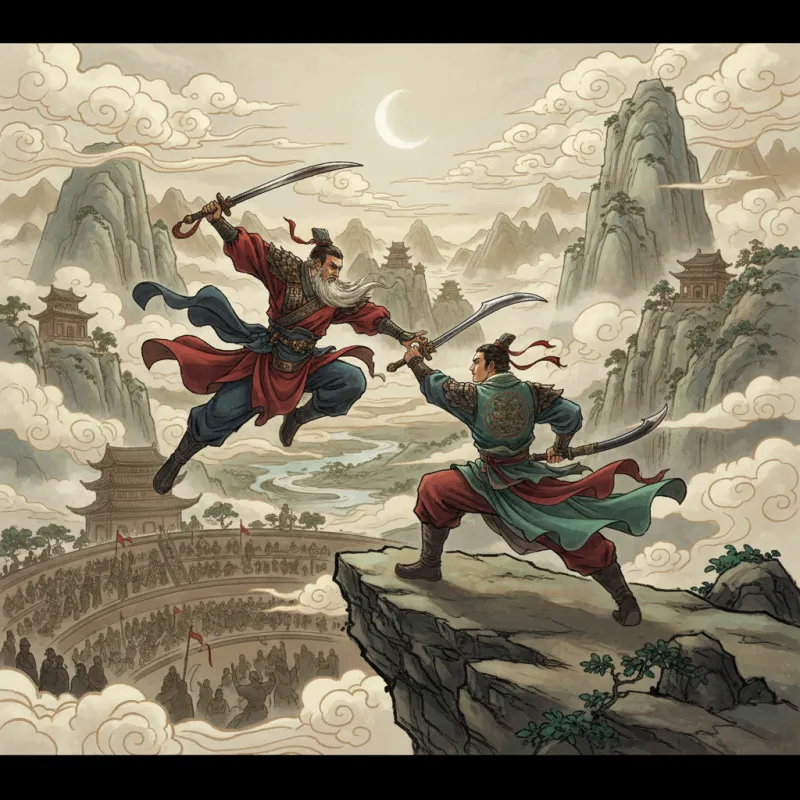
The clash of swords echoes through Mount Hua as Linghu Chong faces off against Yue Buqun—master against disciple, righteousness against ambition. This single duel in The Smiling, Proud Wanderer (笑傲江湖, Xiào'ào Jiānghú) encapsulates everything Jin Yong understood about martial combat: it's never just about who's faster or stronger. Every duel in his novels is a philosophical debate conducted through blade and fist, where victory reveals not just superior technique, but deeper truths about honor, loyalty, and what it means to walk the jianghu (江湖, the martial world).
The Duel as Moral Examination
Jin Yong's duels function as crucibles that test character rather than mere spectacles of violence. Consider the legendary showdown at Mount Hua in The Legend of the Condor Heroes (射雕英雄传, Shèdiāo Yīngxióng Zhuàn), where the Five Greats compete not for glory but to determine who deserves to possess the Nine Yin Manual. Wang Chongyang wins not through brute force but through superior understanding of martial philosophy—he recognizes that true mastery transcends technique.
This pattern repeats throughout Jin Yong's seventeen novels. When Guo Jing fights Yang Kang, their duel represents competing worldviews: patriotism versus self-interest, simplicity versus cunning. Guo Jing's straightforward Eighteen Dragon-Subduing Palms (降龙十八掌, Jiàng Lóng Shíbā Zhǎng) clash against Yang Kang's deceptive techniques, and the outcome feels inevitable—not because Guo Jing is stronger, but because his moral foundation is unshakeable. Jin Yong understood that in wuxia, your internal cultivation (内功, nèigōng) reflects your character, and your character determines your fate.
The Ritual Structure of Combat
Jin Yong's duels follow an almost ceremonial structure that distinguishes them from simple brawls. Combatants typically announce their names, schools, and sometimes even their techniques before engaging. This isn't just literary convention—it reflects the historical code of the jianghu, where reputation and lineage matter as much as skill. When Qiao Feng introduces himself as the leader of the Beggar's Clan before unleashing his devastating palm strikes, he's not being theatrical; he's honoring the unwritten rules that govern martial society.
The pre-duel exchange serves multiple narrative functions. It establishes stakes, builds tension, and most importantly, frames the combat within a moral context. In Demi-Gods and Semi-Devils (天龙八部, Tiānlóng Bābù), when Qiao Feng discovers his Khitan heritage and faces his former brothers, these ritual announcements become heartbreaking—each formal greeting underscores the tragedy of friends forced to become enemies. The structure transforms violence into something more profound: a dialogue about identity, belonging, and the arbitrary nature of ethnic conflict.
Asymmetric Warfare and the Underdog Narrative
Jin Yong excels at crafting duels where conventional power dynamics don't determine outcomes. Wei Xiaobao in The Deer and the Cauldron (鹿鼎记, Lùdǐng Jì) possesses virtually no martial arts skill, yet survives encounters with masters through wit, luck, and shameless pragmatism. His "duels" subvert every wuxia convention—he poisons, tricks, and runs away, yet the narrative validates his approach. Jin Yong seems to argue that survival itself is a form of victory, and that the jianghu's obsession with fair combat can be a fatal weakness.
Similarly, Linghu Chong's mastery of the Dugu Nine Swords (独孤九剑, Dúgū Jiǔ Jiàn) represents a philosophical rejection of rigid martial systems. This technique has no fixed forms—it's pure adaptation, finding the flaw in any opponent's style. When Linghu Chong defeats practitioners of orthodox schools, he's not just winning fights; he's demonstrating that flexibility triumphs over dogma. The philosophy of martial arts in Jin Yong's work consistently favors those who think beyond conventional boundaries.
The Duel as Character Revelation
Combat strips away pretense. In the heat of battle, characters reveal who they truly are. Yue Buqun maintains his "Gentleman Sword" persona for years, but his dueling style—increasingly vicious and underhanded—betrays his corruption long before his villainy becomes explicit. Jin Yong uses fighting choreography as character development, showing rather than telling us about moral decay.
Conversely, some characters discover their true nature through combat. Zhang Wuji in The Heaven Sword and Dragon Saber (倚天屠龙记, Yǐtiān Túlóng Jì) begins as hesitant and conflict-averse, but his duels force him to accept leadership and make impossible choices. His mastery of the Nine Yang Divine Skill (九阳神功, Jiǔyáng Shéngōng) gives him overwhelming power, yet his most important battles are internal—choosing between competing loyalties, deciding when mercy is appropriate and when it's weakness.
The most poignant example might be Duan Yu, who refuses to learn offensive martial arts due to Buddhist principles. His duels become exercises in evasion and defense, and this constraint makes him more interesting than if he simply overpowered opponents. Jin Yong respects characters who maintain principles even when pragmatism would be easier, and structures his duels to reward moral consistency.
The Group Dynamic: When Duels Become Battles
While one-on-one combat dominates wuxia, Jin Yong frequently escalates duels into complex multi-party conflicts that test alliances and expose hidden agendas. The battle at Bright Summit in The Heaven Sword and Dragon Saber begins as a siege but dissolves into a chaotic series of individual confrontations, each revealing different facets of the martial world's political landscape.
These mass combat scenes showcase Jin Yong's narrative sophistication. He tracks multiple simultaneous duels, weaving them into a coherent whole while maintaining individual character arcs. When the Six Major Sects attack Ming Cult, we're not watching a generic battle—we're seeing specific grudges, philosophical disagreements, and personal relationships play out through choreographed violence. The legendary battles in his novels function as microcosms of larger social conflicts.
The Aftermath: Victory Without Triumph
Jin Yong rarely allows his characters to enjoy uncomplicated victories. Duels in his novels often end with pyrrhic outcomes or moral ambiguity. When Guo Jing finally defeats Ouyang Feng in The Return of the Condor Heroes (神雕侠侣, Shéndiāo Xiálǚ), the victory feels hollow—Ouyang Feng has descended into madness, and defeating him brings no satisfaction, only sadness for what he once was.
This melancholic quality distinguishes Jin Yong from more straightforward wuxia authors. His duels acknowledge that violence, even justified violence, carries costs. Yang Guo loses an arm, Qiao Feng dies by his own hand, and countless masters end their days crippled or broken. The jianghu demands excellence in combat, but Jin Yong never lets us forget that this excellence is purchased with suffering.
The most profound duels in Jin Yong's work are those that don't happen. When Zhang Sanfeng faces the possibility of fighting his former disciple in The Heaven Sword and Dragon Saber, the emotional weight of that potential confrontation—master against student, Wudang against Ming Cult—creates more tension than any actual combat could. Sometimes the greatest martial arts wisdom is knowing when not to fight.
The Legacy of Jin Yong's Combat Philosophy
Modern wuxia, from films to video games, owes its combat aesthetics to Jin Yong's innovations. He transformed duels from simple action sequences into narrative engines that drive character development and thematic exploration. His influence extends beyond Chinese media—you can see echoes of his approach in everything from Crouching Tiger, Hidden Dragon to anime like Rurouni Kenshin.
What makes Jin Yong's duels endure is their emotional honesty. He understood that readers don't remember specific techniques or blow-by-blow descriptions—they remember how combat made them feel. The desperation of Linghu Chong fighting while poisoned, the tragedy of Qiao Feng's final stand, the bittersweet triumph of Guo Jing defending Xiangyang—these moments resonate because they're about human struggle, not just martial prowess.
The art of duels in Jin Yong's novels ultimately serves a humanistic purpose. Through the stylized violence of wuxia, he explores questions that transcend genre: How do we maintain integrity under pressure? When is compromise wisdom and when is it betrayal? What do we owe to those who taught us, and when must we surpass them? Every crossed blade in his novels asks these questions, and the answers—complex, contradictory, deeply human—are why his work remains essential reading for anyone interested in the deeper meanings of martial arts fiction.
Related Reading
- The Unsung Heroes of Jin Yong's Wuxia Novels: Side Characters That Steal the Spotlight
- Exploring the Rich Tapestry of Jin Yong's Wuxia Novels: Characters and Martial Arts
- Exploring Jin Yong's Wuxia Novels: Characters, Martial Arts, and Storylines