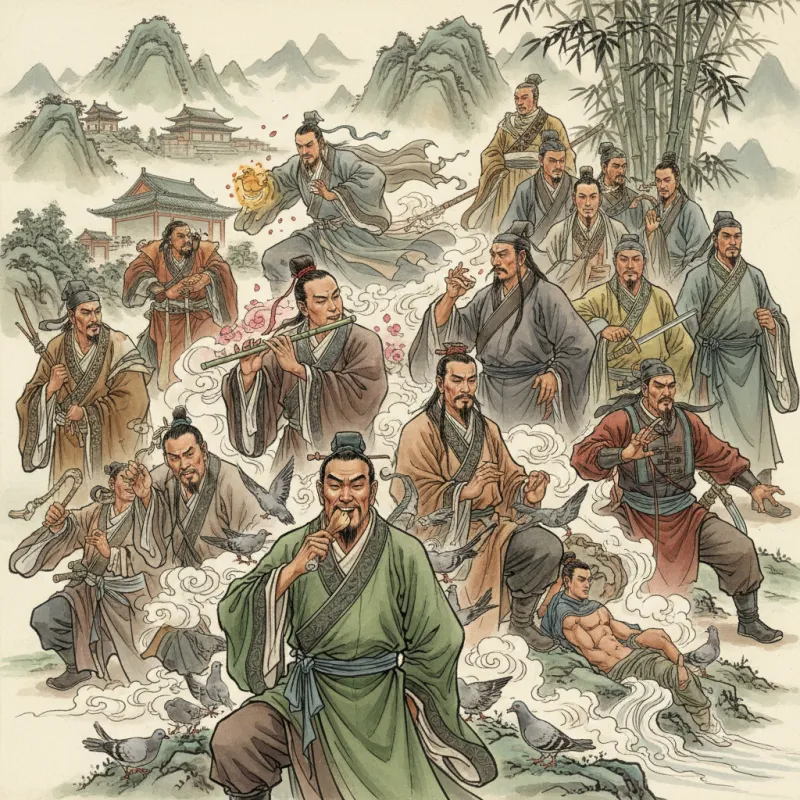
Zhou Botong is dancing on one foot, cackling like a madman while teaching Guo Jing the "Mutual Hands Combat" technique. Huang Yaoshi plays his jade flute on Peach Blossom Island, his melancholy notes drifting across the waves. Qiu Qianren pretends to walk on water while his disciples hold him up with hidden poles beneath the surface. These aren't the heroes whose names grace the covers of Jin Yong's novels—but ask any devoted reader, and they'll tell you these side characters often eclipse the protagonists in memorability, complexity, and sheer entertainment value.
Jin Yong (金庸, Jīn Yōng), born Louis Cha in 1924, understood something fundamental about storytelling: the world feels real not because of the hero's journey, but because of the dozens of fully realized lives intersecting with it. His fifteen wuxia novels contain hundreds of side characters, each with distinct personalities, martial arts styles, moral philosophies, and—most importantly—the capacity to surprise us. While protagonists like Guo Jing and Yang Guo follow predictable arcs of growth and redemption, it's the side characters who inject unpredictability, humor, tragedy, and philosophical depth into the narrative.
The Eccentric Masters Who Redefine Wisdom
The Old Urchin Zhou Botong (老顽童周伯通, Lǎo Wántóng Zhōu Bótōng) from The Legend of the Condor Heroes and The Return of the Condor Heroes represents Jin Yong's most subversive character archetype: the wise fool. Trapped on Peach Blossom Island for fifteen years, Zhou doesn't descend into bitterness or madness—he invents the "Mutual Hands Combat" (双手互搏, shuāng shǒu hù bó) technique out of sheer boredom, teaching his left and right hands to fight each other. This seemingly absurd innovation becomes one of the most powerful martial arts in the jianghu (江湖, jiānghú)—the martial arts world.
Zhou's genius lies in his refusal to take anything seriously, including himself. While other masters obsess over honor, revenge, and legacy, Zhou plays games, tells jokes, and treats martial arts as entertainment rather than a path to power. Yet this childlike approach grants him a clarity that eludes more "serious" characters. He sees through pretension, forgives easily, and never allows pride to cloud his judgment. Jin Yong suggests that perhaps the highest wisdom isn't found in Confucian rectitude or Daoist mysticism, but in the ability to laugh at the cosmic joke of existence.
Huang Yaoshi (黄药师, Huáng Yàoshī), the "Eastern Heretic," offers a different flavor of unconventional wisdom. One of the Five Greats (五绝, Wǔ Jué) of the martial arts world, Huang deliberately positions himself outside orthodox morality. He's a polymath—master of music, mathematics, astronomy, medicine, and divination—who treats Confucian ethics with open contempt. When his wife dies in childbirth, he doesn't seek solace in philosophy or religion; he breaks the legs of his disciples for failing to protect her, then exiles himself to Peach Blossom Island with his daughter.
What makes Huang fascinating is his absolute consistency. He's not a villain pretending to be righteous, nor a hero with a dark side. He's simply himself—brilliant, arrogant, loving, and cruel in equal measure. His relationship with his daughter Huang Rong reveals the tenderness beneath his misanthropic exterior, while his rivalry with the other Greats shows his competitive nature. Jin Yong uses Huang to question whether conventional morality is the only valid framework for judging character, a theme that resonates throughout his work and connects to broader discussions of moral complexity in Jin Yong's character development.
The Tragic Figures Who Haunt the Narrative
Mei Chaofeng (梅超风, Méi Chāofēng), the "Iron Corpse," begins as a terrifying antagonist in The Legend of the Condor Heroes—a blind woman with deadly "Nine Yin Skeleton Claw" (九阴白骨爪, jiǔ yīn bái gǔ zhǎo) technique who kills without mercy. But Jin Yong gradually reveals the woman beneath the monster: a devoted disciple who fell in love with her martial brother Chen Xuanfeng, stole forbidden martial arts manuals to impress him, and was expelled by her master. When Chen died, she continued alone, her love transformed into bitterness and her martial arts into instruments of death.
Her eventual reconciliation with Huang Yaoshi—the master who maimed her and drove her away—is one of Jin Yong's most emotionally devastating scenes. Mei dies protecting Huang from an attack, finally receiving the forgiveness she'd sought for decades. Jin Yong doesn't excuse her murders or pretend her victims don't matter, but he asks us to see the human being who made terrible choices out of love, fear, and desperation. It's a nuanced portrayal that refuses easy categorization.
A Zi (阿紫, Ā Zǐ) from Demi-Gods and Semi-Devils takes tragic obsession even further. Blinded and rejected by the man she loves (Xiao Feng's sworn brother Murong Fu), she manipulates Xiao Feng's younger sworn brother Xu Zhu into giving her his eyes—literally. When that doesn't win her Murong Fu's affection, she gouges out the transplanted eyes and throws herself off a cliff while holding Xiao Feng's corpse. It's grotesque, excessive, and utterly heartbreaking.
A Zi represents the dark side of the wuxia world's romantic ideals. The genre celebrates characters who sacrifice everything for love, but A Zi shows what happens when that devotion becomes pathological. She's not noble or admirable—she's cruel, manipulative, and self-destructive. Yet Jin Yong writes her with such psychological precision that we understand exactly how she became this way: raised by a vicious master, taught that power and cruelty are the only currencies that matter, never shown genuine affection until it was too late to learn how to receive it.
The Comic Relief Who Provide Philosophical Depth
Yue Buqun (岳不群, Yuè Bùqún), the "Gentleman Sword" from The Smiling, Proud Wanderer, initially appears as a minor supporting character—the righteous leader of the Huashan Sect who embodies Confucian virtue. Jin Yong then executes one of literature's most devastating character reveals: Yue has been the primary villain all along, his gentlemanly facade concealing ruthless ambition. To master the forbidden Sunflower Manual (葵花宝典, Kuíhuā Bǎodiǎn), he even castrates himself, sacrificing his masculinity for power.
What elevates Yue beyond a simple hypocrite is Jin Yong's exploration of how he got there. Yue genuinely believes in orthodox martial arts values—he's not cynically manipulating them. But his obsession with restoring his sect's glory gradually corrupts those values until righteousness becomes indistinguishable from ambition. He's a cautionary tale about how noble intentions can metastasize into monstrous actions when filtered through ego and insecurity, a theme Jin Yong explores across multiple works in his examination of power and corruption in martial arts sects.
Wei Xiaobao (韦小宝, Wéi Xiǎobǎo) from The Deer and the Cauldron is Jin Yong's most radical departure from wuxia conventions. He can't do martial arts. He's a compulsive liar, gambler, and womanizer. He's crude, uneducated, and motivated entirely by self-interest. He's also the protagonist of Jin Yong's final and most subversive novel—but his supporting cast of wives, friends, and enemies often feel more traditionally heroic than he does.
Wei succeeds not despite his flaws but because of them. His lack of martial arts skill forces him to rely on wit, charm, and an uncanny ability to read people. His moral flexibility allows him to navigate the treacherous politics of the Qing court where more righteous characters would fail. Jin Yong uses Wei to deconstruct the entire wuxia genre: what if the hero isn't noble, skilled, or even particularly brave? What if survival and happiness matter more than honor and glory? It's a provocative question that recontextualizes everything Jin Yong wrote before.
The Mentors Who Shape Heroes
Hong Qigong (洪七公, Hóng Qīgōng), the "Nine-Fingered Divine Beggar," is the mentor figure done right. Leader of the Beggar Sect (丐帮, Gàibāng)—the largest martial arts organization in the jianghu—Hong has cut off one of his own fingers as punishment for killing innocents while drunk. This act of self-mutilation establishes his character: he holds himself to impossibly high standards and accepts the consequences of his failures.
But Hong isn't a stern, distant teacher. He's a gourmand who'll trade martial arts secrets for a good meal, a prankster who enjoys embarrassing pompous masters, and a surprisingly progressive thinker who judges people by their character rather than their social status. His decision to teach Guo Jing—a slow-witted boy with no obvious talent—proves more consequential than any of his own martial achievements. Hong recognizes that Guo's sincerity and determination matter more than natural ability, a judgment that shapes the entire trajectory of The Legend of the Condor Heroes.
Feng Qingyang (风清扬, Fēng Qīngyáng) from The Smiling, Proud Wanderer represents the hermit master archetype, but with crucial differences. He's not a mystical sage dispensing cryptic wisdom—he's a bitter old man who was betrayed by his sect and has spent decades in isolation. When he teaches Linghu Chong the "Dugu Nine Swords" (独孤九剑, Dúgū Jiǔ Jiàn) technique, it's not because Linghu is destined for greatness, but because Feng sees a kindred spirit: someone who values freedom over orthodoxy.
Feng's martial arts philosophy—that all techniques have weaknesses, and true mastery lies in exploiting those weaknesses rather than perfecting forms—mirrors his life philosophy. He's rejected the rigid hierarchies and political maneuvering of the martial arts world in favor of individual authenticity. His brief appearance in the novel has disproportionate impact because he articulates the thematic core: freedom matters more than power, and genuine skill transcends institutional authority.
The Villains Who Earn Our Sympathy
Qiu Qianren (裘千仞, Qiū Qiānrèn) begins The Legend of the Condor Heroes as a straightforward villain—a master of the "Iron Palm" technique who kills for money and pretends to walk on water to impress his followers. Then his twin brother Qiu Qianzhang appears, a con artist and coward who's been impersonating Qianren to scam people. The brothers' relationship adds unexpected comedy and pathos to what could have been a one-dimensional antagonist.
Later, after Qiu Qianren accidentally kills his own brother and is defeated by the monk Reverend Yideng, he becomes a monk himself, spending the rest of his life in genuine repentance. Jin Yong doesn't erase Qiu's crimes or pretend his conversion makes everything okay, but he shows that even villains can change. It's a Buddhist-influenced perspective on redemption that recurs throughout Jin Yong's work: no one is beyond salvation, but salvation requires genuine transformation, not just regret.
Li Mochou (李莫愁, Lǐ Mòchóu), the "Scarlet Serpent Deity" from The Return of the Condor Heroes, is perhaps Jin Yong's most tragic villain. Abandoned by her lover Lu Zhanyuan, she becomes a serial killer who murders entire families while singing a haunting love song. Her beauty, martial arts skill, and capacity for love have all curdled into instruments of destruction. She's what Mei Chaofeng might have become if she'd never sought forgiveness.
Li's death scene—trapped in a burning building, still singing her love song as the flames consume her—is pure operatic tragedy. Jin Yong doesn't ask us to forgive her murders, but he insists we understand their origin. The wuxia world's romantic ideals—absolute devotion, love unto death, the willingness to sacrifice everything—become toxic when mixed with betrayal and grief. Li is a cautionary tale about how the genre's most celebrated values can destroy as easily as they ennoble.
Why Side Characters Matter More Than We Think
Jin Yong's side characters work because they're not actually "side" characters—they're the protagonists of their own stories that happen to intersect with the main narrative. Zhou Botong isn't comic relief; he's a man who chose joy over bitterness after fifteen years of imprisonment. Huang Yaoshi isn't a mysterious mentor; he's a grieving widower who rejected society because society's rules couldn't save his wife. Mei Chaofeng isn't a monster; she's a woman who made terrible choices and spent her life trying to find her way back.
This approach creates a fictional world that feels genuinely inhabited rather than constructed. When we encounter these characters, we sense the weight of their histories, the complexity of their motivations, and the reality of their inner lives. They're not plot devices or thematic symbols—though they function as both—they're people who would continue existing even if the protagonist never met them.
The best side characters also serve as mirrors and foils for the protagonists, revealing aspects of the hero's character through contrast and comparison. Guo Jing's earnest simplicity becomes more apparent when contrasted with Huang Rong's cleverness and Zhou Botong's playfulness. Linghu Chong's commitment to freedom gains depth when we see how Yue Buqun's ambition corrupts similar ideals. Yang Guo's romantic obsession with Xiaolongnü looks different after we've witnessed Li Mochou's descent into madness.
Jin Yong understood that great fiction isn't about one person's journey—it's about how dozens of journeys intersect, influence, and illuminate each other. His side characters don't just support the main story; they create a narrative ecosystem where every character, no matter how briefly they appear, contributes to our understanding of the jianghu and the human condition. That's why readers remember Zhou Botong's laugh, Huang Yaoshi's flute, and Mei Chaofeng's redemption as vividly as they remember the protagonists' triumphs. In Jin Yong's world, everyone is the hero of their own story—and that's what makes his fictional universe feel so richly, impossibly real.
Related Reading
- Yue Buqun: The Most Terrifying Hypocrite in Chinese Literature
- Fox Volant of the Snowy Mountain: A Tale of Revenge
- Jin Yong's Writing Career: From First Novel to Final Retirement