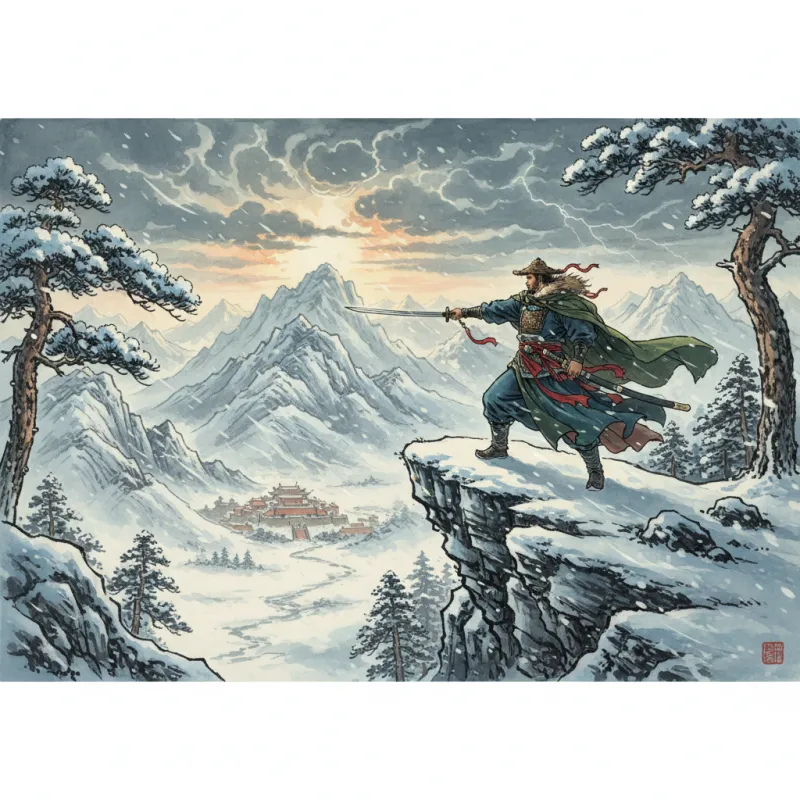
The blade stops mid-swing, frozen in the mountain air. For decades, Jin Yong left readers hanging on that cliffhanger—literally—and it remains one of the most audacious narrative choices in wuxia literature. "Fox Volant of the Snowy Mountain" (雪山飛狐, Xuěshān Fēihú), published in 1959, doesn't just tell a revenge story; it dissects revenge itself, examining whether the sins of fathers should fall upon their children, and whether truth matters when everyone believes a lie.
The Unconventional Structure of a Revenge Tale
Unlike Jin Yong's sprawling epics like The Legend of the Condor Heroes or Demi-Gods and Semi-Devils, "Fox Volant" is remarkably compact—a novella that unfolds almost entirely through flashbacks and conflicting testimonies. The present-day action occurs over mere hours in a remote inn on a snowy mountain, where several martial artists gather and recount the tragic history of the Hu and Miao families. Each narrator brings their own bias, their own version of events from twenty years prior, when Hu Yidao (胡一刀, Hú Yīdāo) died under mysterious circumstances.
This Rashomon-style approach was revolutionary for wuxia fiction in 1959. Jin Yong forces readers to become detectives, piecing together truth from contradiction. Did Miao Renfeng (苗人鳳, Miáo Rénfēng) poison Hu Yidao's blade, or was it Tian Guinong (田歸農, Tián Guīnóng), the supposed friend? The novel presents four different accounts, each plausible, each damning to different parties. By the time we reach the present, Hu Fei (胡斐, Hú Fēi)—Hu Yidao's son—must decide whether to kill Miao Renfeng's daughter, Yuan Ziyi (袁紫衣, Yuán Zǐyī), to complete his revenge.
The Burden of Inherited Vengeance
What makes "Fox Volant" psychologically compelling is how it examines the weight of filial duty (孝, xiào) against personal conscience. Hu Fei grows up believing Miao Renfeng murdered his father through treachery. His entire identity is built around avenging this wrong. But as he learns more—as the testimonies pile up and contradict each other—certainty crumbles. The novel asks: if you're not sure who the villain is, can revenge ever be just?
This theme resonates throughout Jin Yong's work, but nowhere as sharply as here. In The Book and the Sword, Chen Jialuo faces similar moral ambiguity about his Manchu heritage versus his Han Chinese loyalties. But Hu Fei's dilemma is more intimate, more personal. He's fallen in love with Yuan Ziyi, a Buddhist nun who represents everything pure and selfless. To kill her would complete the cycle of revenge his mother demanded with her dying breath. To spare her would betray his father's memory.
Jin Yong offers no easy answers. The novel ends with Hu Fei's blade descending—and then nothing. We never learn whether he strikes or stays his hand. That ambiguity is the point. Revenge, Jin Yong suggests, is a question without a satisfying answer.
Miao Renfeng: The Tragic Hero
While Hu Fei is the protagonist, Miao Renfeng might be the novel's most tragic figure. Known as the "Golden Faced Buddha" (金面佛, Jīnmiàn Fó) for his handsome features and righteous reputation, Miao embodies the wuxia ideal of the honorable warrior. He and Hu Yidao were equals, rivals who respected each other deeply. Their duel on the snowy mountain was meant to determine who was the superior swordsman—a contest of skill, not a fight to the death.
But someone poisoned Hu Yidao's blade. When Miao Renfeng was cut, he should have died. Instead, Hu Yidao collapsed, killed by his own poisoned weapon. For twenty years, Miao Renfeng has lived with the suspicion that he somehow caused his rival's death, even though he knows he didn't poison the blade. His guilt is existential—he survived when his equal died, and the martial arts world whispers that he cheated.
This psychological torment defines Miao Renfeng's character. He's withdrawn from jianghu (江湖, jiānghú), the martial arts world, living in isolation with his daughter. When he finally confronts the truth—that Tian Guinong, his supposed friend, was the poisoner—the revelation destroys him. He's spent two decades mourning a friendship that was always a lie, carrying guilt for a crime he didn't commit. Jin Yong's portrayal of Miao Renfeng's quiet suffering is masterful, showing how reputation and honor can become prisons.
The Women Who Complicate Everything
Yuan Ziyi is not your typical wuxia heroine. She's a Buddhist nun who has renounced worldly attachments, yet she's also a skilled martial artist and the daughter of Miao Renfeng. Her relationship with Hu Fei is charged with impossibility—he's sworn to avenge his father on her family, she's sworn to celibacy and compassion. Their romance is built on stolen glances and unspoken longing, never consummated, never resolved.
Jin Yong uses Yuan Ziyi to explore Buddhist philosophy within the revenge narrative. She represents mercy, forgiveness, and the breaking of karmic cycles. When she learns that Hu Fei is her father's enemy, she doesn't flee or fight—she accepts it with equanimity, understanding that hatred begets hatred. Her presence in the novel is a constant reminder that revenge is a choice, not an obligation.
Contrasting Yuan Ziyi is Hu Fei's mother, who dies demanding that her infant son avenge his father. Her final words chain Hu Fei to a destiny of violence. Jin Yong seems to ask: which woman's wisdom should prevail? The mother who demands blood, or the beloved who offers peace?
The Snowy Mountain as Metaphor
The setting itself—a desolate mountain inn during a blizzard—functions as more than backdrop. The snow represents the cold purity of truth, covering everything equally, obscuring the past. Characters are trapped together, forced to confront their histories, unable to escape until the storm passes. It's a pressure cooker environment where secrets can't stay buried.
Jin Yong frequently uses geography symbolically. The snowy mountain is isolated from jianghu's politics and power struggles, creating a space where only personal honor matters. There are no emperors here, no martial arts sects vying for dominance—just individuals and their choices. This isolation strips away the usual wuxia trappings, leaving only the moral question: what do you do when revenge and righteousness conflict?
The Unresolved Ending: Jin Yong's Boldest Move
That final scene—Hu Fei's blade frozen in mid-strike—remains controversial. Some readers felt cheated, demanding to know what happened. Jin Yong never provided an answer, even when he revised the novel in later editions. He understood that resolving the ending would diminish its power. The ambiguity forces readers to examine their own values. What would you do? What should Hu Fei do?
This open ending influenced countless later works. It demonstrated that wuxia fiction could be literary, could grapple with genuine moral complexity rather than simply delivering satisfying action sequences. Jin Yong proved that sometimes the most honest answer is "I don't know."
Legacy and Influence
"Fox Volant of the Snowy Mountain" may be shorter and less famous than Jin Yong's other novels, but its influence is profound. The Rashomon structure, the psychological depth, the refusal to provide easy answers—these elements elevated wuxia fiction from entertainment to literature. Later writers like Gu Long and Wen Ruian would push these boundaries further, but Jin Yong opened the door.
The novel also spawned a prequel, "The Young Flying Fox" (飛狐外傳, Fēihú Wàizhuàn), which details Hu Fei's adventures before reaching the snowy mountain. Interestingly, the prequel was written after the original but set before it, allowing Jin Yong to develop Hu Fei's character while still preserving the ambiguous ending. It's a testament to how much that unresolved moment mattered to him—he'd rather write around it than resolve it.
For modern readers, "Fox Volant of the Snowy Mountain" offers a compact introduction to Jin Yong's themes and style. It has all his hallmarks—complex morality, tragic heroes, impossible romances, and martial arts that serve character rather than spectacle—condensed into a novella that can be read in a single sitting. Yet it lingers far longer than its page count suggests, that frozen blade haunting the imagination, demanding an answer that will never come.
Related Reading
- Demi-Gods and Semi-Devils: A Complete Guide
- The Legend of the Condor Heroes: A Complete Reader's Guide
- The Book and the Sword: Jin Yong's First Novel
- A Reader's Guide to All 14 Jin Yong Novels
- The Heaven Sword and Dragon Saber: A Complete Guide
- Four-Word Martial Arts Idioms from Jin Yong's Novels
- Exploring the Enigmatic Worlds of Jin Yong's Wuxia Novels
- Exploring the Rich Tapestry of Jin Yong's Wuxia Novels: Characters and Martial Arts