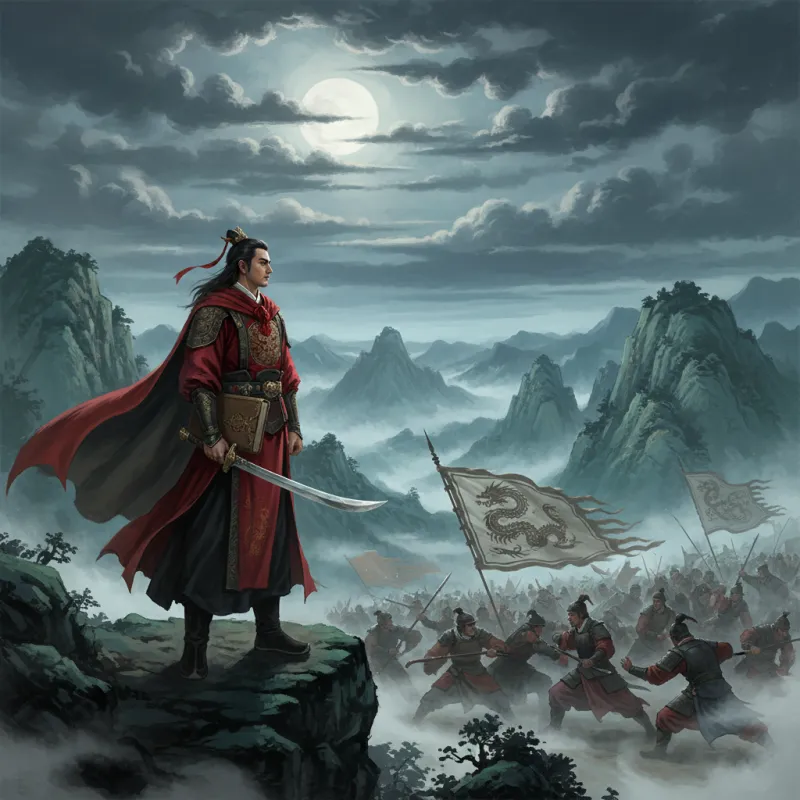
When Jin Yong sat down to write his first novel in 1955, he probably didn't realize he was about to launch a literary phenomenon that would captivate Chinese readers for generations. "The Book and the Sword" (书剑恩仇录, Shū Jiàn Ēn Chóu Lù) emerged as a serialized story in the New Evening Post, and while it may not be his most polished work, it contains the DNA of everything that would make Jin Yong a household name across the Chinese-speaking world.
The Revolutionary Beginning
"The Book and the Sword" wasn't just Jin Yong's debut—it was a statement. Published when the author was only 31 years old, the novel broke away from the traditional wuxia (武侠, martial arts fiction) formula that dominated the genre. Where earlier martial arts novels focused primarily on individual heroism and revenge, Jin Yong wove in layers of political intrigue, ethnic tension, and historical speculation that elevated the genre into something approaching serious literature.
The story centers on Chen Jialuo (陈家洛), the scholarly leader of the Red Flower Society (红花会, Hóng Huā Huì), a secret organization dedicated to overthrowing the Qing Dynasty and restoring Han Chinese rule. But here's where Jin Yong's genius shows even in his first attempt: Chen Jialuo discovers that Emperor Qianlong (乾隆) might actually be his brother, switched at birth with a Han Chinese baby. This revelation transforms what could have been a straightforward rebellion story into a complex meditation on identity, loyalty, and the meaning of justice.
The Qianlong Legend and Historical Speculation
Jin Yong built his entire first novel around one of the most persistent legends in Chinese history—that the Qianlong Emperor was actually Han Chinese, not Manchu. While historians dismiss this as folklore, Jin Yong recognized its narrative power. The idea that the most powerful man in China might be living a lie, that he might secretly sympathize with those who want to overthrow his own dynasty, creates delicious dramatic tension.
This willingness to play with history, to take legends and "what-ifs" seriously, would become a Jin Yong trademark. You can see echoes of this approach in later works like The Deer and the Cauldron, where he again explores the Qing Dynasty through the eyes of a Han Chinese protagonist navigating Manchu power structures.
Characters That Set the Template
Chen Jialuo himself is fascinating precisely because he's flawed in ways that Jin Yong's later heroes would refine. He's intelligent, principled, and skilled in martial arts, but he's also indecisive and somewhat passive. When faced with the choice between his brotherhood oath to the Red Flower Society and his blood relationship with the emperor, Chen Jialuo essentially freezes. He can't bring himself to kill his brother, but he also can't abandon his cause.
Then there's Huo Qingtong (霍青桐) and her sister Kasili (喀丝丽), the Uighur princesses who both fall for Chen Jialuo. This love triangle introduces another Jin Yong staple: the hero torn between multiple women, each representing different values and paths. Huo Qingtong is capable, intelligent, and shares Chen's ideals. Kasili is passionate, impulsive, and ultimately tragic. The romantic subplot doesn't resolve neatly—another Jin Yong signature that would frustrate and fascinate readers throughout his career.
Martial Arts and the Jianghu World
"The Book and the Sword" establishes the jianghu (江湖, the martial arts underworld) as a parallel society with its own codes, hierarchies, and conflicts. The Red Flower Society operates with elaborate rituals, secret signals, and a strict ranking system. Jin Yong describes their martial arts techniques with enough detail to make them feel real, but not so much that the story bogs down in technical minutiae.
The novel introduces several martial arts styles that would become important in Jin Yong's universe, including techniques from the Wudang and Shaolin schools. But more importantly, it establishes that martial arts prowess alone doesn't make someone a hero. Chen Jialuo's greatest challenges aren't physical—they're moral and emotional. This philosophical approach to wuxia would reach its peak in later novels like The Smiling, Proud Wanderer, where the entire plot revolves around the corrupting nature of power.
The Xinjiang Setting and Cultural Complexity
One of the most distinctive aspects of "The Book and the Sword" is its extensive Xinjiang setting. Large portions of the novel take place in the Muslim regions of western China, among the Uighur people. Jin Yong clearly did his research, incorporating details about Islamic customs, Uighur culture, and the complex relationship between the Qing court and its western territories.
This attention to China's ethnic and cultural diversity was unusual for 1950s popular fiction. Jin Yong portrays the Uighur characters with respect and complexity—they're not exotic props but fully realized people with their own political agendas and cultural values. The novel's climax involves Chen Jialuo helping the Uighurs resist Qing oppression, even as he grapples with his personal connection to the Qing emperor.
The Novel's Flaws and Legacy
Let's be honest: "The Book and the Sword" isn't Jin Yong's best work. The pacing drags in places, some plot threads feel underdeveloped, and the ending is frustratingly ambiguous. Chen Jialuo's passivity can be maddening—you want to shake him and tell him to make a decision, any decision.
But these flaws make the novel historically fascinating. You can see Jin Yong learning his craft, experimenting with structure and character development. The seeds of his later masterpieces are all here: the historical settings, the complex heroes, the philosophical depth, the romantic entanglements, the attention to cultural detail.
"The Book and the Sword" sold well enough to encourage Jin Yong to write more, and over the next seventeen years, he would produce fourteen more novels that would define the modern wuxia genre. Without this imperfect but ambitious first attempt, we might never have gotten The Legend of the Condor Heroes or "The Return of the Condor Heroes" or any of the other classics that followed.
Why Read It Today?
So should modern readers tackle "The Book and the Sword"? If you're already a Jin Yong fan, absolutely. It's like listening to a great musician's early recordings—you can hear the raw talent and see the artistic vision taking shape. You'll recognize themes and character types that Jin Yong would refine in later works.
If you're new to Jin Yong, though, you might want to start elsewhere. "The Book and the Sword" rewards readers who already understand what Jin Yong was trying to achieve. It's a fascinating historical document and a genuinely entertaining story, but it's not the most accessible entry point to his work.
What makes "The Book and the Sword" ultimately significant isn't perfection—it's ambition. Jin Yong announced from his very first novel that wuxia fiction could be more than escapist entertainment. It could engage with history, explore moral complexity, and create characters who felt like real people facing impossible choices. That ambition, more than any specific plot point or character, is what makes this first novel worth remembering.
Related Reading
- Journey Through Jin Yong's Wuxia Novels: Martial Arts, Characters, and Cultural Legacy
- Demi-Gods and Semi-Devils: A Complete Guide
- Fox Volant of the Snowy Mountain: A Tale of Revenge
- The Heaven Sword and Dragon Saber: A Complete Guide
- The Complete Guide to Jin Yong: Master of Wuxia Fiction
- Jin Yong Reading Order Guide: Where to Start
- Discovering the Enchanting Locations of Jin Yong's Wuxia Novels
- Jin Yong on Screen: The Best Film Adaptations