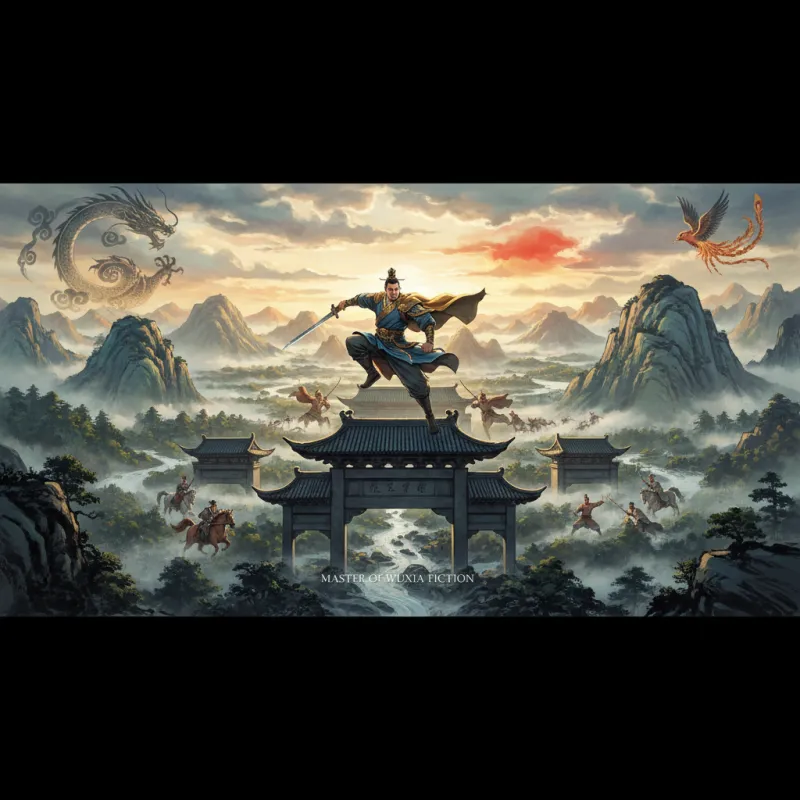
When Louis Cha sat down to write his first wuxia novel in 1955, he was a thirty-one-year-old newspaper editor trying to boost circulation for Hong Kong's New Evening Post. He had no grand literary ambitions, no master plan to reshape Chinese popular culture. He just needed to fill column inches with something people would actually read. Seventeen years and fifteen novels later, he'd created a fictional universe so vast and so deeply embedded in the Chinese imagination that his pen name — Jin Yong (金庸, Jīn Yōng) — became synonymous with the entire wuxia genre itself.
The Man Behind the Pen Name
Louis Cha Leung-yung (查良镛, Zhā Liángyōng) was born in 1924 in Haining, Zhejiang Province, into a family of scholars and landowners. His childhood was steeped in classical Chinese literature — the Romance of the Three Kingdoms, Water Margin, the poetry of the Tang Dynasty. This foundation shows in every page he wrote. Unlike many wuxia writers who treated martial arts fiction as pure entertainment, Jin Yong wove historical events, philosophical debates, and literary allusions into narratives that worked on multiple levels.
He started writing The Book and the Sword (書劍恩仇錄, Shū Jiàn Ēnchóu Lù) as a serialized novel in 1955, publishing installments daily in his newspaper. The response was immediate and overwhelming. Readers lined up at newsstands, desperate to know what happened next. Jin Yong had stumbled onto something powerful: wuxia fiction that didn't just deliver fight scenes and revenge plots, but explored questions of loyalty, identity, and what it means to be Chinese in a world where empires rise and fall.
Between 1955 and 1972, he wrote fifteen novels, most of them serialized in newspapers he owned or edited. Then he stopped. Just stopped. He spent the next two decades revising his works, tightening plots, deepening characters, removing inconsistencies. The revised editions are the ones most readers know today, and they're remarkably polished for what began as daily newspaper serials written under crushing deadlines.
The Fifteen Novels: A Reading Order
Jin Yong's novels aren't a continuous series, but they share a universe. Characters from one novel occasionally appear in another. Martial arts techniques get passed down through generations. The martial arts sects maintain their rivalries across centuries. Here's the chronological order by internal timeline, not publication date:
The Sword of the Yue Maiden (越女劍, Yuè Nǚ Jiàn) — Set during the Spring and Autumn period (771-476 BCE), this short story stands apart from the rest, a mythic origin tale for Chinese swordsmanship.
The Book and the Sword (書劍恩仇錄, Shū Jiàn Ēnchóu Lù) — Qing Dynasty, 18th century. Jin Yong's first novel follows the Red Flower Society's attempts to overthrow the Manchu rulers. It's rough around the edges but shows flashes of the brilliance to come.
Fox Volant of the Snowy Mountain (雪山飛狐, Xuěshān Fēihú) and The Young Flying Fox (飛狐外傳, Fēihú Wàizhuàn) — Mid-Qing Dynasty. These companion novels tell the story of the Hu family across two generations, with the first novel famously ending on an unresolved cliffhanger that Jin Yong never definitively answered.
The Deer and the Cauldron (鹿鼎記, Lù Dǐng Jì) — Early Qing Dynasty, during the Kangxi Emperor's reign. Jin Yong's final and most subversive novel features Wei Xiaobao, a protagonist who can't do martial arts, lies constantly, and succeeds through cunning rather than righteousness. It's a deliberate deconstruction of everything the genre stands for.
Sword Stained with Royal Blood (碧血劍, Bìxuě Jiàn) — Late Ming Dynasty, as the dynasty collapses. A darker, more tragic novel about the costs of loyalty and the futility of trying to save a doomed regime.
The Legend of the Condor Heroes (射鵰英雄傳, Shè Diāo Yīngxióng Zhuàn) — Southern Song Dynasty, 13th century. This is where most readers should start. Guo Jing's journey from simple-minded boy to legendary hero is Jin Yong's most accessible and beloved work.
The Return of the Condor Heroes (神鵰俠侶, Shén Diāo Xiá Lǚ) — Continues the Condor trilogy. Yang Guo and Xiaolongnü's forbidden romance scandalized readers in the 1960s and remains one of the most emotionally complex relationships in the entire corpus.
The Heaven Sword and Dragon Saber (倚天屠龍記, Yǐtiān Túlóng Jì) — Concludes the Condor trilogy in the late Yuan Dynasty. Zhang Wuji's indecisiveness with women has frustrated readers for decades, but the novel's exploration of martial arts philosophy is unmatched.
Demi-Gods and Semi-Devils (天龍八部, Tiānlóng Bābù) — Northern Song Dynasty, 11th century. Jin Yong's most ambitious novel follows three protagonists whose fates intertwine across a sprawling narrative about identity, destiny, and the Buddhist concept of suffering.
Ode to Gallantry (俠客行, Xiákè Xíng) — Yuan Dynasty. A lighter novel about a nameless protagonist who accidentally becomes the most powerful martial artist in the world by misunderstanding a set of martial arts manuals.
The Smiling, Proud Wanderer (笑傲江湖, Xiào Ào Jiānghú) — Ming Dynasty (deliberately vague). A political allegory about power, orthodoxy, and the corruption of martial arts sects. Linghu Chong remains one of Jin Yong's most beloved protagonists.
Duke of Mount Deer — Already mentioned above, but worth repeating: this is Jin Yong's farewell to the genre, and he went out by gleefully demolishing every convention he'd spent seventeen years building.
What Makes Jin Yong Different
Plenty of writers produced wuxia fiction before Jin Yong. Huanzhu Louzhu's Legend of the Swordsmen of the Mountains of Shu ran to millions of words. Gu Long wrote faster and died younger, leaving behind dozens of novels. Liang Yusheng was Jin Yong's contemporary and rival. But none of them achieved what Jin Yong did, and the reason comes down to craft.
Jin Yong understood structure. His novels build momentum through carefully orchestrated revelations. A throwaway detail in chapter five becomes crucial in chapter fifty. A minor character introduced for comic relief turns out to be connected to the main plot in ways that recontextualize everything you've read. He learned this from classical Chinese novels like Dream of the Red Chamber, where every scene serves multiple purposes and nothing is wasted.
He also understood character psychology in ways most wuxia writers didn't bother with. Guo Jing isn't just "the righteous hero" — he's a man whose simplicity is both his greatest strength and his tragic flaw. Yang Guo's arrogance masks deep insecurity about his father's reputation. Qiao Feng's entire identity shatters when he discovers his true heritage, and the novel doesn't shy away from the psychological devastation that follows. These aren't archetypes; they're people.
And then there's the prose itself. Jin Yong wrote in vernacular Chinese, accessible to ordinary readers, but he peppered his narratives with classical poetry, historical allusions, and philosophical debates that rewarded educated readers without alienating everyone else. A teenager could read The Legend of the Condor Heroes for the adventure. A literature professor could read it for the intertextual references to Tang poetry and Song Dynasty history. Both would be satisfied.
The Cultural Impact
Three hundred million copies sold. That's the official number, though it doesn't account for pirated editions, which probably double or triple that figure. Jin Yong's novels have been adapted into over a hundred films and television series. There are Jin Yong video games, theme parks, academic conferences, university courses. The Chinese government has issued stamps featuring his characters.
But the real impact is harder to quantify. Jin Yong's novels shaped how Chinese people think about their own history and identity. His Song Dynasty heroes fighting against Mongol invaders resonated with readers who'd lived through Japanese occupation and civil war. His Qing Dynasty stories about Han Chinese under Manchu rule spoke to questions of ethnic identity that remain sensitive today. His martial arts sects, with their rigid hierarchies and internal politics, became metaphors for every organization from corporations to governments.
Walk into any Chinese bookstore, and you'll find his complete works prominently displayed. Mention a character's name in conversation, and people will immediately understand what you're referencing — not just the character, but the values they represent. Say someone is "like Guo Jing," and you're calling them honest but perhaps a bit slow. Call someone "Huang Rong," and you're saying they're clever and resourceful. These references work across generations and geographic boundaries in ways that few other fictional universes achieve.
Where to Start
If you're new to Jin Yong, start with The Legend of the Condor Heroes. It's his most accessible novel, with a clear hero's journey structure, memorable supporting characters, and enough plot twists to keep you hooked. The romance between Guo Jing and Huang Rong is genuinely charming, and the martial arts sequences are spectacular without being overwhelming.
From there, move to The Return of the Condor Heroes if you want more emotional complexity, or jump to Demi-Gods and Semi-Devils if you want Jin Yong at his most ambitious. Save The Deer and the Cauldron for last — it's brilliant, but it works best when you understand all the conventions it's subverting.
Don't worry too much about reading order. The novels stand alone. You'll catch more references and connections if you read chronologically, but Jin Yong wrote each novel to be someone's first Jin Yong novel. He knew most readers would encounter his work through whatever happened to be serialized in their local newspaper.
The Translation Challenge
Here's the hard truth: if you don't read Chinese, you're missing something essential. Jin Yong's prose is dense with wordplay, classical allusions, and linguistic tricks that don't survive translation. Character names often have meanings that inform their personalities. Martial arts technique names are poetic in Chinese but sound ridiculous in English. The rhythm of his sentences, the way he shifts between vernacular and classical registers — it's all lost.
That said, translations exist and keep improving. Anna Holmwood's translation of Legends of the Condor Heroes (the first volume of the trilogy) is excellent, capturing more of Jin Yong's voice than previous attempts. More volumes are coming. If you're serious about understanding Jin Yong's impact on Chinese culture, learning to read Chinese is worth it just for access to his novels. That's not an exaggeration — his work is that central to modern Chinese literature.
Why Jin Yong Still Matters
Jin Yong died in 2018 at age ninety-four. The outpouring of grief across the Chinese-speaking world was immediate and genuine. People who'd never met him mourned like they'd lost a family member. Because in a sense, they had. His characters had been their companions through childhood, adolescence, adulthood. His stories had taught them about loyalty, sacrifice, love, and loss.
But his legacy isn't just nostalgia. New readers discover his novels every year. Television adaptations continue to be produced, each generation reinterpreting his characters for contemporary audiences. His influence on Chinese fantasy literature is so pervasive that it's almost invisible — every wuxia novel written after 1972 exists in conversation with Jin Yong, either following his template or deliberately breaking from it.
In the West, we talk about Tolkien creating modern fantasy or George R.R. Martin subverting it. Jin Yong did both, for a readership larger than either of them could imagine. He took a pulp genre and elevated it to literature without losing the pulse-pounding excitement that made it popular in the first place. He created characters who feel real and stories that matter, all while meeting daily newspaper deadlines and running a media empire.
That's the real achievement. Not just that he wrote fifteen novels, but that he wrote fifteen novels that continue to shape how over a billion people imagine heroism, romance, and what it means to live righteously in a complicated world. Start with The Legend of the Condor Heroes. Thank me later.
Related Reading
- The Smiling, Proud Wanderer: A Complete Guide
- The Legend of the Condor Heroes: A Complete Reader's Guide
- A Reader's Guide to All 14 Jin Yong Novels
- The Deer and the Cauldron: Jin Yong's Comic Masterpiece
- The Book and the Sword: Jin Yong's First Novel
- Exploring the Rich Tapestry of Jin Yong's Wuxia Novels: Characters and Martial Arts
- How the Condor Trilogy Connects: Characters, Weapons, and Secrets Across 155 Years
- Jin Yong References in Modern Chinese Daily Life