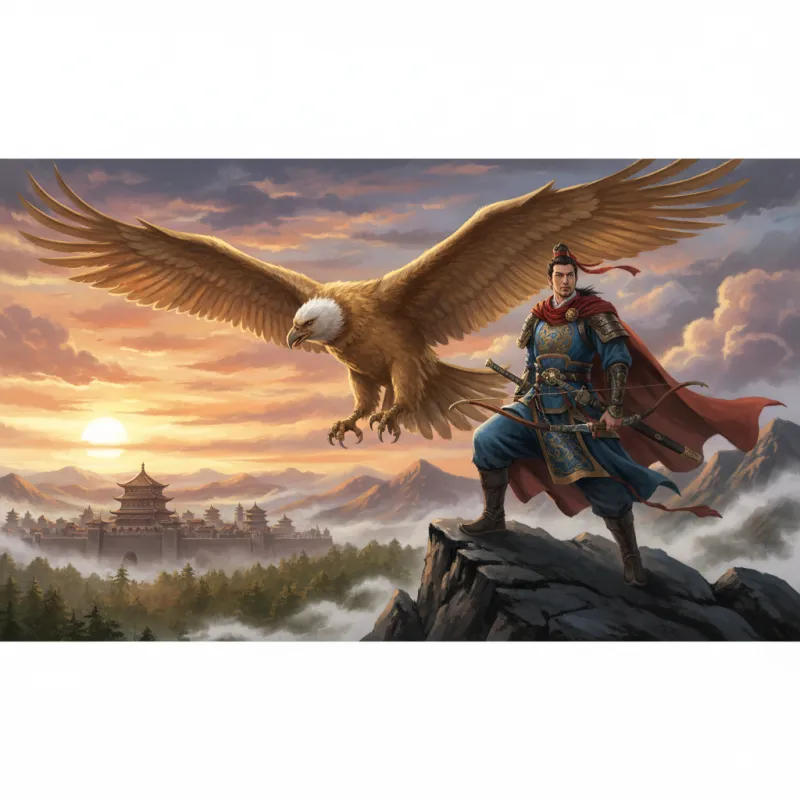
When Guo Jing first draws his bow on the Mongolian steppe, he's aiming at more than just a target — he's launching the entire trajectory of Jin Yong's literary empire. 射雕英雄传 (Shèdiāo Yīngxióng Zhuàn), The Legend of the Condor Heroes, isn't just Jin Yong's breakthrough novel; it's the foundation upon which his entire fictional universe rests. Published serially in Ming Pao from 1957 to 1959, this is the novel that transformed Louis Cha from a newspaper editor into 金庸 (Jīn Yōng), the undisputed master of wuxia fiction. And here's the thing: seventy years later, it still holds up.
Why This Novel Changed Everything
Before Condor Heroes, wuxia novels were pulp entertainment — formulaic revenge tales with interchangeable heroes performing impossible feats. Jin Yong took the genre's bones and gave it a soul. He grounded his martial arts in recognizable human emotion, set his story against the vast canvas of the Mongol conquest, and created characters who felt like people you might actually know. Guo Jing (郭靖 Guō Jìng) isn't a genius or a chosen one — he's stubborn, loyal, and frankly not that bright. Huang Rong (黄蓉 Huáng Róng) is brilliant and manipulative, using her wits to survive in a world that would rather she stay decorative and quiet.
The novel's genius lies in its structure. Jin Yong weaves together three narrative threads: Guo Jing's coming-of-age journey from the steppes to the Central Plains, the political machinations of the Song-Jin-Mongol conflict, and the romantic comedy of two young people who shouldn't work together but absolutely do. Each thread strengthens the others. The romance gives stakes to the political drama; the historical backdrop gives weight to personal choices; the martial arts sequences become expressions of character rather than mere spectacle.
This is also where Jin Yong established his signature move: the 武林 (wǔlín) — the martial arts world — as a complete society with its own rules, hierarchies, and moral codes that both mirror and critique the political world. The Five Greats (五绝 Wǔjué) aren't just powerful fighters; they represent different philosophies of power and its use.
The Story You Need to Know
The plot spans roughly twenty years, from 1205 to 1227, covering the rise of Genghis Khan and the twilight of the Southern Song Dynasty. Guo Jing is born in Mongolia after his father is murdered by corrupt Song officials. Raised among the Mongols, he becomes sworn brother to Temujin (the future Genghis Khan) and learns archery from the legendary 哲别 (Zhébié). His mother makes him swear to return to the Song lands and avenge his father — a promise that will eventually force him to choose between his Mongolian family and his Chinese heritage.
Meanwhile, in Jiangnan, Huang Rong grows up as the daughter of 黄药师 (Huáng Yàoshī), the Heretical Eastern Master, one of the Five Greats. Brilliant, spoiled, and desperate for her father's attention, she runs away from Peach Blossom Island disguised as a beggar boy. When she meets the earnest, clueless Guo Jing, it's a collision of opposites that somehow generates chemistry.
The novel's central conflict revolves around the 武穆遗书 (Wǔmù Yíshū), a military treatise by the Song general Yue Fei, and the question of what loyalty means when your homeland is corrupt and your adopted family is the invading force. Guo Jing must navigate between the Mongol court (where he's trusted), the Song court (where he's suspected), and the martial arts world (where everyone wants to use him for their own purposes).
Characters Who Actually Matter
Guo Jing is the anti-protagonist. He's slow to learn, terrible at reading social cues, and his idea of strategy is "try harder." But his absolute sincerity and unwavering moral compass make him magnetic. He's the guy who will spend three years learning a technique that a genius would master in three months, and somehow that makes his eventual mastery more satisfying. His signature martial art, the 降龙十八掌 (Jiàngláng Shíbā Zhǎng) — the Eighteen Dragon-Subduing Palms — is perfectly suited to his character: straightforward, powerful, and requiring more determination than cleverness.
Huang Rong is the novel's secret weapon. She's manipulative, yes, but in a world where women have almost no agency, her schemes are survival tools. She's also genuinely kind to those she loves and ruthlessly protective of Guo Jing. The novel never punishes her for being smart or ambitious — instead, it shows how her intelligence complements Guo Jing's integrity. Their relationship works because neither tries to change the other; they just make space for each other's strengths.
The supporting cast is where Jin Yong's world-building shines. The Seven Freaks of Jiangnan (江南七怪 Jiāngnán Qī Guài) are Guo Jing's teachers — eccentric, quarrelsome, and ultimately outmatched by the story's real masters, but their loyalty to their student never wavers. 洪七公 (Hóng Qīgōng), the Northern Beggar and leader of the Beggar Clan, is a gourmand who trades martial arts lessons for Huang Rong's cooking. 欧阳锋 (Ōuyáng Fēng), the Western Venom, is the novel's most compelling villain — not because he's evil, but because he's so thoroughly committed to his own twisted logic.
And then there's 杨康 (Yáng Kāng), Guo Jing's sworn brother and narrative foil. Raised as a Jin prince, Yang Kang chooses comfort and status over truth and honor at every turn. His tragedy isn't that he's weak — it's that he's just clever enough to rationalize his choices but not wise enough to see where they lead. His relationship with 穆念慈 (Mù Niàncí) is one of the novel's most heartbreaking subplots, and his fate sets up the entire premise of The Return of the Condor Heroes.
The Martial Arts That Define the Genre
Jin Yong uses martial arts as character development. The 九阴真经 (Jiǔyīn Zhēnjīng) — the Nine Yin Manual — is the novel's MacGuffin, a legendary text that everyone wants but few can properly use. It's not just powerful; it's dangerous, capable of driving practitioners mad if they don't have the right foundation. This becomes a recurring theme in Jin Yong's work: power without wisdom is corruption.
The novel's best martial arts sequences aren't the flashiest — they're the ones that reveal character. When Guo Jing finally masters the Eighteen Dragon-Subduing Palms, it's not because he learned some secret technique; it's because Hong Qigong helped him understand that the palms' power comes from righteousness and conviction. When Huang Rong uses the 打狗棒法 (Dǎgǒu Bàngfǎ) — the Dog-Beating Staff Technique — it's all about misdirection and adaptability, perfectly matching her personality.
The Five Greats represent different martial philosophies. 王重阳 (Wáng Chóngyáng), the Central Divine, practiced Daoist internal cultivation. Huang Yaoshi, the Eastern Heretic, created his own unorthodox techniques based on music and mathematics. Hong Qigong's Beggar Clan techniques emphasize simplicity and directness. Ouyang Feng's Toad Stance is all about overwhelming force and poison. 段智兴 (Duàn Zhìxīng), the Southern Emperor, uses Buddhist martial arts focused on compassion. Their philosophical differences drive the plot as much as their actual fights.
Historical Context That Grounds the Fantasy
Jin Yong sets his story during one of Chinese history's most traumatic periods: the Mongol conquest. The Southern Song Dynasty is in terminal decline, its court riddled with corruption and its military weakened by decades of appeasement. The Jin Dynasty, which conquered northern China a century earlier, is now being crushed by the rising Mongol Empire. And Genghis Khan is in the process of building the largest contiguous land empire in history.
This isn't just backdrop — it's the novel's moral engine. Guo Jing's eventual choice to defend Xiangyang (襄阳 Xiāngyáng) against the Mongols, despite his personal ties to the Mongol court, becomes the defining moment of his character. The novel asks: what do you owe to a corrupt government that represents your people? What do you owe to a foreign power that treated you with honor? Jin Yong doesn't offer easy answers, but he makes clear that Guo Jing's choice to defend the common people of Xiangyang, regardless of who rules them, is the right one.
The historical figures who appear — Genghis Khan, 托雷 (Tuōléi), Jebe — are portrayed with nuance. Genghis Khan is brutal and ambitious, yes, but also charismatic and capable of genuine affection for Guo Jing. The novel doesn't demonize the Mongols or romanticize the Song; it shows both as complex political entities with their own internal contradictions.
Why You Should Read This First
If you're new to Jin Yong, The Legend of the Condor Heroes is the perfect entry point. It's more accessible than Demi-Gods and Semi-Devils, more focused than The Deer and the Cauldron, and more optimistic than The Smiling, Proud Wanderer. The romance actually works, the hero is genuinely heroic, and the ending feels earned rather than tragic.
But it's also the foundation for understanding Jin Yong's later, more complex work. The sequel, The Return of the Condor Heroes, deliberately subverts everything this novel establishes — taking the son of the villain and making him the protagonist, questioning whether righteousness is always right, exploring what happens when the hero's children don't live up to their legacy. You can't fully appreciate that subversion without understanding what's being subverted.
The novel also establishes the geography and history of Jin Yong's fictional universe. Peach Blossom Island, the Beggar Clan, the rivalry between the Song and Jin — these elements recur throughout his work. Characters from this novel appear in later stories, and events here cast long shadows. When you read about the fall of Xiangyang in The Heaven Sword and Dragon Saber, it hits harder because you remember Guo Jing and Huang Rong's determination to defend it.
The Translation Question
English readers have several translation options, and they're not all equal. The official translation by Anna Holmwood and Gigi Chang (published by St. Martin's Press as A Hero Born, A Bond Undone, A Snake Lies Waiting, and A Heart Divided) is readable and accessible, though it sometimes smooths over the novel's rougher edges. The fan translations are more literal but can be clunky. Whichever version you choose, you're getting a story that has captivated readers for nearly seventy years — and will likely captivate you too.
The novel's influence extends far beyond literature. It's been adapted into films, TV series, comics, video games, and even theme park attractions. The 1983 TVB adaptation starring Felix Wong and Barbara Yung is considered definitive by many fans, though the 2003 and 2017 versions have their advocates. But no adaptation can quite capture the novel's scope and depth — the way Jin Yong balances action and introspection, romance and politics, individual choice and historical inevitability.
Start here. Meet Guo Jing on the steppe, watch him stumble through his first encounters with the martial arts world, see him fall in love with the girl who's too smart for him, and follow him as he grows from a naive boy into the Defender of Xiangyang. This is where Jin Yong's legend begins — and where yours should too.
Related Reading
- A Reader's Guide to All 14 Jin Yong Novels
- The Smiling, Proud Wanderer: A Complete Guide
- Demi-Gods and Semi-Devils: A Complete Guide
- The Heaven Sword and Dragon Saber: A Complete Guide
- Fox Volant of the Snowy Mountain: A Tale of Revenge
- The Art of Duels in Jin Yong's Wuxia Novels: A Journey Through Martial Valor
- The Xiao Ao Jianghu Theme Song: Music as Philosophy
- Exploring the Rich Tapestry of Jin Yong's Wuxia Novels and Their Enduring Legacy