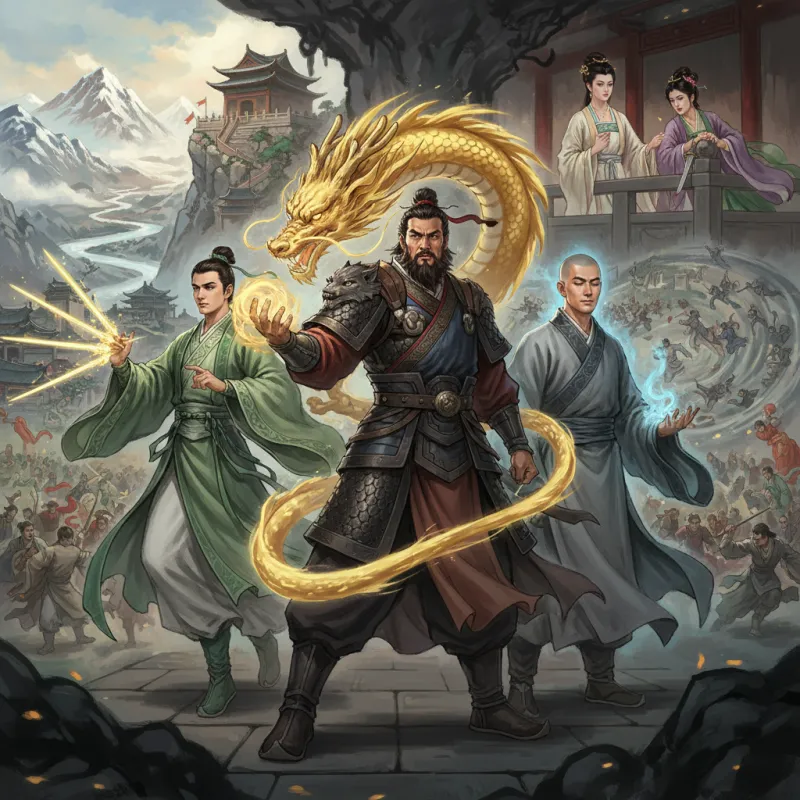
What if I told you the most devastating character in Jin Yong's universe isn't a villain at all — but a man who spends the entire novel trying to do the right thing and fails spectacularly every single time? That's 天龙八部 (Tiānlóng Bābù), Demi-Gods and Semi-Devils, in a nutshell: a 1,300-page meditation on how good intentions, ethnic hatred, and cosmic bad luck can destroy everyone you love. Jin Yong wrote this between 1963-1966, and it remains his most ambitious, most Buddhist, and most emotionally punishing work. If The Legend of the Condor Heroes is his crowd-pleaser and The Deer and the Cauldron is his subversive comedy, Demi-Gods is his tragedy — the one where he looked at the wuxia genre and said, "What if nobody wins?"
Three Protagonists, Three Disasters
Most Jin Yong novels give you one hero. Demi-Gods gives you three, and then systematically destroys each one in a different way.
段誉 (Duàn Yù) is the prince of Dali who refuses to learn martial arts because he's a devout Buddhist. Naturally, he stumbles into the 北冥神功 (Běimíng Shéngōng) and 凌波微步 (Língbō Wēibù) — two of the most overpowered techniques in the entire Jin Yong canon — purely by accident. He spends the novel falling in love with women who turn out to be his half-sisters. Yes, plural. Jin Yong really said "let's make this boy suffer in the most awkward way possible."
虚竹 (Xū Zhú) is a Shaolin monk so rule-bound he apologizes for breathing too loudly. Then he accidentally becomes the leader of the 逍遥派 (Xiāoyáo Pài), inherits 70+ years of internal energy from two dying masters, and ends up sleeping with a princess while blindfolded. His entire character arc is "devout monk has cosmic joke played on him by the universe." He's also the only protagonist who gets a genuinely happy ending, which tells you everything about Jin Yong's sense of irony.
萧峰 (Xiāo Fēng), also known as 乔峰 (Qiáo Fēng), is the chief of the Beggars' Sect and the novel's emotional core. He's the righteous hero everyone admires — until they discover he's ethnically Khitan, not Han Chinese. What follows is the most brutal examination of racism and ethnic identity in any Jin Yong novel. Xiao Feng doesn't change; the world's perception of him does. He goes from beloved hero to "barbarian spy" overnight, and Jin Yong forces you to watch as every relationship in his life disintegrates. His ending — standing between two armies, trying to prevent a war by threatening his own adoptive father — is the most tragic scene Jin Yong ever wrote.
The Title Isn't Just Decoration
天龙八部 (Tiānlóng Bābù) literally means "eight groups of demi-gods and semi-devils" — a term from Buddhist cosmology referring to eight classes of non-human beings who protect the dharma: devas (天 tiān), nagas (龙 lóng), yakshas (夜叉 yèchā), gandharvas (乾闼婆 gāntàpó), asuras (阿修罗 āxiūluó), garudas (迦楼罗 jiālóuluó), kinnaras (紧那罗 jǐnnàluó), and mahoragas (摩睺罗伽 móhóuluójiā). These beings have supernatural powers but are still trapped in samsara, the cycle of suffering.
Jin Yong maps major characters onto these categories. Xiao Feng is the deva — powerful, righteous, but doomed by his karma. 阿紫 (Ā Zǐ), the obsessive, self-destructive girl who blinds herself for love, is the asura. 鸠摩智 (Jiūmózhì), the Tibetan monk who goes mad pursuing martial arts, is the yaksha. The novel's message is embedded in the title: everyone — heroes, villains, monks, princes — is trapped by desire, hatred, and delusion. Nobody escapes.
This is Jin Yong at his most Buddhist. Unlike The Smiling, Proud Wanderer, which is about Daoist freedom, Demi-Gods is about Buddhist suffering. Every character wants something they can't have. Every victory is temporary. The novel's philosophy isn't "good triumphs over evil" — it's "everyone suffers, and attachment makes it worse."
The Villains Are More Interesting Than the Heroes
Jin Yong packed this novel with antagonists who are more compelling than half his protagonists. 慕容复 (Mùróng Fù) is the fallen prince obsessed with restoring his kingdom of Yan — a kingdom that fell 400 years ago. He's the anti-Xiao Feng: both are defined by ethnic identity, but while Xiao Feng transcends it, Murong Fu is consumed by it. His descent into madness — ending with him playing emperor in a ruined garden, surrounded by imaginary subjects — is pathetic and horrifying.
Then there's 段延庆 (Duàn Yánqìng), the "Most Evil" of the Four Villains, who turns out to be Duan Yu's real father and the rightful king of Dali. He's a grotesque figure — crippled, face destroyed, communicating through ventriloquism — but Jin Yong gives him unexpected dignity. His final scene, where he chooses to disappear rather than reclaim his throne, is quietly devastating.
And 丁春秋 (Dīng Chūnqiū), the "Old Freak of Xingxiu," is pure theatrical villainy — a narcissistic cult leader who travels with disciples who sing his praises constantly. He's comic relief and genuine threat simultaneously, which is harder to pull off than it sounds.
The Martial Arts Are Genuinely Insane
Jin Yong went absolutely wild with the power scaling in this novel. The 六脉神剑 (Liùmài Shénjiàn) — Six Meridians Divine Sword — shoots invisible sword energy from your fingertips. The 北冥神功 (Běimíng Shéngōng) absorbs other people's internal energy like a martial arts vampire. The 天山折梅手 (Tiānshān Zhéméi Shǒu) and 天山六阳掌 (Tiānshān Liùyáng Zhǎng) are techniques so versatile they counter almost everything.
Then there's the 逍遥派 (Xiāoyáo Pài) — the Carefree Sect — whose founder created techniques based on Daoist philosophy and then disappeared, leaving behind three disciples who all hate each other. This sect produces 无崖子 (Wú Yázǐ), who transfers 70 years of power to Xu Zhu via a bizarre chess puzzle, and 天山童姥 (Tiānshān Tónglǎo), a 96-year-old woman who looks like a child and has the most terrifying personality in the novel.
The martial arts in Demi-Gods are less about technique and more about cosmic power. Characters don't just fight — they manipulate internal energy, project force fields, and occasionally explode from too much qi. It's Jin Yong's most fantastical combat system, which makes sense for a novel named after Buddhist supernatural beings.
Why Adaptations Keep Failing
Demi-Gods and Semi-Devils has been adapted into TV series at least eight times, and none of them fully work. The 1997 TVB version with Felix Wong is beloved but dated. The 2003 version with Hu Jun as Xiao Feng is considered the most faithful. The 2013 version with Kim Ki-bum tried to make it prettier and lost the emotional weight. The 2021 version was... let's not talk about the 2021 version.
The problem is structural. The novel has three protagonists whose stories only intersect occasionally, a dozen major villains with complex backstories, and a philosophical framework that doesn't translate to screen. Xiao Feng's tragedy requires you to understand Song-Liao ethnic tensions in the 11th century. Xu Zhu's comedy requires you to appreciate Buddhist monastic rules. Duan Yu's romance requires you to track a family tree so complicated it needs a flowchart.
Most adaptations solve this by focusing on Xiao Feng and cutting everything else, which is understandable but means you lose the novel's scope. Demi-Gods isn't just Xiao Feng's tragedy — it's a panoramic view of how desire and hatred trap everyone, from emperors to beggars.
The Ending Nobody Wanted But Everyone Needed
Jin Yong doesn't do happy endings in Demi-Gods and Semi-Devils. Xiao Feng kills himself to prevent a war. Duan Yu becomes king but loses the woman he loves. Xu Zhu gets his princess but abandons his Buddhist vows. 阿朱 (Ā Zhū), the novel's most beloved character, dies in a case of mistaken identity that destroys Xiao Feng emotionally. Her sister A Zi blinds herself and jumps off a cliff holding Xiao Feng's corpse.
It's bleak. It's also honest. Jin Yong wrote this novel during a period of personal turmoil — his son had recently died — and you can feel the grief in every page. Demi-Gods asks: what if being a hero isn't enough? What if good intentions, martial arts mastery, and moral righteousness can't save you from a world built on hatred and misunderstanding?
The novel's final image is Xu Zhu riding away with his princess, the only protagonist who gets happiness — and he gets it precisely because he stopped trying to be good and accepted his flawed, human self. That's the Buddhist message: attachment to righteousness is still attachment. Let go, or suffer.
Demi-Gods and Semi-Devils isn't Jin Yong's most popular novel, but it might be his most profound. It's the one where he stopped writing adventure stories and started writing about the human condition — with flying monks and finger lasers, sure, but the pain is real.
Related Reading
- The Book and the Sword: Jin Yong's First Novel
- The Smiling, Proud Wanderer: A Complete Guide
- The Deer and the Cauldron: Jin Yong's Comic Masterpiece
- Fox Volant of the Snowy Mountain: A Tale of Revenge
- The Legend of the Condor Heroes: A Complete Reader's Guide
- Exploring the Enigmatic Worlds of Jin Yong's Wuxia Novels
- The Five Greats Across All Generations: How the Rankings Changed
- Jin Yong's Global Influence: How Wuxia Went Worldwide