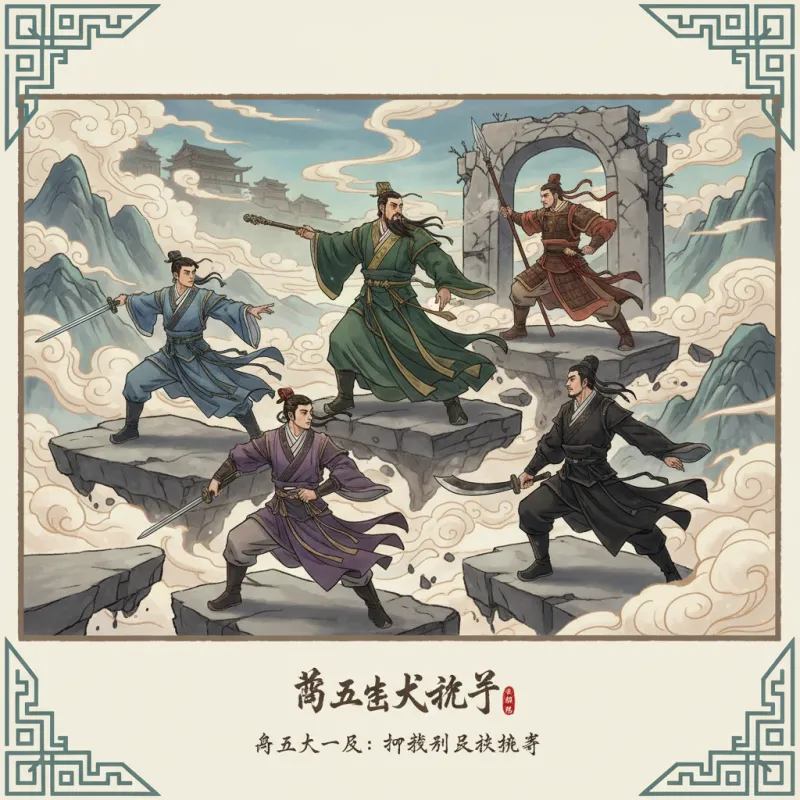
Who would win in a fight: the greatest martial artist of one generation, or the fifth-best of the next? Jin Yong forces us to ask this question by doing something most wuxia authors avoid — he actually tracks how power shifts across time. The Five Greats (五绝 Wǔjué) aren't just a ranking system. They're a statement about mortality, legacy, and the uncomfortable truth that even legends get replaced.
The Original Five: When the System Made Perfect Sense
The first generation of Five Greats appears in Legend of the Condor Heroes (射雕英雄传 Shèdiāo Yīngxióng Zhuàn), and they're exactly what you'd expect from a formal ranking: five masters at the absolute peak of their abilities, each representing a cardinal direction and a distinct martial philosophy.
Eastern Heretic Wang Chongyang (东邪 Dōng Xié Wáng Chóngyáng) — no wait, that's wrong already. Wang Chongyang was Central Divinity (中神通 Zhōng Shéntōng), the undisputed number one who won the Nine Yin Manual (九阴真经 Jiǔyīn Zhēnjīng) at the first Mount Hua tournament. Eastern Heretic was Huang Yaoshi (黄药师 Huáng Yàoshī), the eccentric genius of Peach Blossom Island. Western Venom was Ouyang Feng (欧阳锋 Ōuyáng Fēng), the ambitious schemer. Southern Emperor was Duan Zhixing (段智兴 Duàn Zhìxīng), the Dali prince who became a monk. Northern Beggar was Hong Qigong (洪七公 Hóng Qīgōng), leader of the Beggar Clan.
This lineup worked because it balanced geography, personality, and martial style. More importantly, it was earned — these five fought at Mount Hua and proved themselves. The system had legitimacy. When Wang Chongyang died, the remaining four maintained an uneasy equilibrium, none quite able to claim absolute supremacy.
The Second Generation: When Everything Got Complicated
By Return of the Condor Heroes (神雕侠侣 Shén Diāo Xiálǚ), the original Five Greats are mostly dead or retired, and the ranking becomes messy in fascinating ways. This is where Jin Yong reveals his real interest — not in static power levels, but in how reputations are built, contested, and inherited.
The new Five Greats include some holdovers and some newcomers, but the selection process is far less clear. Zhou Botong (周伯通 Zhōu Bótōng) becomes Central Divinity, which makes sense given his mastery of multiple supreme techniques. Huang Yaoshi remains Eastern Heretic. Ouyang Feng, despite going insane, is still considered Western Venom — his raw power hasn't diminished even if his mind has. Yideng (一灯 Yīdēng, formerly Duan Zhixing) continues as Southern Emperor. Northern Beggar transitions from Hong Qigong to his successor.
But here's where it gets interesting: Yang Guo (杨过 Yáng Guò) and Xiaolongnü (小龙女 Xiǎolóngnǚ) are clearly at Five Greats level by the end of the novel, yet they're never formally included in the ranking. Why? Because they don't participate in the jianghu's social structures. They don't attend the gatherings, don't compete for recognition, don't care about titles. The Five Greats system, it turns out, isn't just about martial ability — it's about participation in the martial world's status games.
The Third Generation: When the System Breaks Down Completely
By Heaven Sword and Dragon Saber (倚天屠龙记 Yǐtiān Túlóng Jì), set decades later, the Five Greats system has essentially collapsed. There's no formal ranking, no Mount Hua tournament, no consensus about who the top fighters are. Why?
First, the martial world has fragmented. The Mongol conquest has disrupted traditional power structures. The major sects are focused on survival and resistance rather than status competitions. Second, the supreme martial arts have proliferated — the Nine Yang Manual (九阳真经 Jiǔyáng Zhēnjīng), the Nine Yin Manual, and techniques from the Heaven Sword and Dragon Saber are scattered across multiple practitioners. There's no longer a clear hierarchy of techniques that maps onto a hierarchy of people.
Third, and most importantly, the generation that remembered the original Five Greats is gone. Zhang Sanfeng (张三丰 Zhāng Sānfēng) is the only living link to that era, and he's deliberately stayed outside the ranking system his entire life. Without institutional memory, without agreed-upon rules for succession, the system simply fades away.
Zhang Wuji (张无忌 Zhāng Wújì) is probably the strongest martial artist of his generation, but nobody calls him a "Great" of any direction. The title has lost its meaning. This isn't a failure of the system — it's Jin Yong showing us that all such systems are temporary, dependent on specific social conditions that don't last forever.
What the Rankings Actually Measured
Here's what's easy to miss: the Five Greats were never purely about combat ability. If they were, the rankings would have changed more often and more dramatically. Hong Qigong admits that Huang Yaoshi might be slightly better than him, but both remain in the Five Greats because the ranking measures something more complex than "who would win in a fight."
The Five Greats measured a combination of: peak martial ability, breadth of knowledge, contribution to martial arts development, leadership and influence, and longevity of reputation. Ouyang Feng remained Western Venom even after going insane because his martial arts were still terrifying and his reputation was still intact. Zhou Botong became Central Divinity not because he was the strongest fighter (debatable) but because he mastered multiple supreme techniques and represented a synthesis of different martial traditions.
This explains why Yang Guo never got a directional title despite being arguably stronger than several of the second-generation Five Greats. He was a lone wolf, a romantic figure who saved Xiangyang and then disappeared. He didn't build a school, didn't take disciples, didn't participate in the ongoing project of martial arts development. The Five Greats system rewarded people who were embedded in the martial world's social fabric, not just powerful individuals.
The Generational Power Creep Question
There's a persistent debate among Jin Yong fans: does each generation get stronger than the last? The evidence is mixed and probably intentionally ambiguous.
On one hand, martial arts clearly accumulate and improve over time. Zhang Wuji learns the Nine Yang Manual, which is more advanced than most of what the first generation knew. Yang Guo creates the Dismal Ecstasy Palm (黯然销魂掌 Ànrán Xiāohún Zhǎng), a new supreme technique. Each generation builds on the previous one's innovations.
On the other hand, Jin Yong consistently suggests that raw talent and individual genius matter more than accumulated knowledge. Zhang Sanfeng creates Taiji entirely from first principles, suggesting that a true genius doesn't need to inherit supreme techniques. Wang Chongyang's martial arts were profound enough that his disciples, learning only fragments, could still compete at the highest levels decades later.
My read: Jin Yong is deliberately ambiguous because he's not interested in power scaling. He's interested in how different generations face different challenges. The first generation fought for personal glory and the Nine Yin Manual. The second generation dealt with the Mongol invasion and the question of how to use martial arts for righteous purposes. The third generation struggled with fragmentation, lost knowledge, and the need to rebuild martial arts traditions from scratch. Comparing their power levels misses the point — they're not playing the same game.
Why the System Mattered (and Why It Ended)
The Five Greats system served a specific purpose in Jin Yong's narrative architecture. It gave readers a clear framework for understanding relative power levels in a complex fictional universe. It created dramatic tension — when characters approached Five Greats level, we knew they'd reached the peak. It allowed for elegant storytelling about succession, legacy, and the passing of generations.
But Jin Yong was too sophisticated a writer to let the system become a crutch. By the third novel, he's moved beyond it, showing us a martial world that's messier, more fragmented, and more realistic. There's no neat ranking because real power structures don't work that way. There are multiple centers of power, competing claims to legitimacy, and no consensus about who's really the strongest.
The Five Greats system appears, serves its purpose, and fades away — just like the characters themselves. It's a reminder that all rankings, all hierarchies, all attempts to impose order on the chaos of human ability are temporary. The jianghu moves on. New heroes rise. Old systems become irrelevant.
And maybe that's the real lesson: the Five Greats were never about creating a permanent hierarchy. They were about capturing a specific moment in time when five extraordinary people happened to be alive simultaneously, and the martial world was organized enough to recognize and rank them. That moment passed. The system ended. The story continued.
For more on how Jin Yong structures power in his universe, see The Mount Hua Tournament: More Than Just a Fight and Supreme Techniques: Why Some Martial Arts Matter More.
Related Reading
- The 20 Strongest Characters in Jin Yong's Universe: A Definitive Ranking
- The Definitive Jin Yong Martial Arts Power Ranking
- The Martial Arts Ranking Debate: Who Is Actually the Strongest in Jin Yong?
- The 10 Most Powerful Martial Arts Techniques in Jin Yong's Novels
- Wine Culture in Jin Yong's Wuxia World
- Love and Sacrifice in Jin Yong's World
- Exploring the Love Stories in Jin Yong's Wuxia Novels: Romance Amidst Adventure