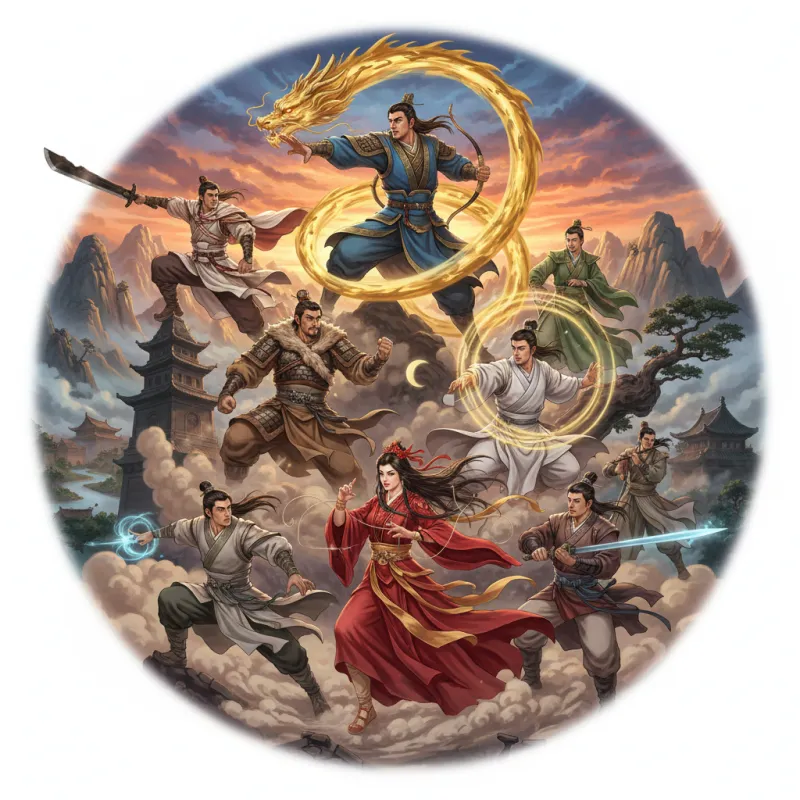
But that's never stopped anyone from trying. So here's my attempt, with reasoning, caveats, and the full expectation that readers will disagree violently.
The Methodology Problem
Before ranking anyone, we need to acknowledge the fundamental difficulties:
The era problem: Jin Yong's novels span roughly 700 years of Chinese history, from the late Tang Dynasty through the Qing. Characters from Demi-Gods and Semi-Devils (Northern Song, 1094) never meet those from The Deer and the Cauldron (Qing Dynasty, 1670s). Jin Yong himself suggested that martial arts knowledge degraded over time — the ancients were stronger. But he never quantified how much stronger.
The system problem: Each novel operates on different power scaling. In The Legend of the Condor Heroes, Guo Jing's Eighteen Dragon-Subduing Palms (降龍十八掌, jiàng lóng shíbā zhǎng) are presented as nearly unbeatable. In Demi-Gods and Semi-Devils, set 100 years earlier, at least five characters could probably handle them without breaking a sweat. The novels aren't meant to be cross-referenced this way.
The narrative problem: Jin Yong writes martial arts as plot devices, not video game stats. A character's strength fluctuates based on what the story needs. Zhou Botong can be comic relief in one chapter and genuinely threatening in another. Duan Yu stumbles through most of Demi-Gods as a bumbling amateur, then suddenly has enough internal energy to rival the greats.
The mysticism problem: Some characters transcend normal martial arts entirely. Dugu Qiubai (獨孤求敗, dúgū qiúbài) never appears in any novel — he's a legend within the legend. Sweeping Monk shows up for one chapter, performs impossible feats, then vanishes. How do you rank a character who exists more as concept than person?
With all that said, here's my ranking. I'm focusing on peak demonstrated ability, not potential or reputation.
The Untouchable Tier: Beyond Mortal Comprehension
1. Sweeping Monk (掃地僧, sǎodì sēng)
The nameless monk from Demi-Gods and Semi-Devils who sweeps floors at Shaolin's Sutra Repository. He appears in exactly one scene. In that scene, he casually stops attacks from Xiao Yuanshan and Murong Bo — two of the era's greatest masters — without moving. He projects a three-foot qi barrier that renders him essentially untouchable. He brings a dead man back to life through pure internal energy manipulation.
The text strongly implies he's been at Shaolin for decades, possibly his entire life, and has read every martial arts manual in their collection while developing his own transcendent understanding. He represents Jin Yong's Buddhist ideal: the ultimate martial artist is one who has moved beyond martial arts entirely, achieving a state where violence becomes impossible because he exists in a different reality than his opponents.
Could anyone beat him? The text doesn't give us enough information. He might be invincible. He might have weaknesses we never see. Jin Yong deliberately keeps him mysterious.
2. Dugu Qiubai (獨孤求敗)
The "Lonely Seeking Defeat" — a swordsman so skilled he couldn't find worthy opponents and eventually abandoned the sword entirely. We never meet him. He's been dead for decades by the time Yang Guo discovers his cave in The Return of the Condor Heroes. Everything we know comes from the inscription he left behind, describing his progression through four stages: sharp sword, soft sword, heavy sword, wooden sword, and finally no sword at all.
His legacy techniques — the Dugu Nine Swords (獨孤九劍, dúgū jiǔ jiàn) — make Linghu Chong nearly unbeatable in The Smiling, Proud Wanderer. And Linghu only learned a fraction of the system. The full art, as Dugu Qiubai practiced it, must have been extraordinary.
I rank him second because unlike Sweeping Monk, we have no direct demonstration of his abilities. He's reputation and inference. But what a reputation.
The Transcendent Tier: The Absolute Peak
3. Xiaoyao Zi (逍遙子)
The founder of the Carefree Sect (逍遙派, xiāoyáo pài) in Demi-Gods and Semi-Devils. Another character we never meet — he's long dead by the novel's events. But his three disciples are Wu Yazi, Li Qiushui, and Tianshan Tonglao, each of whom is individually terrifying. The martial arts he created include the Small Non-Phase Method (小無相功, xiǎo wúxiāng gōng), which allows practitioners to mimic any other martial art, and the Eight Desolations and Six Directions Supremacy Technique (天山六陽掌, tiānshān liù yáng zhǎng), which grants eternal youth.
His understanding of martial arts theory was so profound that his students, despite being geniuses themselves, never fully grasped his teachings. That's the mark of someone operating on a different level.
4. Zhang Sanfeng (張三丰)
The founder of Wudang and creator of Taiji Quan (太極拳, tàijí quán). He appears as an elderly master in The Heaven Sword and Dragon Saber, where at over 100 years old he's still the most formidable martial artist alive. His Taiji principles — using softness to overcome hardness, turning an opponent's strength against them — represent a complete martial philosophy.
What puts Zhang Sanfeng in this tier is his creative genius. He invents an entirely new martial art system on the spot when teaching Zhang Wuji. He sees through the weaknesses in Shaolin's techniques after watching them once. He's not just powerful; he understands the fundamental principles underlying all martial arts.
5. Wang Chongyang (王重陽)
The founder of Quanzhen Sect (全真教, quánzhēn jiào) and winner of the first Huashan Sword Tournament in The Legend of the Condor Heroes. He defeated the other Four Greats — Eastern Heretic, Western Venom, Southern Emperor, and Northern Beggar — to claim the Nine Yin Manual (九陰真經, jiǔ yīn zhēn jīng). Then, in a move that defines his character, he never practiced it, considering it too dangerous.
His Innate Skill (先天功, xiāntiān gōng) was powerful enough to dominate his generation. More importantly, he had the wisdom to recognize that pure power isn't everything — a theme Jin Yong returns to repeatedly.
The Legendary Tier: The Greatest of Their Eras
6. Duan Yu (段譽) — Peak Form
This ranking assumes Duan Yu at the end of Demi-Gods and Semi-Devils, after absorbing the internal energy of multiple masters. His Six Meridians Divine Sword (六脈神劍, liù mài shén jiàn) can project sword qi from his fingertips, essentially giving him six invisible swords. His Lingbo Microstep (凌波微步, língbō wēibù) makes him nearly impossible to hit. And his internal energy reserves, thanks to the Beiming Divine Art (北冥神功, běimíng shén gōng), are essentially bottomless.
The problem with Duan Yu is consistency. He's a pacifist who doesn't want to fight, which means he rarely performs at his peak. But when properly motivated, he's devastating.
7. Xuzhu (虛竹)
Another Demi-Gods character who gains power through absorption rather than training. He receives the 70-year internal energy cultivation of Wu Yazi, plus additional energy from Tianshan Tonglao and Li Qiushui. He masters the Tianshan Folding Plum Hand (天山折梅手, tiānshān zhé méi shǒu) and the Life and Death Talisman technique.
Like Duan Yu, Xuzhu's weakness is his gentle nature. He's a Buddhist monk who stumbled into martial arts mastery. He has the power but not the killer instinct.
8. Xiao Feng (蕭峰)
The true protagonist of Demi-Gods and Semi-Devils and, in my opinion, the most complete martial artist in Jin Yong's canon. Unlike Duan Yu and Xuzhu, who gained power through lucky encounters, Xiao Feng earned every bit of his skill through training and combat experience. His Eighteen Dragon-Subduing Palms are presented as the most powerful external martial art in existence. His Demon-Subduing Staff Technique is equally formidable.
What makes Xiao Feng special is his combat intelligence and indomitable will. He fights smart, adapts quickly, and never gives up. In pure technical skill, he might be below Duan Yu and Xuzhu. In actual combat effectiveness, he's probably superior to both.
9. Yang Guo (楊過)
The protagonist of The Return of the Condor Heroes and creator of the Dismal Ecstasy Palm (黯然銷魂掌, ànrán xiāohún zhǎng). He learned from multiple masters, including Ouyang Feng and Hong Qigong, then synthesized their teachings into his own style. His final technique, the Dismal Ecstasy Palm, channels emotional pain into devastating power — the more heartbroken he feels, the stronger the technique becomes.
Yang Guo also learned the Jade Maiden Heart Sutra (玉女心經, yùnǚ xīn jīng) and practiced with the Dark Iron Heavy Sword (玄鐵重劍, xuántiě zhòng jiàn) left by Dugu Qiubai. By the end of his story, he's strong enough to kill Jinlun Fawang, one of the era's top masters, with a single strike.
10. Linghu Chong (令狐沖)
The protagonist of The Smiling, Proud Wanderer and practitioner of the Dugu Nine Swords. What makes Linghu Chong remarkable is that he achieves top-tier status with relatively little internal energy. The Dugu Nine Swords is a pure technique system — it has no internal energy component. It's about reading your opponent, finding the flaw in their technique, and exploiting it before they can react.
Linghu Chong also absorbs the internal energies of multiple masters through the Star Absorbing Great Technique (吸星大法, xī xīng dà fǎ), though this causes him significant problems. His real strength is his swordsmanship, which by the novel's end is essentially unbeatable in one-on-one combat.
The Exceptional Tier: Masters Who Define Their Eras
11-15: The Five Greats of the Southern Song
The winners and competitors of the Huashan Sword Tournaments in The Legend of the Condor Heroes and The Return of the Condor Heroes: Eastern Heretic Huang Yaoshi (東邪黃藥師, dōng xié huáng yàoshī), Western Venom Ouyang Feng (西毒歐陽鋒, xī dú ōuyáng fēng), Southern Emperor Duan Zhixing (南帝段智興, nán dì duàn zhìxīng), Northern Beggar Hong Qigong (北丐洪七公, běi gài hóng qīgōng), and Central Divinity Wang Chongyang (中神通王重陽, zhōng shéntōng wáng chóngyáng).
These five represent the peak of Southern Song martial arts. They're roughly equal in ability, with individual matchups depending on style compatibility and circumstance. Wang Chongyang was slightly superior, which is why he won the first tournament, but the gap wasn't enormous.
16. Zhang Wuji (張無忌)
The protagonist of The Heaven Sword and Dragon Saber and master of the Nine Yang Divine Skill (九陽神功, jiǔ yáng shén gōng) and Heaven and Earth Great Shift (乾坤大挪移, qiánkūn dà nuóyí). Zhang Wuji has tremendous internal energy and powerful techniques, but he lacks the combat experience and killer instinct of higher-ranked characters.
His placement here is controversial. Some fans rank him much higher based on his raw power. I rank him lower because he's too hesitant, too merciful, and too easily manipulated. In a pure power contest, he might beat several characters ranked above him. In actual combat, where psychology and tactics matter, he'd struggle.
The Contentious Cases
Guo Jing (郭靖): The protagonist of The Legend of the Condor Heroes is powerful but not exceptional by the standards of this list. His Eighteen Dragon-Subduing Palms are formidable, and his defense is nearly impenetrable, but he lacks the transcendent qualities of higher-ranked characters. He'd probably rank around 20-25.
Wei Xiaobao (韋小寶): The protagonist of The Deer and the Cauldron has essentially no martial arts ability. He survives through luck, cunning, and social manipulation. He's the anti-martial artist, which is precisely Jin Yong's point in that novel.
Shi Potian (石破天): The protagonist of Swordsman who masters the Tai Xuan Sutra (太玄經, tài xuán jīng). He might belong in the Transcendent Tier based on the text's description of his final abilities, but the novel is so different in tone from Jin Yong's other works that it's hard to compare directly.
Why This Ranking Is Wrong
It is, of course. Any attempt to create a definitive power ranking across Jin Yong's novels is fundamentally flawed because the novels weren't designed to be compared this way. Jin Yong was writing literature, not creating a fighting game tier list.
The real answer to "who's strongest" is: whoever the story needs to be strongest at that moment. That's not a cop-out — it's how narrative fiction works. Xiao Feng is as strong as he needs to be to make his tragedy meaningful. Zhang Sanfeng is as wise as he needs to be to represent Taoist ideals. Sweeping Monk is as mysterious as he needs to be to embody Buddhist transcendence.
But we're fans, and fans love to argue about this stuff. So here's my ranking, offered with humility and the full expectation that you'll tell me I'm completely wrong about everything. That's part of the fun.
For more debates on individual character strength, check out The Strongest Character Debate. And if you want to dive deeper into specific martial arts systems, see Internal vs External Martial Arts.
Related Reading
- The 20 Strongest Characters in Jin Yong's Universe: A Definitive Ranking
- The Five Greats Across All Generations: How the Rankings Changed
- The 10 Most Powerful Martial Arts Techniques in Jin Yong's Novels
- The Complete Timeline of Events Across Jin Yong's Novels
- Exploring the Intricate Sects within Jin Yong's Iconic Wuxia Novels
- Villains of Jin Yong's Wuxia Novels: Complexity, Motives, and Legacy