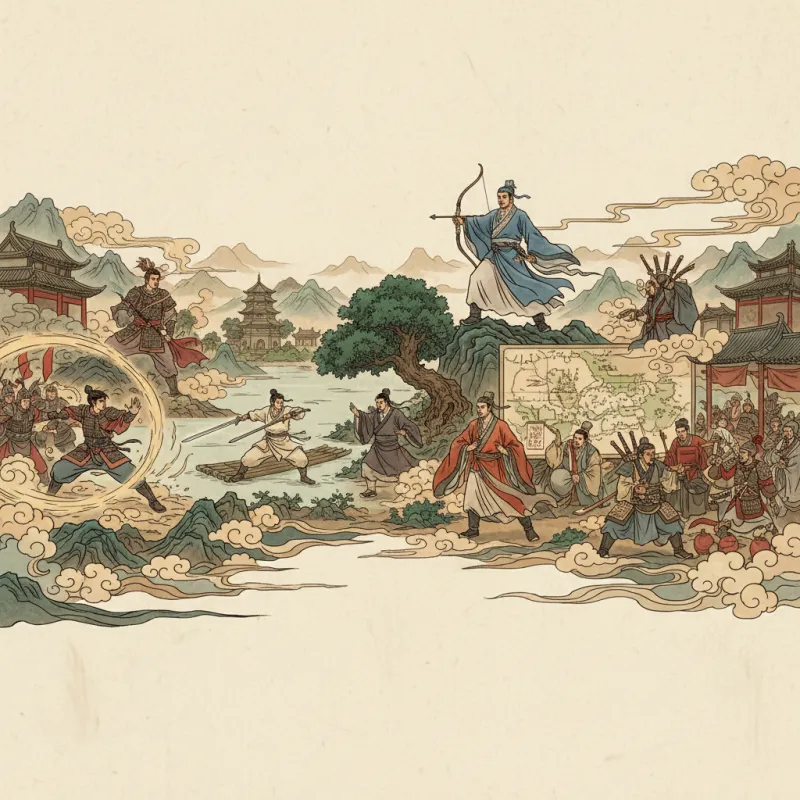
When Yang Guo stands at the edge of Heartbreak Cliff in The Return of the Condor Heroes, mourning his lost love, he's not just a tragic hero in his own story — he's the adopted son of Guo Jing, the grandson-in-law of Huang Yaoshi, and the spiritual heir to martial arts techniques that span three dynasties. Jin Yong didn't just write fifteen novels. He constructed a millennium-spanning tapestry where bloodlines, martial arts manuals, and legendary weapons weave through Chinese history from the Tang Dynasty to the Qing. Understanding this chronology transforms casual reading into archaeological excavation, where each novel reveals new layers of connection to the others.
The Song-Yuan Transition: Where Everything Converges
The heart of Jin Yong's universe beats strongest during the Southern Song Dynasty's final decades and the Mongol conquest. Three novels — The Legend of the Condor Heroes (射雕英雄传 Shèdiāo Yīngxióng Zhuàn), The Return of the Condor Heroes (神雕侠侣 Shéndiāo Xiálǚ), and The Heaven Sword and Dragon Saber (倚天屠龙记 Yǐtiān Túlóng Jì) — form what fans call the Condor Trilogy, covering roughly 1200 to 1370 CE. This isn't arbitrary. Jin Yong chose the Mongol invasion as his canvas because it represents China's greatest existential crisis before the modern era, a time when martial heroes could plausibly affect the fate of nations.
Guo Jing and Huang Rong's defense of Xiangyang in the 1270s becomes the pivot point. Their deaths — never shown but heavily implied — mark the end of the Song Dynasty and the beginning of Mongol rule. The Heaven-Reliant Sword (倚天剑 Yǐtiān Jiàn) and Dragon-Slaying Saber (屠龙刀 Túlóng Dāo), forged from Yang Guo's Dark Iron Heavy Sword, carry their legacy forward. Inside these weapons, Guo Jing and Huang Rong hide the Nine Yin Manual and Yue Fei's military treatise — a time capsule of martial knowledge waiting for Zhang Wuji's generation to discover.
The Early Timeline: Tang to Northern Song
Before the Condor Trilogy, Jin Yong's universe stretches back to the Tang Dynasty with The Book and the Sword (书剑恩仇录 Shū Jiàn Ēnchóu Lù), set around 1750s — actually one of his later historical periods, but we'll return to that. The earliest confirmed setting is Demi-Gods and Semi-Devils (天龙八部 Tiānlóng Bā Bù), set in 1094 during the Northern Song Dynasty. Here we meet Duan Yu, whose Dali Kingdom ancestry connects directly to later novels. His descendant, Duan Zhixing (later known as Reverend Yideng), appears in The Legend of the Condor Heroes 130 years later, still practicing the same Duan family martial arts.
The Smiling, Proud Wanderer (笑傲江湖 Xiào'ào Jiānghú) deliberately avoids specific dating — Jin Yong wanted to explore political themes without historical constraints — but most scholars place it in the Ming Dynasty, roughly 1500s. The novel's ambiguity is intentional; it's Jin Yong's most allegorical work, where the struggle between orthodox and unorthodox martial arts sects mirrors political persecution in any era.
The Duke of Mount Deer (鹿鼎记 Lùdǐng Jì), set in the 1670s-1680s during early Qing Dynasty, represents Jin Yong's final word on the wuxia genre. Wei Xiaobao's adventures occur in documented history — he meets the actual Kangxi Emperor, participates in real military campaigns. By grounding his most comedic protagonist in the most historically accurate setting, Jin Yong suggests that the age of martial heroes has passed. The jianghu (江湖 jiānghú) — that lawless world of martial artists — is dying, replaced by bureaucracy and gunpowder.
Martial Arts Lineages: The Real Timeline
The novels' chronology becomes clearer when you trace martial arts techniques rather than characters. The Nine Yang Manual (九阳真经 Jiǔyáng Zhēnjīng) provides the clearest through-line. Created by a Shaolin monk after reading the Nine Yin Manual in The Return of the Condor Heroes (set around 1240s), it's discovered by Zhang Wuji's teacher decades later in The Heaven Sword and Dragon Saber (1330s-1360s). Zhang Wuji masters it, combining it with the Great Solar Shift technique to become arguably Jin Yong's most powerful protagonist.
But the Nine Yin Manual itself has deeper roots. Huang Shang created it during the Northern Song Dynasty (around 1100 CE), decades before The Legend of the Condor Heroes begins. By the time Zhou Botong and Guo Jing are practicing it in the 1200s, it's already a century-old text, its creator long dead. This layering — where martial arts manuals outlive their creators, accumulating legend and misinterpretation — mirrors how real martial arts traditions evolved in China.
The Eighteen Dragon-Subduing Palms technique shows even longer continuity. Perfected by Hong Qigong in The Legend of the Condor Heroes, taught to Guo Jing, then passed to Guo Jing's daughter Guo Xiang, who later founds the Emei Sect. By The Heaven Sword and Dragon Saber, the technique has fragmented — only twelve palms remain in common knowledge. This degradation of martial knowledge over time reflects Jin Yong's pessimistic view of cultural transmission. Each generation loses something, misunderstands something, until the original art becomes unrecognizable.
The Duan Family: A Millennium of Continuity
No family demonstrates Jin Yong's chronological ambition better than the Duan clan of Dali. In Demi-Gods and Semi-Devils (1094), Duan Yu represents the family at its height — a prince who becomes emperor, master of the Six Meridians Divine Sword (六脉神剑 Liùmài Shénjiàn). Fast forward 130 years to The Legend of the Condor Heroes, and we meet Duan Zhixing, who becomes the monk Reverend Yideng after romantic tragedy. He's still practicing Duan family martial arts, though the Six Meridians Divine Sword has been lost — its manual destroyed, its techniques too difficult to transmit.
By The Heaven Sword and Dragon Saber (1330s-1360s), another century later, the Duan family has faded from prominence. The Dali Kingdom has fallen to the Mongols. But echoes remain: the Emei Sect, founded by Guo Xiang (who learned from Duan Zhixing/Yideng), preserves fragments of Duan family techniques mixed with other traditions. This three-novel arc spanning 270 years shows Jin Yong's sophisticated understanding of how martial traditions evolve — not through clean transmission but through fragmentation, loss, and creative misremembering.
Historical Anchors: Real Events, Fictional Heroes
Jin Yong anchors his timeline using actual historical events. The Battle of Xiangyang (1268-1273), where the Song Dynasty made its last stand against Kublai Khan's forces, provides the tragic backdrop for Guo Jing and Huang Rong's final years. The Mongol conquest of China, the establishment of the Yuan Dynasty, the Red Turban Rebellion that overthrew it — these aren't background details but the engine driving character decisions.
In The Heaven Sword and Dragon Saber, Zhang Wuji's involvement with the Ming Dynasty's founding is historically plausible. The novel ends around 1368, exactly when Zhu Yuanzhang established the Ming Dynasty. Jin Yong suggests that martial artists played hidden roles in this transition — not as generals or politicians, but as the underground network that made rebellion possible. The jianghu becomes a shadow government, operating beneath official history.
The Duke of Mount Deer takes this historical integration furthest. Wei Xiaobao's adventures — suppressing the Revolt of the Three Feudatories, negotiating the Treaty of Nerchinsk with Russia, capturing Taiwan from Zheng Keshuang — are all real events from Kangxi's reign (1661-1722). By inserting a fictional trickster into documented history, Jin Yong asks: what if the real heroes of history weren't the names in textbooks but the unnamed operators working behind the scenes?
The Outliers: Novels Outside the Main Timeline
Three novels resist easy chronological placement. The Smiling, Proud Wanderer, as mentioned, deliberately avoids dating. Its themes — political persecution, the corruption of power, the price of nonconformity — apply to any dynasty. Some scholars argue for a Ming setting based on cultural details; others suggest early Qing. Jin Yong himself refused to clarify, insisting the novel exists in "no particular time."
Ode to Gallantry (侠客行 Xiákè Xíng) similarly floats in temporal ambiguity, though most place it in the Ming Dynasty based on social structures and martial arts styles. The novel's focus on a martial arts manual written in incomprehensible poetry — which the illiterate protagonist masters by treating the characters as pictures — suggests Jin Yong's playful attitude toward martial arts lineages. Sometimes ignorance preserves knowledge better than scholarship.
Fox Volant of the Snowy Mountain (雪山飞狐 Xuěshān Fēihú) and its prequel The Young Flying Fox (飞狐外传 Fēihú Wàizhuàn) are set in the mid-Qing Dynasty, roughly 1740s-1760s, making them contemporaneous with The Book and the Sword. These novels explore how martial arts families maintain their traditions across generations, with the Hu and Miao families' blood feud spanning decades. The chronology here is personal rather than historical — what matters isn't which emperor rules but how long a grudge can last.
Why Chronology Matters: Reading Order vs. Timeline Order
New readers often ask: should I read Jin Yong's novels in publication order or chronological order? The answer reveals something about how the timeline functions. Publication order (starting with The Book and the Sword in 1955, ending with The Duke of Mount Deer in 1972) shows Jin Yong's artistic evolution. Chronological order (starting with Demi-Gods and Semi-Devils in 1094, ending with The Duke of Mount Deer in the 1680s) reveals the fictional universe's internal logic.
But there's a third option: thematic order, following the martial arts lineages and family connections. Start with The Legend of the Condor Heroes, continue through the Condor Trilogy, then branch out to Demi-Gods and Semi-Devils to understand the Duan family's origins. This approach treats the novels as an interconnected web rather than a linear sequence, which better reflects how Jin Yong actually wrote them — constantly referring back to earlier works, planting seeds for future connections.
The timeline isn't just a curiosity for completists. It's the structural principle that transforms fifteen separate novels into a unified meditation on Chinese history, martial culture, and the transmission of knowledge across generations. When you realize that the sword technique Zhang Wuji learns in 1360 has roots in a manual written in 1100, practiced by heroes in 1200, and will influence martial artists for centuries to come, you're not just reading adventure stories. You're witnessing Jin Yong's argument about how culture survives — imperfectly, fragmentarily, but persistently — through China's most turbulent millennium.
Related Reading
- A Timeline of Jin Yong's Martial World: From the Song Dynasty to the Qing
- Jin Yong's Writing Career: From First Novel to Final Retirement
- Jin Yong Novel Chronology: When Each Story Takes Place
- How the Condor Trilogy Connects: Characters, Weapons, and Secrets Across 155 Years
- Visiting Jin Yong Locations in Real Life
- Exploring the Intricate Sects within Jin Yong's Iconic Wuxia Novels
- Four-Word Martial Arts Idioms from Jin Yong's Novels