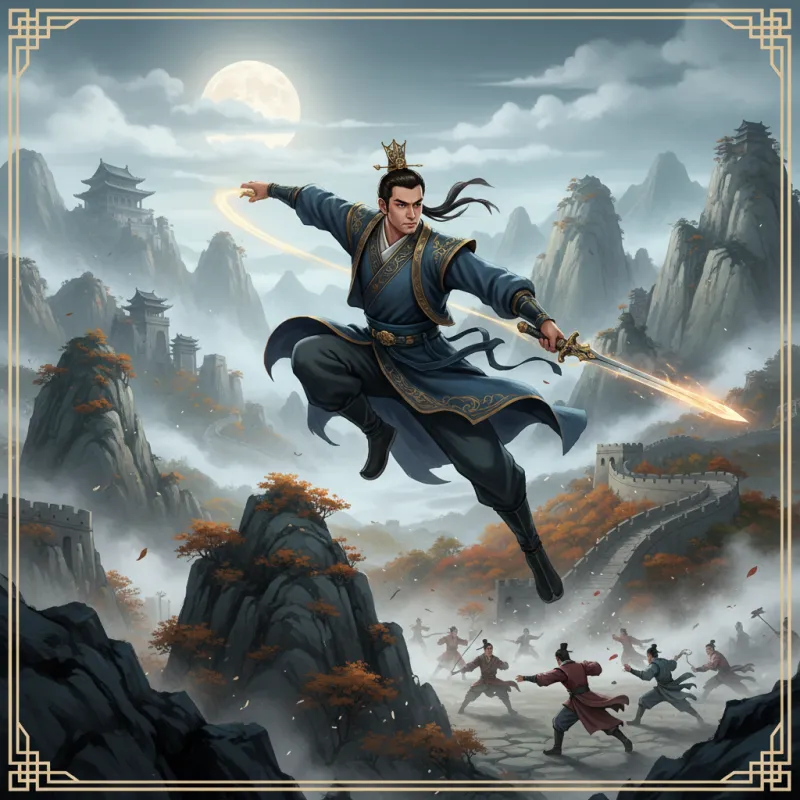
You're standing on a granite precipice 7,000 feet above sea level, wind whipping your face, staring at a stone tablet that reads "华山论剑" — Sword Discussion at Mount Hua. Below you, the Shaanxi plains stretch to the horizon. Behind you, a tour group poses for selfies with foam swords. This is what happens when fiction becomes pilgrimage: Jin Yong's imagined martial arts world collides with China's very real tourist economy, and the result is both magical and absurd.
Jin Yong didn't invent these places. He borrowed them,描写 (miáoxiě, described) them with obsessive geographical accuracy, and returned them to China transformed. Mount Hua was already one of the Five Great Mountains before Legend of the Condor Heroes. Dali was a historical kingdom before Demi-Gods and Semi-Devils. But after Jin Yong, these locations acquired a second identity — not just as scenic spots or historical sites, but as stages where fictional heroes fought, loved, and died. I've spent years visiting these places, and what strikes me most is how the novels have rewritten the landscape itself.
Mount Hua (华山, Huáshān) — The Original Pilgrimage
Mount Hua in Shaanxi Province is where it all begins. This is the site of the Huashan Sword Discussion (华山论剑, Huáshān lùn jiàn), the tournament that determines the greatest martial artist in the Condor Trilogy. In the novels, the Five Greats — Eastern Heretic, Western Venom, Southern Emperor, Northern Beggar, and Central Divinity — meet here to compete for the Nine Yin Manual. The winner gets the title "Number One Under Heaven" (天下第一, tiānxià dì yī).
The real Mount Hua is one of China's Five Great Mountains (五岳, Wǔyuè), sacred to Taoism for over two millennia. It's famous for being terrifyingly steep — the hiking trails include sections with names like "Thousand-Foot Precipice" and "Hundred-Foot Crevice" where you climb vertical rock faces using chains bolted into stone. The cable car, installed in the 1990s, was a concession to modernity and survival instincts.
What Jin Yong did was layer martial arts mythology onto existing Taoist mysticism. The mountain already had a reputation for hermits and spiritual cultivation. He simply replaced Taoist immortals with martial arts masters. Now, at the summit, there's a stone monument carved with "华山论剑" in calligraphy. It was erected in 2003, decades after the novels were published, proof that fiction can retroactively colonize reality.
The tourist infrastructure is overwhelming. Souvenir shops sell foam swords and "Condor Hero" t-shirts. Loudspeakers play the Legend of the Condor Heroes TV drama theme song on loop. But if you hike early — before the cable cars start running, before the crowds arrive — you can stand on the East Peak at sunrise and understand why Jin Yong chose this place. The granite peaks emerge from morning mist like islands in a sea of clouds. It looks exactly like a martial arts novel should look: impossible, beautiful, and slightly unreal.
Dali (大理) — Where History and Fiction Blur
Dali in Yunnan Province is the setting for much of Demi-Gods and Semi-Devils (天龙八部, Tiānlóng Bābù). In the novel, it's the capital of the Duan family's kingdom, home to the "Six Meridians Divine Sword" (六脉神剑, Liùmài shénjiàn) and the tragic prince Duan Yu. The historical Dali Kingdom (937-1253 CE) really existed — it was an independent state that controlled much of what is now Yunnan and parts of Burma, until Kublai Khan's Mongol armies conquered it.
Jin Yong's genius was recognizing that most Chinese readers knew almost nothing about Dali's history. The kingdom was geographically remote, ethnically Bai rather than Han Chinese, and had left relatively few records. This gave him creative freedom. He could invent the Duan family's martial arts lineage, their Buddhist devotion, their complicated relationship with the Central Plains, and readers would accept it because it felt historically plausible.
Modern Dali has leaned hard into the Jin Yong connection. The reconstructed old town is full of shops named after characters — "Duan Yu's Tea House," "Wang Yuyan's Bookstore." The Three Pagodas (三塔, Sāntǎ), which appear in the novel, are now marketed as a Jin Yong landmark even though they were built in the 9th century, a thousand years before he was born. There's even a "Tianlong Babu Film City" (天龙八部影视城, Tiānlóng Bābù yǐngshì chéng), a theme park built around the 2003 TV adaptation's sets.
But Dali is also genuinely beautiful in ways that transcend the novels. Erhai Lake (洱海, Ěrhǎi) reflects the Cangshan Mountains (苍山, Cāngshān) in water so clear you can see the bottom. The old town's Bai architecture — white walls, gray tiles, painted eaves — creates a visual aesthetic distinct from anywhere else in China. Jin Yong captured this in his descriptions of Duan Yu wandering through Dali's streets, and when you walk those same streets today, you recognize the scenes even though the buildings are reconstructed and the crowds are modern.
The relationship between Jin Yong's historical accuracy and creative license is most visible in Dali. He got the broad strokes right — the kingdom's existence, its Buddhist culture, its ethnic distinctiveness — but invented freely within that framework. The result is that Dali now has two histories: the actual one, documented in Chinese chronicles and archaeological sites, and the fictional one, which more people know and care about.
Peach Blossom Island (桃花岛, Táohuā Dǎo) — Inventing Geography
Peach Blossom Island is where Jin Yong's geographical method gets interesting, because this place didn't exist until he created it. In Legend of the Condor Heroes, it's the home of Huang Yaoshi (黄药师, Huáng Yàoshī), the "Eastern Heretic," one of the Five Greats. The island is described as being off the coast of Zhejiang Province, covered in peach trees, and protected by elaborate maze-like defenses that Huang Yaoshi designed using the Book of Changes.
There is no historical Peach Blossom Island in that location. Jin Yong made it up. But after the novels became popular, the Zhoushan Islands in Zhejiang started marketing themselves as the "real" Peach Blossom Island. One island in particular — previously called Anqi Island (安期岛, Ānqī Dǎo) — was officially renamed Peach Blossom Island in 1996. They planted peach trees. They built a "Huang Yaoshi Villa" and a "Condor Hero Square." They created a tourist destination based on a fictional place that Jin Yong had supposedly based on their island, even though he probably hadn't.
This is fiction eating reality and then reality eating fiction back. I visited in spring when the peach trees were blooming, and the island was packed with tourists taking photos in rented "ancient costume" hanfu. The whole thing felt like a theme park, which it essentially is. But there's something fascinating about how a place can acquire meaning through collective belief. Thousands of people visit "Peach Blossom Island" every year because they want to stand where Huang Yaoshi stood, even though Huang Yaoshi never stood anywhere because he's fictional, and even if he were real, he wouldn't have stood here because Jin Yong invented the island's location.
The geography of Jin Yong's world operates on dream logic: specific enough to feel real, vague enough to accommodate imagination.
Shaolin Temple (少林寺, Shàolín Sì) — The Most Commercialized
Shaolin Temple in Henan Province appears in almost every Jin Yong novel. It's the center of orthodox martial arts, home to the Yijin Jing (易筋经, Yìjīn Jīng, Muscle-Tendon Change Classic) and the 72 Shaolin Arts. In Demi-Gods and Semi-Devils, the sweeping monk who lives in the sutra library is possibly the greatest martial artist in the entire novel. In The Smiling, Proud Wanderer, Shaolin represents establishment power that the protagonist Linghu Chong both respects and rebels against.
The real Shaolin Temple is 1,500 years old, genuinely important in Chinese Buddhist history, and the documented origin of several martial arts styles. It's also the most aggressively commercialized site I've visited. The entrance fee is expensive. Inside, there are constant kung fu performances — monks (or performers dressed as monks) breaking bricks, doing backflips, spinning staffs. There's a massive gift shop. The abbot has been accused of corruption. The whole place feels less like a monastery and more like a martial arts Disneyland.
Jin Yong didn't create Shaolin's martial reputation — that existed for centuries before him. But his novels amplified it, made it the default reference point for Chinese martial arts in popular imagination. Now the temple trades on that reputation, and it's impossible to separate the historical Shaolin from the fictional one from the commercial one. They've collapsed into a single entity that exists primarily to extract money from tourists who want to feel like they're in a Jin Yong novel.
The irony is that the novels often portrayed Shaolin as hypocritical — publicly righteous but privately political, claiming to be above worldly concerns while constantly interfering in jianghu affairs. The modern temple's commercialization feels like Jin Yong's critique made manifest.
Hengshan (衡山, Héngshān) and Huashan (华山) — The Sacred Mountains
Jin Yong used China's sacred mountains repeatedly. Mount Heng (衡山, Héngshān) in Hunan appears in The Smiling, Proud Wanderer as the home of the Hengshan Sect, led by the nun Dingxian Shitai. Mount Hua we've already discussed. Mount Emei (峨眉山, Éméi Shān) in Sichuan shows up in The Heaven Sword and Dragon Saber as the base of the Emei Sect, founded by the ruthless Abbess Miejue.
These mountains were already pilgrimage sites — Buddhist or Taoist, depending on the mountain — before Jin Yong wrote about them. What he did was add a martial arts layer to their existing religious significance. Now when you visit Mount Emei, you're walking through both Buddhist sacred space and the territory of Abbess Miejue's sect. The two identities coexist, and for many visitors, the fictional one is more vivid than the historical one.
I hiked Mount Emei in winter when the peaks were covered in snow and ice. The Buddhist temples were quiet, filled with monks chanting sutras. But at the summit, there were tourists posing with swords, recreating scenes from Heaven Sword and Dragon Saber. The juxtaposition was jarring: genuine religious practice happening alongside martial arts cosplay, both groups treating the mountain as sacred but for completely different reasons.
Xiangyang (襄阳) — Where Fiction Rewrites History
Xiangyang in Hubei Province is the setting for the climactic defense against the Mongols in Legend of the Condor Heroes and Return of the Condor Heroes. In the novels, Guo Jing and Huang Rong spend decades defending the city, knowing they'll eventually lose but fighting anyway because it's the right thing to do. The city's fall to the Mongols in 1273 is one of the most emotionally devastating moments in Jin Yong's entire body of work.
Historically, Xiangyang really was besieged by the Mongols, and it really did fall in 1273 after holding out for years. Jin Yong's account is broadly accurate. But Guo Jing and Huang Rong didn't exist, and the defense wasn't led by martial arts heroes. It was led by generals whose names most people don't remember.
Modern Xiangyang has embraced the fictional version. There are statues of Guo Jing and Huang Rong on the city walls. The tourist literature emphasizes the Jin Yong connection more than the actual historical siege. When you walk the reconstructed walls, the plaques talk about the Condor Heroes, not the real defenders.
This is how Jin Yong's influence on Chinese culture works: his version of events becomes more culturally significant than what actually happened. The real siege of Xiangyang is a footnote in Yuan Dynasty history. Jin Yong's fictional siege is a defining moment in modern Chinese popular culture. The city has chosen to memorialize the fiction because more people care about it.
What Visiting These Places Actually Means
After visiting dozens of Jin Yong locations, I've realized that what you're looking for determines what you find. If you want unspoiled natural beauty, you'll be disappointed by the commercialization, the crowds, the foam swords and theme songs. If you want to feel connected to the novels, to stand where fictional characters stood and see what they saw, then the experience can be genuinely moving despite the tourist infrastructure.
The best visits happen when you can separate the two. Go to Mount Hua at dawn before the crowds. Hike the back trails at Mount Emei where there are no souvenir shops. Visit Dali in the off-season when the old town is quiet. In those moments, you can understand why Jin Yong chose these places — not because they were famous, but because they were beautiful and strange and felt like they belonged in a story about heroes and martial arts and impossible deeds.
The worst visits happen when you expect the places to be exactly like the novels. They're not. They're real places with real histories that existed long before Jin Yong and will exist long after his novels are forgotten. The Jin Yong layer is just the most recent addition to centuries or millennia of accumulated meaning.
But that layer matters. These places have been transformed by fiction in ways that are now permanent. Peach Blossom Island exists because Jin Yong wrote it into existence. Mount Hua's identity is now inseparable from the Sword Discussion. Dali's history has been partially overwritten by Demi-Gods and Semi-Devils. This is the power of popular fiction: it doesn't just reflect culture, it shapes geography, rewrites history, and creates pilgrimage sites for a secular age.
When you visit these places, you're not just seeing where Jin Yong set his novels. You're seeing how stories can colonize reality, how fiction and fact blur until they're indistinguishable, and how a writer's imagination can permanently alter the landscape of an entire country. That's worth the crowds, the commercialization, and the foam swords.
Related Reading
- Discovering the Enchanting Locations of Jin Yong's Wuxia Novels
- The Forbidden City in Jin Yong's Wuxia Fiction
- Peach Blossom Island: The Most Magical Location in Jin Yong's World
- Jin Yong's Locations: The Real Places Behind the Fictional Battles
- A Map of the Jianghu: Geography in Jin Yong's Novels
- Jin Yong's Music: The Soundtracks That Made a Nation Cry
- The Unsung Heroes of Jin Yong's Wuxia Novels: Side Characters That Steal the Spotlight
- Zhou Botong: The Old Urchin Who Never Grew Up