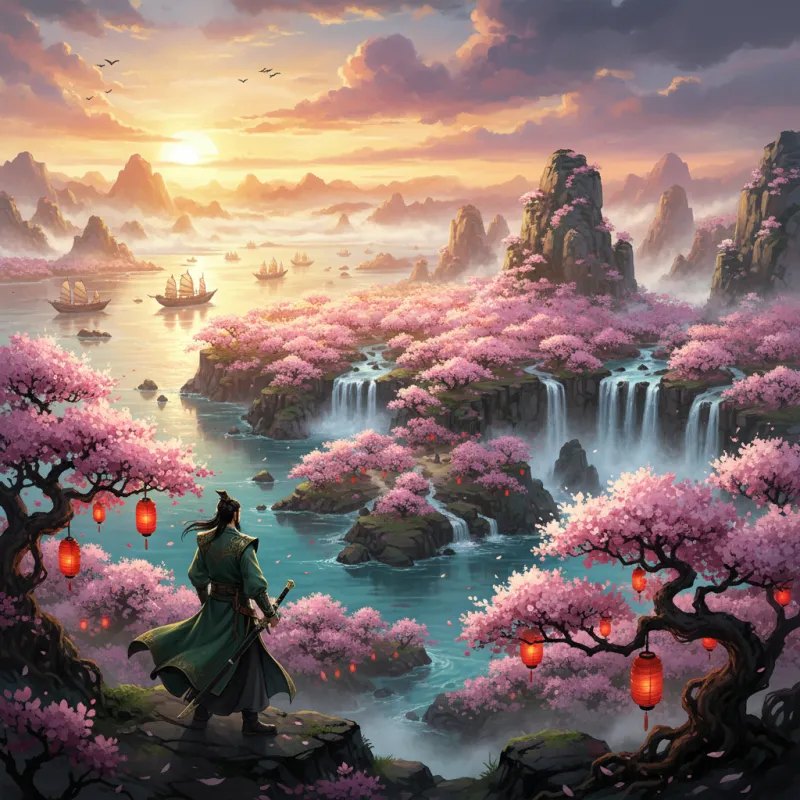
The moment you step onto Peach Blossom Island, you're not just entering a location — you're walking into someone's mind. And that mind belongs to one of the most fascinating eccentrics in all of wuxia literature: Huang Yaoshi (黄药师 Huáng Yàoshī), the Eastern Heretic (东邪 Dōng Xié). This isn't a fortress designed for defense or a palace built for display. It's a three-dimensional expression of genius, paranoia, grief, and defiance, all wrapped in pink petals and mathematical precision.
The Geography of Genius
Peach Blossom Island (桃花岛 Táohuā Dǎo) sits somewhere in the East China Sea, off the coast of Zhejiang province. Jin Yong (金庸 Jīn Yōng) deliberately keeps its exact location vague in The Legend of the Condor Heroes (射雕英雄传 Shèdiāo Yīngxióng Zhuàn), which makes perfect sense — a man like Huang Yaoshi wouldn't advertise his address. The island is large enough to contain multiple ecosystems: peach groves that bloom year-round through some horticultural wizardry, rocky cliffs that make landing treacherous, hidden caves that serve as laboratories and libraries, and a central manor that's equal parts home and fortress.
What makes the island extraordinary isn't its natural beauty, though that's considerable. It's the layers of human intervention. Huang Yaoshi has transformed every inch of this place into a reflection of his polymathic brilliance. The peach trees aren't just decorative — they're arranged according to principles from the Book of Changes (易经 Yìjīng), creating a living maze that disorients intruders. The paths between buildings follow astronomical alignments. Even the placement of rocks in the gardens corresponds to musical theory, so that wind passing through creates specific tones.
This is what separates Peach Blossom Island from other famous locations in Jin Yong's novels. Shaolin Temple represents institutional power and orthodox tradition. Mount Hua is a stage for competition and conflict. But Peach Blossom Island is personal — it's autobiography written in landscape architecture.
The Five Elements Maze: Where Mathematics Meets Murder
The island's most infamous feature is the Five Elements Maze (五行阵 Wǔxíng Zhèn), a defensive system so complex that even skilled martial artists get hopelessly lost within minutes. Huang Yaoshi designed it using principles from traditional Chinese cosmology — the five elements of wood, fire, earth, metal, and water — combined with the eight trigrams (八卦 bāguà) and advanced mathematics.
Here's what makes it brilliant: the maze isn't static. Depending on the time of day, the season, and even the weather, different paths open and close. What worked yesterday won't work today. The peach trees themselves are part of the mechanism — their branches create visual barriers that shift with growth and pruning. Huang Yaoshi maintains the system personally, which means it evolves with his moods and interests.
When Guo Jing (郭靖 Guō Jìng) first arrives on the island, he blunders through the maze by sheer luck and his practice of the Nine Yin Manual (九阴真经 Jiǔyīn Zhēnjīng), which gives him an intuitive sense of spatial relationships. But even he can't explain how he did it. Later, when Zhou Botong (周伯通 Zhōu Bótōng) gets trapped in a cave on the island for years, it's not because he lacks martial skill — it's because Huang Yaoshi's mathematical genius creates a prison that physical strength can't break.
The maze serves multiple purposes. Obviously, it's defensive — uninvited guests don't make it past the beach. But it's also a statement of philosophy. Huang Yaoshi rejects the orthodox martial world's emphasis on brute force and rigid tradition. His maze says: intelligence matters more than strength, creativity trumps convention, and the world is more complex than your simple moral categories can handle.
A Monument to Lost Love
Understanding Peach Blossom Island requires understanding why Huang Yaoshi built it this way. The island wasn't always a fortress of solitude. It was meant to be a paradise for two people: Huang Yaoshi and his wife, Feng Heng (冯蘅 Féng Héng). She was the only person who truly understood him, who could match his intellectual range and appreciate his unconventional thinking.
When Feng Heng died giving birth to their daughter Huang Rong (黄蓉 Huáng Róng), something broke in Huang Yaoshi. The island transformed from a love nest into a mausoleum. He expelled his disciples in a rage (after they destroyed his wife's final manuscript), leaving only the mute servants who couldn't disturb his grief with conversation. The peach blossoms that once symbolized romance became a perpetual reminder of loss.
This is why the island feels so contradictory. It's breathtakingly beautiful but deeply lonely. It's a showcase of human achievement that's deliberately isolated from humanity. The same genius that created the Five Elements Maze also composed the Jade Flute Swordplay (玉箫剑法 Yùxiāo Jiànfǎ), a martial art that combines music and combat in ways that are as aesthetically perfect as they are deadly. Huang Yaoshi could have been a leader in the martial world, but he chose to be a hermit on an island that's equal parts paradise and prison.
The Island as Character Development Device
Jin Yong uses Peach Blossom Island brilliantly as a narrative tool. Characters reveal themselves through how they interact with the place. Guo Jing's honest, straightforward nature means he treats the island's challenges with earnest effort rather than cleverness — and somehow that works. His future wife Huang Rong grew up here, and she inherited both her father's brilliance and his tendency toward isolation and manipulation. The island shaped her into someone who's simultaneously playful and calculating, generous and suspicious.
When Yang Guo visits in The Return of the Condor Heroes (神雕侠侣 Shéndiāo Xiálǚ), the island has changed. Huang Yaoshi has mellowed slightly, and the place feels less like a fortress and more like a home. But it's still fundamentally weird — still a place where normal social rules don't quite apply, where genius and eccentricity blur together.
The island also serves as a counterpoint to orthodox martial society. While the rest of the jianghu (江湖 jiānghú) — the martial world — argues about righteousness and evil, Huang Yaoshi sits on his island playing his flute and not caring about their categories. He's called the Eastern Heretic not because he's villainous but because he refuses to conform. His island is physical proof that there are other ways to live, other values to pursue beyond the endless status competitions of the martial world.
Real-World Inspirations and Tourist Traps
Jin Yong never specified exactly where Peach Blossom Island is, but that hasn't stopped the Chinese tourism industry from claiming it. There's an actual island called Taohua Island in the Zhoushan Archipelago off Zhejiang that's been heavily marketed as "the real Peach Blossom Island." They've built Jin Yong-themed attractions, planted extensive peach groves, and created a whole tourist economy around the connection.
Is it the "real" location? Of course not — the place is fictional. But there's something appropriate about a real island transforming itself to match a fictional ideal. Huang Yaoshi would probably appreciate the audacity of it, even if he'd mock the commercialization.
The literary inspiration likely comes from several sources. The peach blossom motif has deep roots in Chinese literature, most famously in Tao Yuanming's (陶渊明 Táo Yuānmíng) "Peach Blossom Spring" (桃花源记 Táohuā Yuán Jì), a 4th-century tale about a hidden utopia. Jin Yong inverts this — his Peach Blossom Island isn't a communal paradise but a personal refuge that's as much about keeping the world out as creating beauty within.
The idea of a genius creating an elaborate island fortress also echoes historical figures like Zhuge Liang (诸葛亮 Zhūgě Liàng), whose strategic brilliance included designing defensive systems based on cosmological principles. Huang Yaoshi is essentially a Song Dynasty polymath taken to fictional extremes — the kind of person who really did exist in Chinese history, just not quite this extreme.
Why This Island Matters
Peach Blossom Island endures in readers' imaginations because it represents something we all understand: the desire to create a space that's entirely our own, that reflects our values and aesthetics without compromise. Huang Yaoshi took that universal impulse and had the genius, resources, and stubbornness to actually do it.
But Jin Yong doesn't let us romanticize this too much. The island is also a warning about the costs of isolation. Huang Yaoshi's brilliance created something magnificent, but his refusal to engage with the world on any terms but his own left him lonely and bitter. It took his daughter leaving the island and his eventual reconciliation with Guo Jing to begin healing that wound.
The island works as a symbol because it's genuinely ambiguous. Is it a triumph of individual vision or a monument to antisocial pride? Is Huang Yaoshi a hero for rejecting orthodox hypocrisy or a cautionary tale about the dangers of unchecked ego? Jin Yong leaves these questions open, which is why we're still arguing about them decades later.
In the end, Peach Blossom Island is the most magical location in Jin Yong's world not because of supernatural elements — there aren't any — but because it's the most psychologically complex. Every other location in the novels is defined by its institution or its history. This island is defined by one man's personality, and that makes it feel more real and more strange than any amount of fantasy could achieve. It's a place where mathematics becomes poetry, where grief transforms into beauty, and where one person's refusal to conform creates something that nobody else could have imagined.
Related Reading
- The Forbidden City in Jin Yong's Wuxia Fiction
- Discovering the Enchanting Locations of Jin Yong's Wuxia Novels
- Jin Yong's Locations: The Real Places Behind the Fictional Battles
- A Map of the Jianghu: Geography in Jin Yong's Novels
- Visiting Jin Yong Locations in Real Life
- The Allure of Jin Yong's Wuxia: Exploring Martial Arts, Characters, and Legendary Storylines
- Ouyang Feng: The Western Venom
- Exploring Jin Yong's Wuxia Novels: Characters, Martial Arts, and Storylines