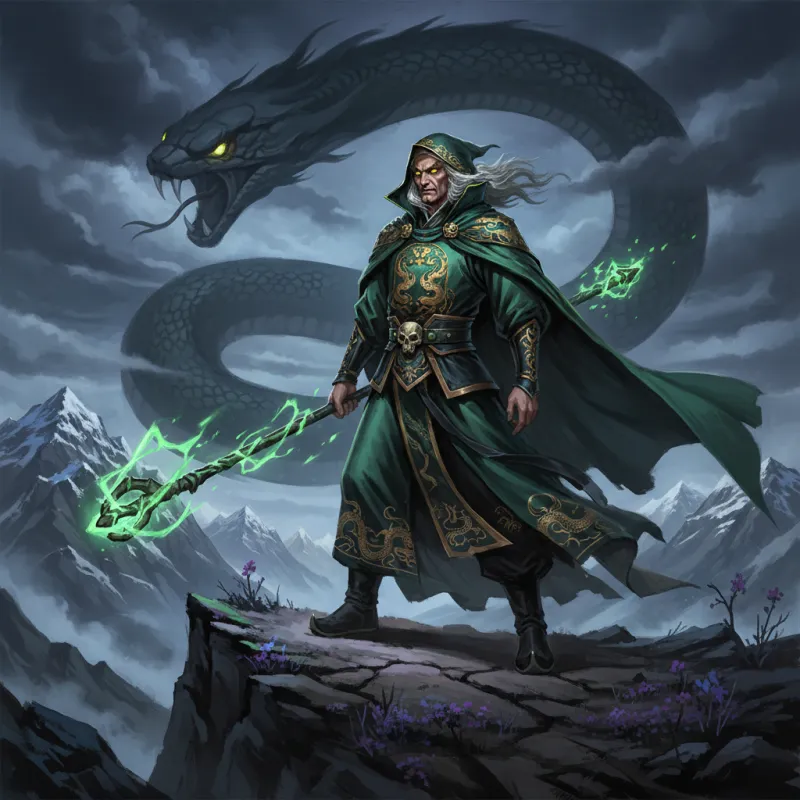
The madman laughs at the edge of the desert, his white hair whipping in the wind, unable to remember his own name but still capable of killing with a single strike. This is Ouyang Feng in his final form—a tragic descent that makes him one of Jin Yong's most psychologically complex villains. Unlike the straightforward evil of characters like Yue Buqun, Ouyang Feng's villainy stems from obsession, pride, and a twisted sense of honor that ultimately destroys everything he holds dear.
The Western Venom's Origins
Ouyang Feng (歐陽鋒, Ōuyáng Fēng) first appears in The Legend of the Condor Heroes (射鵰英雄傳, Shèdiāo Yīngxióng Zhuàn) as one of the Five Greats (五絕, Wǔ Jué)—the five most powerful martial artists in the world. His title, Western Venom (西毒, Xī Dú), reflects both his geographical domain in the Western Regions and his mastery of poison-based martial arts. He rules White Camel Mountain (白駝山, Bái Tuó Shān) in the Western Regions, a fortress that symbolizes his isolation from the orthodox martial world and his willingness to embrace techniques that others consider taboo.
What makes Ouyang Feng particularly dangerous isn't just his martial prowess—it's his intelligence. Jin Yong portrays him as a strategic thinker who manipulates events from behind the scenes, using others as pawns in his schemes. His signature technique, the Toad Stance (蛤蟆功, Hámá Gōng), is a grotesque but devastatingly effective martial art that channels internal energy in ways that mimic a toad's movements. It's ugly, unorthodox, and perfectly suited to his character.
The Obsession with Being Number One
Ouyang Feng's defining characteristic is his obsessive need to be recognized as the greatest martial artist in the world. This isn't mere vanity—it's a consuming hunger that drives every major decision he makes. When Hong Qigong and Wang Chongyang are alive, he knows he cannot claim the top position. So he schemes, he waits, and he plots.
The second Huashan Sword Tournament becomes his fixation. He doesn't just want to win through superior skill—he's willing to cheat, to poison, to manipulate the rules themselves. This reveals something crucial about his character: his pride is so fragile that he cannot accept losing fairly, yet so immense that he believes any method of winning is justified. It's a paradox that Jin Yong explores with remarkable psychological insight.
His rivalry with Hong Qigong, the Northern Beggar, provides some of the novel's most memorable confrontations. These two represent opposite poles of the martial world—Ouyang Feng's cold calculation versus Hong Qigong's warm-hearted righteousness. Their battles aren't just physical; they're philosophical debates conducted through fists and internal energy.
The Forbidden Love and Family Tragedy
Beneath the villain's exterior lies Ouyang Feng's most humanizing element: his unrequited love for his sister-in-law. This forbidden passion, never explicitly consummated in the original text but heavily implied, produces a son—Ouyang Ke (歐陽克, Ōuyáng Kè). The tragedy is that Ouyang Feng can never publicly acknowledge this relationship, forcing him to present Ouyang Ke as his nephew rather than his son.
This secret love transforms Ouyang Feng from a one-dimensional villain into something far more complex. His cruelty toward others contrasts sharply with his genuine affection for Ouyang Ke. When his son dies, killed during the schemes and battles that Ouyang Feng himself set in motion, we see the first cracks in his psychological armor. Jin Yong suggests that Ouyang Feng's subsequent descent into madness isn't just from practicing reversed martial arts—it's from the unbearable weight of grief and guilt.
The relationship also reveals Ouyang Feng's capacity for genuine emotion, which makes his villainy more disturbing. He's not evil because he lacks feelings; he's evil despite having them. He knows love, loss, and pain, yet still chooses to inflict suffering on others.
The Reversed Nine Yin Manual
The turning point in Ouyang Feng's story comes when he obtains a version of the Nine Yin Manual (九陰真經, Jiǔ Yīn Zhēn Jīng)—but it's been deliberately reversed by Zhou Botong as a prank. Ouyang Feng, in his arrogance, believes he can master even a reversed version of the world's most powerful martial arts text. This decision is quintessentially Ouyang Feng: brilliant, audacious, and ultimately self-destructive.
Practicing the reversed manual doesn't immediately destroy him. In fact, it initially makes him even more powerful, allowing him to defeat opponents he couldn't before. But the cost accumulates slowly—his mind begins to fracture, his memories become confused, and his personality splinters. Jin Yong uses this as a metaphor for how the pursuit of power at any cost inevitably corrupts and destroys.
The medical and martial arts theory here is fascinating. Jin Yong suggests that martial arts practice isn't just physical training but a form of mental and spiritual cultivation. Reversing the techniques means reversing the flow of qi (氣, qì) through the meridians, which gradually damages both body and mind. It's pseudoscience, certainly, but it works brilliantly as narrative symbolism.
The Descent into Madness
By The Return of the Condor Heroes (神鵰俠侶, Shén Diāo Xiá Lǚ), set years later, Ouyang Feng has completely lost his mind. He can't remember his name, his past, or even why he practices martial arts. Yet his body retains its muscle memory, making him perhaps even more dangerous—a pure fighting instinct without conscience or restraint.
This version of Ouyang Feng is both pitiable and terrifying. He wanders the martial world like a ghost, occasionally erupting into violence when triggered by half-remembered grudges. His encounters with Yang Guo and Huang Rong show that fragments of his former self remain buried beneath the madness, but they're inaccessible even to him.
Jin Yong's portrayal of mental illness here is surprisingly nuanced for a 1950s wuxia novel. Ouyang Feng's madness isn't played for laughs or simple horror—it's treated as a genuine tragedy, the inevitable endpoint of a life consumed by obsession and pride.
The Final Redemption
Ouyang Feng's death scene is one of Jin Yong's most moving passages. On Huashan Mountain, he finally remembers who he is—and immediately realizes everything he's lost. In his final moments of clarity, he achieves a kind of enlightenment, understanding that his lifelong pursuit of being number one was ultimately meaningless.
His final battle with Hong Qigong, both of them dying, is less a fight than a reconciliation. Two old enemies, stripped of pretense and pride, simply enjoying the pure art of martial combat one last time. They die together, and there's a strange peace in it—the Western Venom and the Northern Beggar, forever linked in death as they were in life.
This ending elevates Ouyang Feng beyond typical villainy. Jin Yong suggests that even the most twisted soul contains the possibility of understanding, if not quite redemption. Ouyang Feng never becomes good, but he becomes aware—and that awareness, coming at the moment of death, is its own form of tragedy.
Legacy and Adaptations
Ouyang Feng has been portrayed by numerous actors across decades of film and television adaptations, with each interpretation emphasizing different aspects of his character. Some play up his menace, others his tragic dimensions. Wong Kar-wai's Ashes of Time (1994) reimagines him as a melancholic figure haunted by lost love, stripping away much of the original's martial arts spectacle to focus on emotional devastation.
What remains consistent across adaptations is Ouyang Feng's status as one of Jin Yong's most psychologically rich villains. He's not evil for evil's sake—he's a man whose virtues (intelligence, determination, capacity for love) become vices when twisted by pride and obsession. In a genre often criticized for simplistic morality, Ouyang Feng stands as proof that wuxia can explore genuine psychological complexity.
The Western Venom reminds us that the most dangerous enemies aren't those who lack humanity—they're those who possess it but choose to ignore it. His tragedy isn't that he became a monster, but that he was always capable of being something better, and consciously chose not to be.
Related Reading
- Ren Yingying: Love and Freedom
- Unraveling the Heroes and Antiheroes of Jin Yong's Wuxia Novels
- Huang Rong: The Smartest Person in Jin Yong's Universe
- Jin Yong's Greatest Characters: The Ones You Never Forget
- Qiao Feng / Xiao Feng: The Tragic Hero Who Defined Wuxia
- Exploring the Intricate Sects within Jin Yong's Iconic Wuxia Novels
- Six Meridian Divine Sword: Invisible Blade
- The Complete Timeline of Events Across Jin Yong's Novels