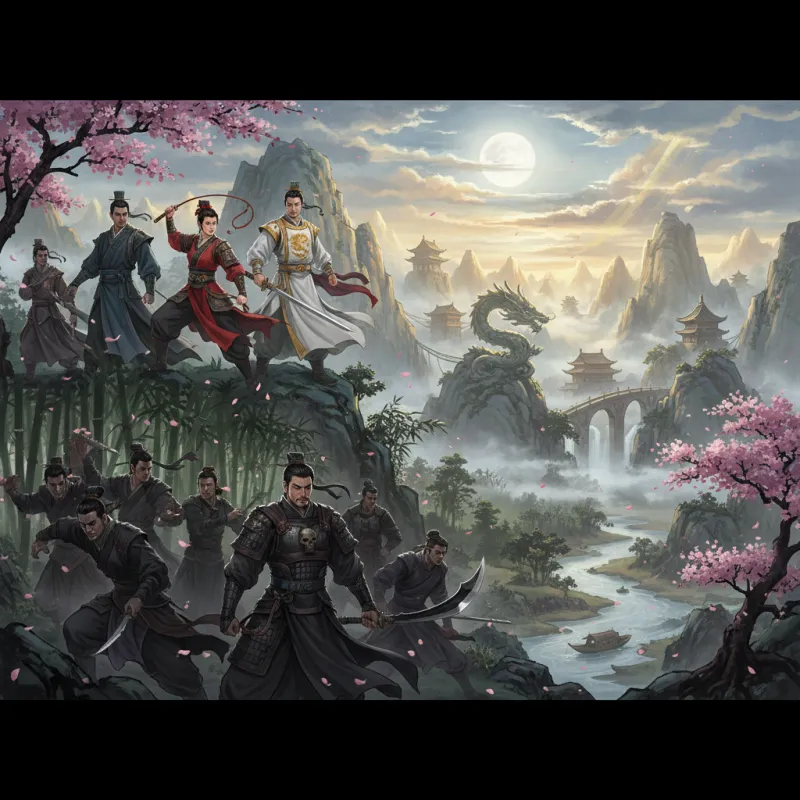
When Guo Jing stands atop the walls of Xiangyang, choosing certain death over abandoning his post, he embodies everything we think we know about wuxia heroes. But flip a few hundred pages to Yang Guo—the orphaned troublemaker who grows up to defy every convention of righteousness—and suddenly Jin Yong's moral universe becomes far more interesting. The genius of Louis Cha's sixteen novels isn't that he created perfect heroes and despicable villains. It's that he understood something most writers miss: the line between hero and antihero is drawn in sand, constantly shifting with perspective, circumstance, and the weight of impossible choices.
The Traditional Hero: Burden of Righteousness
Jin Yong's conventional heroes carry the weight of xia (侠, xiá)—that untranslatable concept blending chivalry, righteousness, and self-sacrifice. Guo Jing from The Legend of the Condor Heroes (射雕英雄传, Shèdiāo Yīngxióng Zhuàn) represents this archetype in its purest form. He's almost painfully straightforward: loyal to a fault, honest to the point of naivety, and willing to die for principles most people wouldn't even understand. When he refuses to abandon Xiangyang despite knowing the Mongol invasion will eventually succeed, he's not being strategic—he's being righteous.
But here's what makes Jin Yong brilliant: he never lets us forget the cost. Guo Jing's unwavering morality strains his marriage, alienates his daughter, and ultimately leads to his death. His best friend Huang Rong, far more pragmatic and clever, spends half their relationship frustrated by his inflexibility. The traditional hero in Jin Yong's world doesn't get a clean victory. He gets respect, certainly, but also loneliness and tragedy.
Xiao Feng (萧峰, Xiāo Fēng) from Demigods and Semi-Devils (天龙八部, Tiānlóng Bābù) takes this burden even further. As a Khitan raised among Han Chinese, he embodies righteousness so completely that when he discovers his true heritage, the cognitive dissonance nearly destroys him. His suicide at the end isn't weakness—it's the logical conclusion of a man who cannot reconcile his identity with his principles. Jin Yong seems to ask: what happens when being a hero means there's no place left for you in the world?
The Antihero: Charm in Imperfection
Then there's Yang Guo. If Guo Jing is the hero your parents want you to be, Yang Guo from The Return of the Condor Heroes (神雕侠侣, Shéndiāo Xiálǚ) is the one you actually want to read about. Rebellious, emotionally volatile, and willing to bend rules when it suits him, Yang Guo represents Jin Yong's most fascinating exploration of the antihero. He falls in love with his teacher—a relationship that violates every social convention of the jianghu (江湖, jiānghú, the martial arts world). He allies with "evil" sects when the "righteous" ones treat him poorly. He holds grudges, seeks revenge, and makes decisions based on personal loyalty rather than abstract morality.
Yet somehow, Yang Guo becomes heroic. His sixteen-year wait for Xiaolongnü demonstrates devotion that puts conventional heroes to shame. His defense of Xiangyang (yes, the same city Guo Jing dies protecting) shows that antiheroes can rise to the occasion when it matters. Jin Yong's message is clear: heroism isn't about following rules—it's about the choices you make when everything is on the line.
Wei Xiaobao (韦小宝, Wéi Xiǎobǎo) from The Deer and the Cauldron (鹿鼎记, Lùdǐng Jì) pushes this concept to its extreme. He's a liar, a con artist, and completely devoid of martial arts skills in a genre defined by them. He serves both the Qing Emperor and the anti-Qing resistance, playing both sides with shameless opportunism. By traditional standards, he shouldn't be a protagonist at all. Yet Jin Yong makes him the hero of his final novel, suggesting that perhaps survival, adaptability, and loyalty to friends matter more than rigid adherence to wuxia codes. Wei Xiaobao succeeds where more "heroic" characters fail precisely because he's not burdened by their moral constraints.
The Villain Who Isn't: Complexity in Antagonism
Jin Yong's antagonists often have more compelling motivations than his heroes. Ouyang Feng (欧阳锋, Ōuyáng Fēng), the "Western Venom," pursues martial arts supremacy with single-minded obsession, but his rivalry with Hong Qigong contains genuine respect. When he loses his memory and befriends Yang Guo, we see the person he might have been without his consuming ambition. His final moments—regaining his memory and dying while practicing martial arts—are almost tragic.
Yue Buqun (岳不群, Yuè Bùqún) from The Smiling, Proud Wanderer (笑傲江湖, Xiào'ào Jiānghú) represents something more sinister: the hypocrite who wears righteousness as a mask. As leader of the Huashan Sect, he preaches orthodox values while secretly practicing the evil Sunflower Manual (葵花宝典, Kuíhuā Bǎodiǎn). Jin Yong uses him to critique the very concept of orthodox versus heterodox martial arts—suggesting that the "righteous" sects can be more corrupt than the "evil" ones they condemn. This connects directly to the broader theme of martial arts sects and their philosophies that Jin Yong explores throughout his works.
The Gray Zone: Where Heroes and Antiheroes Meet
The most interesting characters exist in the space between. Linghu Chong (令狐冲, Línghú Chōng) from The Smiling, Proud Wanderer starts as a conventional hero but becomes increasingly disillusioned with orthodox martial arts politics. He befriends members of the "evil" Sun Moon Holy Cult, drinks excessively, and refuses leadership positions that would require him to play political games. He's heroic in his loyalty and skill, but antiheroic in his rejection of the system.
Duan Yu (段誉, Duàn Yù) from Demigods and Semi-Devils takes a different approach. As a prince who refuses to learn martial arts due to Buddhist principles, he accidentally becomes one of the most powerful fighters in the jianghu through a series of fortunate encounters. His pacifism in a violent world makes him both admirable and frustrating—he has the power to stop conflicts but often won't use it. Jin Yong seems to question whether non-violence is truly heroic when it allows evil to flourish.
Zhang Wuji (张无忌, Zhāng Wújì) from The Heaven Sword and Dragon Saber (倚天屠龙记, Yǐtiān Túlóng Jì) embodies indecision as a character trait. He becomes leader of the Ming Cult but constantly wavers between women, between loyalty to different factions, between action and inaction. Traditional readers find him frustrating, but Jin Yong might be making a point: real people aren't decisive action heroes. They struggle, doubt, and make mistakes. Zhang Wuji's humanity—his very unheroic hesitation—makes him more relatable than the unwavering Guo Jing.
The Female Factor: Heroines Beyond the Male Gaze
Jin Yong's female characters complicate the hero-antihero dynamic further. Huang Rong is brilliant, manipulative, and willing to use her beauty as a weapon—traits that would make a male character an antihero. Yet she's also fiercely loyal and ultimately heroic. Zhao Min (赵敏, Zhào Mǐn) from The Heaven Sword and Dragon Saber starts as an antagonist—a Mongol princess working against Han Chinese rebels—but her intelligence, determination, and eventual love for Zhang Wuji transform her into one of Jin Yong's most beloved characters.
Ren Yingying (任盈盈, Rèn Yíngyíng) from The Smiling, Proud Wanderer is the daughter of the "evil" cult leader but demonstrates more genuine righteousness than many orthodox sect members. Her relationship with Linghu Chong shows that love can bridge the supposed divide between good and evil factions. These women aren't simply love interests—they're active participants in the moral complexity that defines Jin Yong's universe, much like the complex female characters who deserve their own detailed analysis.
The Evolution of Jin Yong's Moral Vision
Reading Jin Yong's novels chronologically reveals a fascinating evolution. His early works like The Book and the Sword (书剑恩仇录, Shūjiàn Ēnchóu Lù) feature more conventional heroes and villains. By the time he writes Demigods and Semi-Devils in the 1960s, the moral landscape has become almost impossibly complex—the novel features multiple protagonists with conflicting loyalties and no clear villains, just people making terrible choices for understandable reasons.
The Deer and the Cauldron, his final novel completed in 1972, abandons traditional heroism entirely. Wei Xiaobao's success through cunning rather than martial prowess suggests Jin Yong had grown skeptical of the very genre he mastered. It's as if he spent fifteen years building up the mythology of wuxia heroes only to deconstruct it completely in his final work.
Why the Distinction Matters
Jin Yong's blurring of hero and antihero isn't just literary sophistication—it reflects real moral complexity. In the jianghu, as in life, people aren't simply good or evil. They're products of their circumstances, their traumas, their loyalties, and their choices. Guo Jing's righteousness is admirable but inflexible. Yang Guo's rebelliousness is problematic but authentic. Wei Xiaobao's opportunism is distasteful but effective.
The enduring appeal of Jin Yong's work lies in this refusal to provide easy answers. His heroes struggle with doubt. His antiheroes perform heroic acts. His villains have comprehensible motivations. This moral ambiguity makes his characters feel real in a way that simple archetypes never could. When modern readers debate whether Yang Guo or Guo Jing is the "better" hero, they're missing the point—Jin Yong created both to show that heroism has many faces, and sometimes the most heroic thing is admitting you don't have all the answers.
The jianghu Jin Yong created isn't a fantasy world where good always triumphs. It's a mirror reflecting our own moral struggles, dressed in the elegant clothing of martial arts fiction. His heroes and antiheroes endure because they remind us that righteousness is complicated, heroism is costly, and sometimes the person who breaks all the rules is exactly the hero we need.
Related Reading
- The Enduring Legacy of Jin Yong’s Wuxia Characters and Martial Arts
- Xiao Longnü: The Maiden Beyond the World
- Ouyang Feng: The Western Venom
- Jin Yong's Greatest Characters: The Heroes, Villains, and Everyone in Between
- Huang Rong: The Smartest Person in Jin Yong's Universe
- Nationalism and Identity in Jin Yong's Novels
- Alternative Endings Fans Wish Jin Yong Had Written
- Jin Yong: The Man Behind the Martial Arts World