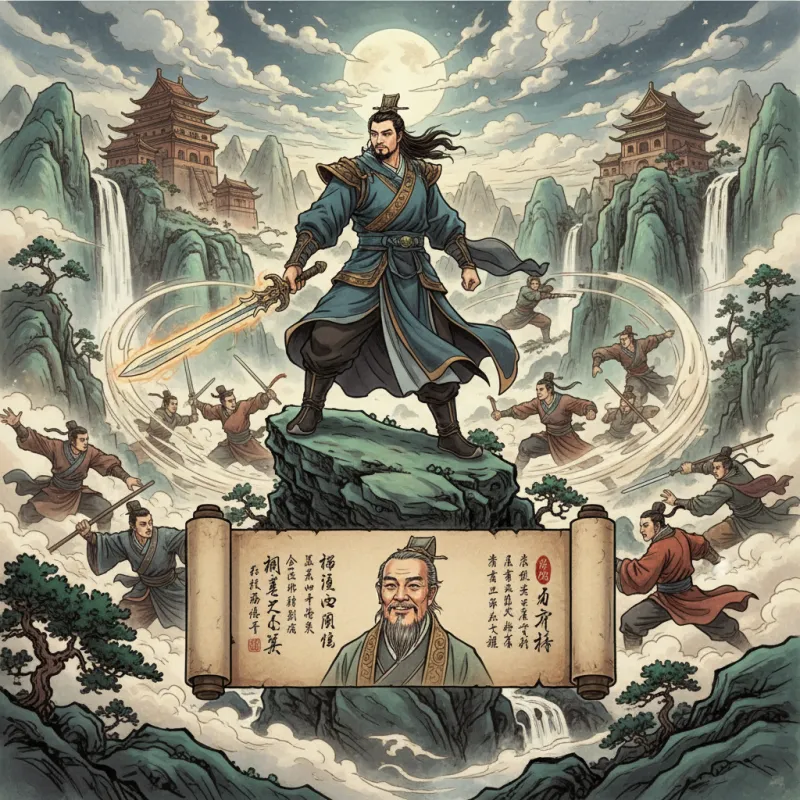
When Louis Cha sat down to write his first serialized novel in 1955, he had no idea he was about to accidentally invent modern Chinese popular culture. He was just a 31-year-old journalist trying to boost newspaper sales. Sixty-nine years later, his pen name Jin Yong (金庸 Jīn Yōng) is more recognizable in the Chinese-speaking world than his own face, and his fourteen wuxia novels have become the shared mythology of over a billion people.
The Accidental Architect of a Genre
Jin Yong didn't create wuxia fiction — martial arts novels existed long before him, stretching back to the Ming Dynasty's Water Margin and beyond. But what he did was transform a pulpy, disreputable genre into legitimate literature. Before Jin Yong, wuxia was what your grandmother read on the bus. After Jin Yong, it was what literature professors taught in universities.
His first novel, The Book and the Sword (書劍恩仇錄 Shū Jiàn Ēnchóu Lù), began serialization in 1955 in Hong Kong's New Evening Post. The newspaper's circulation doubled. Cha realized he'd stumbled onto something, and over the next seventeen years, he wrote at a pace that would kill most modern authors — often serializing two novels simultaneously while running a newspaper empire. By 1972, when he completed The Deer and the Cauldron (鹿鼎記 Lù Dǐng Jì), he'd created an entire fictional universe that felt more real to readers than actual Chinese history.
What made his work different? Three things: psychological depth, historical authenticity, and moral complexity. His heroes weren't perfect. Guo Jing was loyal but dim. Yang Guo was brilliant but arrogant. Wei Xiaobao was a lying, gambling, womanizing conman who somehow became the most beloved protagonist in Chinese literature. Jin Yong understood that readers don't want saints — they want people.
The Man Behind the Mythology
Louis Cha Leung-yung (查良鏞 Zhā Liángyōng) was born on March 10, 1924, in Haining, Zhejiang Province, into a family so distinguished that tracing their scholarly lineage was basically a full-time job. His ancestors included Qing Dynasty officials and the famous poet Xu Zhimo was a distant relative. This wasn't a man who stumbled into literacy — he was born into it, marinated in classical Chinese literature from childhood.
But his privileged background collided brutally with twentieth-century Chinese reality. His father was executed during the Communist land reforms in 1951, accused of being a landlord and counter-revolutionary. Cha was in Hong Kong by then, already working as a journalist, and the news devastated him. He never returned to mainland China for decades, and the trauma of that loss — of family, of homeland, of certainty — bleeds through every novel he wrote. His obsession with loyalty, betrayal, and the moral ambiguity of political movements wasn't academic. It was personal.
He channeled that pain into journalism first, co-founding Ming Pao (明報) in 1959, which became one of Hong Kong's most respected newspapers. By day, he wrote editorials about politics and social issues. By night, he wrote about wandering swordsmen and forbidden love. The two weren't as separate as you'd think — his novels are deeply political, constantly interrogating questions of power, justice, and what individuals owe to nations that betray them.
The Novels That Rewired a Culture
Between 1955 and 1972, Jin Yong wrote fourteen novels, and trying to pick the "best" one is like trying to pick your favorite child — everyone has an opinion and they're all willing to fight about it. But certain novels stand out for their cultural impact.
The Legend of the Condor Heroes (射鵰英雄傳 Shè Diāo Yīngxióng Zhuàn, 1957-1959) established the template: a coming-of-age story set against the Mongol invasion of China, featuring the earnest hero Guo Jing and the clever Huang Rong. It's the novel that made Jin Yong a household name, and its sequel, The Return of the Condor Heroes (神鵰俠侶 Shén Diāo Xiá Lǚ, 1959-1961), pushed boundaries by featuring a romance between a student and his teacher — scandalous in the 1960s, still controversial today.
Demi-Gods and Semi-Devils (天龍八部 Tiān Lóng Bā Bù, 1963-1966) is often considered his most ambitious work, weaving together three protagonists, multiple kingdoms, and Buddhist philosophy into a sprawling epic about identity and fate. It's also brutally tragic — almost everyone dies, and not heroically. They die stupidly, pointlessly, the way people actually die in wars.
But his final novel, The Deer and the Cauldron (1969-1972), might be his masterpiece precisely because it deconstructs everything he'd built. The protagonist Wei Xiaobao can't do martial arts, doesn't care about honor, and succeeds through luck, charm, and shameless opportunism. It's a comedy, a satire, and a middle finger to every wuxia convention Jin Yong himself had established. After writing it, he retired from fiction entirely. He'd said everything he needed to say.
The Revision Obsession
Here's something most Western readers don't know: the Jin Yong novels you can read today aren't the originals. Between 1970 and 1980, Cha revised all fourteen novels, sometimes extensively. Then he revised them again between 1999 and 2006. He was a perfectionist who couldn't stop tinkering, and the changes weren't minor — he altered plot points, rewrote endings, and even changed character fates.
Some revisions improved the novels. Others sparked riots among fans who preferred the original versions. When he changed the ending of Demi-Gods and Semi-Devils in the 2005 revision, the internet exploded with outrage. Imagine if J.K. Rowling went back and changed who Harry Potter married — that's the level of controversy we're talking about.
This obsessive revision reveals something essential about Cha's character: he was never satisfied. Even after becoming the most successful Chinese author of the twentieth century, even after his novels had been adapted into hundreds of films and TV series, he kept trying to make them better. Whether he succeeded is still debated in Chinese literary circles, usually over drinks, often loudly.
Beyond the Novels
Jin Yong's influence extends far beyond the fourteen novels. He shaped Hong Kong's political discourse through Ming Pao, advocating for democracy and human rights while navigating the impossible position of being caught between British colonial rule and Chinese Communist power. He was appointed to help draft Hong Kong's Basic Law, the mini-constitution that would govern the territory after the 1997 handover to China.
His relationship with mainland China was complicated. After decades of exile, he finally visited in 1981, meeting with Deng Xiaoping. The Communist Party, which had once banned his novels as "spiritual pollution," gradually embraced him as a cultural ambassador. By the 2000s, his works were taught in Chinese universities, and he received honorary doctorates from institutions that would have imprisoned him fifty years earlier.
He also became an academic late in life, earning a Ph.D. in Chinese history from Cambridge University at age 81. His dissertation examined the legal codes of the Tang Dynasty — because apparently writing fourteen novels and running a newspaper empire wasn't enough intellectual stimulation.
The Legacy That Won't Die
Jin Yong passed away on October 30, 2018, at age 94, and the outpouring of grief across the Chinese-speaking world was immediate and overwhelming. Presidents issued statements. Newspapers ran special editions. Social media flooded with tributes. It wasn't just that a famous author had died — it felt like a piece of collective childhood had disappeared.
But his legacy isn't going anywhere. His novels continue to sell millions of copies annually. New adaptations appear constantly — the 2021 The Legend of the Condor Heroes series introduced his work to yet another generation. Video games, comics, theme parks, and academic conferences keep his universe alive and expanding.
More importantly, his influence on Chinese storytelling is permanent. Every modern wuxia novel, film, or game exists in conversation with Jin Yong's work, either building on his foundations or deliberately subverting them. Writers like the creators of contemporary wuxia are still grappling with the genre he defined.
His novels also created a shared cultural vocabulary. When Chinese speakers talk about loyalty, they reference Guo Jing. When discussing romantic devotion, they mention Yang Guo and Xiaolongnü. When debating the nature of heroism, they argue about whether Wei Xiaobao counts. Jin Yong's characters have become archetypes, his plots have become parables, and his martial arts techniques — entirely fictional — are discussed as if they were real historical practices.
The Writer Who Became a World
What's remarkable about Jin Yong isn't just that he wrote popular novels. It's that he created an entire fictional universe that feels more coherent, more lived-in, and more emotionally true than most actual histories. His jianghu (江湖 jiānghú) — the martial arts underworld that serves as the setting for his novels — has its own geography, politics, ethics, and logic. Readers don't just enjoy his stories; they inhabit his world.
This is why comparing Jin Yong to Western authors always falls short. He's not the Chinese Tolkien, though both created detailed fantasy worlds. He's not the Chinese Shakespeare, though both shaped their language's literary canon. He's something unique: a popular novelist who accidentally became a civilization's shared mythology while still alive to see it happen.
Louis Cha spent his life writing about wandering heroes searching for justice in a corrupt world, about individuals caught between personal loyalty and political duty, about the gap between the ideals we profess and the compromises we make. He wrote about these things because he lived them. And in writing about them, he gave millions of readers a way to understand their own lives, their own choices, their own impossible positions between competing loyalties.
That's not just good writing. That's literature that matters. And that's why, decades after he stopped writing fiction, Jin Yong's name still means something that transcends authorship — it means a world you can escape into, a moral framework you can argue with, and a set of stories that feel true even when they're impossible. For a journalist who just wanted to sell newspapers, that's not a bad legacy.
Related Reading
- Jin Yong Reading Order Guide: Where to Start
- Gu Long vs. Jin Yong: The Great Wuxia Debate
- The Major Themes in Jin Yong's Novels
- The Literary Depth of Jin Yong's Martial Arts Fiction
- Exploring the Intricate Sects within Jin Yong's Iconic Wuxia Novels
- The Greatest Villains in Jin Yong's Novels
- The Enigmatic Hidden Techniques in Jin Yong’s Wuxia Novels Explored