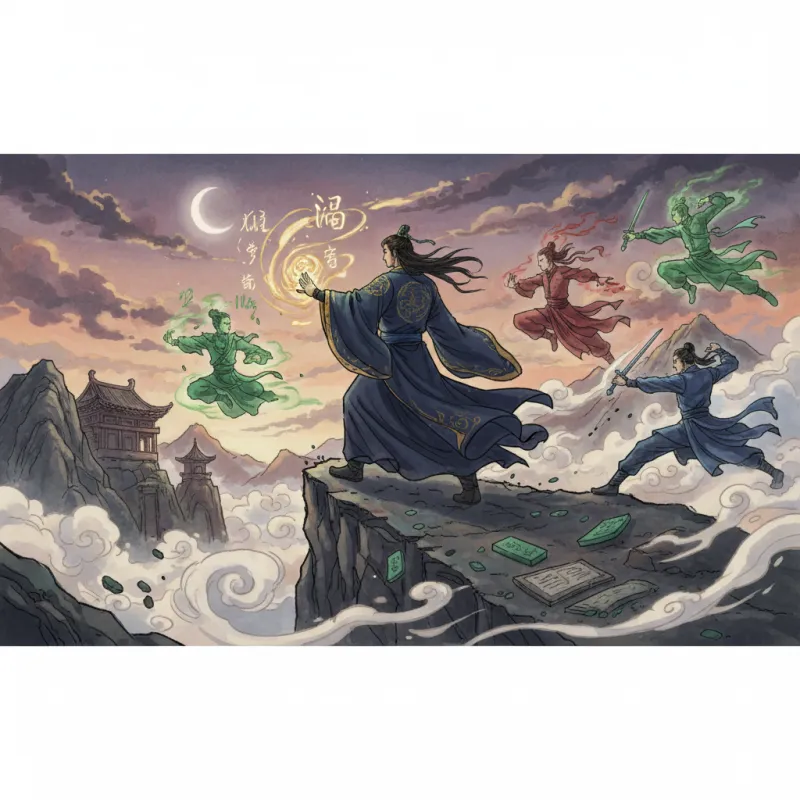
When Duan Yu stumbles into a hidden cave in Demi-Gods and Semi-Devils (天龙八部, Tiānlóng Bābù) and discovers the Beiming Divine Art (北冥神功, Běimíng Shéngōng) etched on ancient scrolls, he doesn't just find a powerful technique—he unlocks one of Jin Yong's most fascinating narrative devices. These hidden techniques, scattered throughout Jin Yong's fifteen novels like buried treasure, aren't merely plot conveniences. They're philosophical statements about power, destiny, and the price of greatness wrapped in the silk of martial arts fantasy.
The Architecture of Secrecy
Jin Yong constructs his hidden techniques with deliberate layers of concealment. Unlike openly practiced martial arts taught in established schools, these secret methods exist in margins—carved on cliff faces, hidden in Buddhist sutras, or passed down through cryptic oral traditions. The Nine Yin Manual (九阴真经, Jiǔyīn Zhēnjīng) from The Legend of the Condor Heroes (射雕英雄传, Shèdiāo Yīngxióng Zhuàn) exemplifies this perfectly. Written in Sanskrit, hidden in a fake Buddhist scripture, the manual requires not just martial prowess but scholarly cultivation to even access its contents.
This architectural secrecy serves multiple purposes. First, it creates natural scarcity—when only three people in the entire martial world can practice the Sunflower Manual (葵花宝典, Kuíhuā Bǎodiǎn), its appearance transforms the power dynamics of an entire novel. Second, the difficulty of acquisition tests character. Zhou Botong learns the Nine Yin Manual by accident and refuses to practice it out of principle, while Ouyang Feng drives himself mad trying to practice a deliberately corrupted version. The technique doesn't just measure martial ability—it measures moral fiber.
The Price of Power
Here's where Jin Yong gets genuinely dark: his most powerful hidden techniques demand horrifying sacrifices. The Sunflower Manual, featured in The Smiling, Proud Wanderer (笑傲江湖, Xiàoào Jiānghú), requires self-castration before practice. This isn't gratuitous shock value—it's Jin Yong forcing readers to confront an uncomfortable question: what would you sacrifice for ultimate power?
Yue Buqun's descent into monstrosity after practicing the Sunflower Manual becomes one of Jin Yong's most chilling character arcs. The respectable sect leader who preached Confucian righteousness mutilates himself in secret, then watches his humanity erode technique by technique. The forbidden martial arts in Jin Yong's universe consistently corrupt their practitioners, suggesting that power obtained through shortcuts and secrets carries inherent moral poison.
The Beiming Divine Art presents a different cost structure—it allows practitioners to absorb others' internal energy, essentially stealing decades of cultivation in moments. Duan Yu, characteristically naive, stumbles into this technique and uses it almost accidentally. But Ding Chunqiu, who practices a similar absorption technique, becomes a parasitic monster who drains his own disciples. Same mechanism, different moral outcomes—Jin Yong's way of showing that techniques themselves aren't evil, but they amplify existing character flaws to catastrophic proportions.
Hidden Techniques as Narrative Engines
Jin Yong uses these secret methods to solve a fundamental storytelling problem: how do you make a protagonist powerful enough to matter without making them boringly invincible? The answer: give them incomplete knowledge, dangerous techniques, or powers they can't fully control.
Zhang Wuji's learning of the Heaven and Earth Great Shift (乾坤大挪移, Qiánkūn Dà Nuóyí) in The Heaven Sword and Dragon Saber (倚天屠龙记, Yǐtiān Túlóng Jì) demonstrates this brilliantly. Trapped in a secret passage, he masters in hours what should take decades—but only because he's already cultivated the Nine Yang Divine Skill (九阳神功, Jiǔyáng Shéngōng). The technique doesn't make him instantly supreme; it makes him competitive. He still loses fights, still makes tactical errors, still grows throughout the novel.
Compare this to Western fantasy's tendency toward linear power progression. Jin Yong's hidden techniques create lateral complexity instead. Guo Jing, the protagonist of The Legend of the Condor Heroes, learns the Eighteen Dragon-Subduing Palms (降龙十八掌, Xiánglóng Shíbā Zhǎng) through conventional training, but his true breakthrough comes from understanding the Nine Yin Manual's internal energy cultivation. The hidden technique doesn't replace his existing skills—it creates synergies, multiplicative effects that reward readers who pay attention to the technical details.
The Philosophy of Concealment
Why hide these techniques in the first place? Jin Yong's novels suggest multiple answers, all rooted in Chinese philosophical traditions. The Taoist concept of 天机不可泄露 (tiānjī bù kě xièlòu)—"heaven's secrets must not be revealed"—permeates these narratives. Some knowledge is dangerous not because it's evil, but because humanity isn't ready for it.
The ancient martial arts manuscripts in Jin Yong's world often come with explicit warnings. The creator of the Nine Yin Manual, Huang Shang, hid his work because he understood its potential for abuse. He wasn't being elitist—he was being responsible. When Mei Chaofeng and Chen Xuanfeng steal an incomplete version and practice only the lethal techniques without the ethical framework, they become the Nine Yin Skeleton Claws, terrorizing the martial world for decades.
This reflects a deeply Confucian anxiety about knowledge without virtue. The hidden techniques aren't hidden from the worthy—they're hidden from the unworthy, and the process of discovery itself serves as a moral filter. Those who seek power for its own sake, like Qiu Qianren or Ouyang Feng, either fail to find the techniques or destroy themselves in the practice. Those who stumble upon them through fate, like Duan Yu or Guo Jing, tend to use them more responsibly.
The Irony of Incompleteness
Jin Yong loves a good ironic twist, and his hidden techniques provide ample opportunity. The most powerful martial arts in his universe are often incomplete, corrupted, or misunderstood—and sometimes that's what makes them interesting.
Ouyang Feng's backward practice of the Nine Yin Manual in The Legend of the Condor Heroes should have killed him. Instead, it creates something new and terrifying: a martial art that defies conventional counters because it operates on inverted principles. He becomes more dangerous with the wrong version than he might have been with the correct one. This isn't just plot convenience—it's Jin Yong suggesting that creativity and adaptation sometimes matter more than orthodox mastery.
The Yijin Jing (易筋经, Yìjīn Jīng), or Muscle-Tendon Change Classic, appears in multiple novels with different interpretations. In Demi-Gods and Semi-Devils, it's a Shaolin treasure that heals internal injuries. In The Smiling, Proud Wanderer, it's the foundation technique that makes other advanced skills possible. Jin Yong deliberately keeps these techniques somewhat vague and contradictory across novels, acknowledging that martial arts mythology, like all mythology, exists in multiple valid versions.
Hidden Techniques and Social Commentary
Beneath the fantasy, Jin Yong uses hidden techniques to comment on Chinese society's relationship with knowledge, power, and tradition. Written during the 1950s-1970s, his novels reflect anxieties about cultural revolution, the destruction of traditional knowledge, and the question of who deserves to inherit China's martial heritage.
The recurring motif of techniques hidden in Buddhist or Taoist temples speaks to the historical role of religious institutions as preservers of knowledge during chaotic periods. When the Shaolin Temple burns in The Heaven Sword and Dragon Saber, the loss isn't just architectural—it's the potential destruction of irreplaceable martial knowledge. Jin Yong, writing during the Cultural Revolution's assault on traditional culture, wasn't being subtle.
The generational transmission of hidden techniques also matters. In The Return of the Condor Heroes (神雕侠侣, Shéndiāo Xiálǚ), Yang Guo learns the Toad Stance (蛤蟆功, Hámá Gōng) from Ouyang Feng, who's gone mad and forgotten his own identity. The technique passes from master to student despite complete social breakdown—suggesting that genuine knowledge transcends institutional structures and personal relationships. It's a quietly radical idea in a Confucian context that emphasizes proper hierarchies and formal transmission.
The Modern Resonance
Why do these hidden techniques still captivate readers decades after Jin Yong wrote them? Partly because they tap into universal fantasies about discovering hidden potential within ourselves. But more specifically, they represent a particularly Chinese approach to power fantasy—one that emphasizes cultivation, patience, and moral worthiness over raw talent or destiny.
The secret training methods in Jin Yong's novels require time. Even when characters learn quickly by wuxia standards, they're still investing months or years. Zhang Wuji spends years cultivating the Nine Yang Divine Skill before it fully matures. This delayed gratification feels increasingly countercultural in an age of instant results and life hacks.
Moreover, Jin Yong's hidden techniques rarely make their practitioners invincible. They create advantages, open possibilities, but victory still requires strategy, allies, and often luck. When Zhang Wuji faces the Six Major Sects at Brightness Peak, his superior internal energy helps—but he wins through negotiation and moral authority, not just martial supremacy. The hidden technique enables his heroism; it doesn't replace it.
The Legacy of Secrecy
Jin Yong's approach to hidden techniques has influenced generations of Chinese fantasy writers, game designers, and filmmakers. The entire cultivation novel (修真小说, xiūzhēn xiǎoshuō) genre, now globally popular through translations, builds on his framework of secret techniques, dangerous knowledge, and power obtained through discovery rather than inheritance.
But Jin Yong's version remains distinctive for its restraint. Modern cultivation novels often feature protagonists collecting techniques like Pokemon cards, stacking power-ups until they become gods. Jin Yong's heroes typically master one or two hidden techniques at most, and those techniques create as many problems as they solve. Duan Yu's Beiming Divine Art makes him powerful but also makes him a target. Linghu Chong's absorption of different internal energies nearly kills him multiple times before Ren Woxing helps him reconcile them.
This restraint reflects Jin Yong's fundamentally humanistic worldview. His hidden techniques are powerful, yes, but they're not solutions. They're complications, tests, opportunities for characters to reveal who they really are under pressure. The techniques themselves are morally neutral—it's what characters do with them that matters.
The enigmatic hidden techniques in Jin Yong's novels work because they're never just about martial arts. They're about the seductive danger of shortcuts, the responsibility that comes with power, and the question of what we're willing to sacrifice for strength. When modern readers encounter these techniques, whether in the original novels or their countless adaptations, they're engaging with questions that transcend the wuxia genre: What is power worth? Who deserves knowledge? And what happens when we find something we weren't meant to find?
Related Reading
- Wine Culture in Jin Yong's Wuxia World
- The 20 Strongest Characters in Jin Yong's Universe: A Definitive Ranking
- Huang Rong: The Smartest Person in Jin Yong's Universe