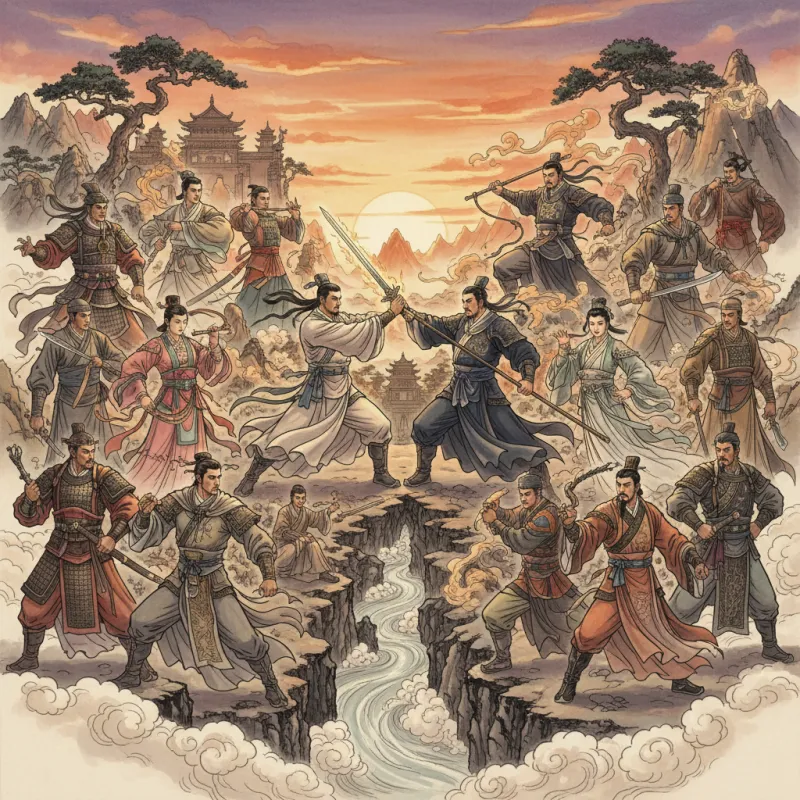
Ask ten Jin Yong (金庸 Jīn Yōng) fans to rank the strongest characters, and you'll get twelve different lists and a fistfight. I've been in those arguments. I've lost friendships over whether Dugu Qiubai could take Zhang Sanfeng. But after reading through all fifteen novels multiple times, cross-referencing power feats, and accounting for narrative context, I'm ready to stake my claim. This isn't just another tier list—it's a defensible hierarchy based on demonstrated abilities, canonical statements, and the internal logic of Jin Yong's martial world. Disagree? Good. That's what the comments are for.
The Untouchables: Characters Who Transcend Combat
1. The Sweeping Monk (扫地僧 Sǎodì Sēng)
He appears for exactly one scene in 天龙八部 (Tiānlóng Bābù, Demi-Gods and Semi-Devils), sweeping leaves in the Shaolin scripture repository. Then he casually stops Xiao Yuanshan and Murong Bo—two grandmasters who've been secretly studying Shaolin's 72 arts for decades—with invisible qi barriers. He resurrects Xiao Feng's adoptive father with Buddhist healing techniques. He explains that martial arts without Buddhist cultivation leads to self-destruction, revealing he's been secretly protecting every Shaolin monk who studied forbidden techniques for the past forty years.
The Sweeping Monk doesn't just win fights. He operates on a different plane entirely. His martial arts are inseparable from spiritual cultivation, making him less a fighter and more a force of nature. Jin Yong himself confirmed in interviews that this character represents the ultimate synthesis of martial skill and Buddhist enlightenment—a ceiling no other character reaches.
2. Dugu Qiubai (独孤求败 Dúgū Qiúbài)
We never meet him. He's been dead for decades before 神雕侠侣 (Shéndiāo Xiálǚ, The Return of the Condor Heroes) begins. Yet his legend shapes the entire series. Yang Guo finds his sword tomb and discovers four stages of swordsmanship: the sharp sword (youth), the soft sword (maturity), the heavy sword (mastery), and no sword at all (transcendence). By the end of his life, Dugu Qiubai fought with a wooden stick because metal swords were unnecessary.
His name means "Lonely Seeking Defeat"—he spent his final decades unable to find a worthy opponent. The Divine Eagle that guides Yang Guo was his only companion. This isn't speculation; it's textual fact. When Yang Guo masters the heavy sword technique, he becomes one of the strongest fighters of his generation. Dugu Qiubai was doing this in his thirties, then moved beyond it entirely.
3. Zhang Sanfeng (张三丰 Zhāng Sānfēng)
The founder of Wudang (武当 Wǔdāng) and creator of Taiji Quan (太极拳 Tàijí Quán). In 倚天屠龙记 (Yǐtiān Túlóng Jì, The Heaven Sword and Dragon Saber), he's over a hundred years old and still the most dangerous person alive. When six major sects besiege Wudang, he defeats their combined leadership without killing anyone—a harder feat than simply winning.
What sets Zhang Sanfeng apart is innovation. He created an entirely new martial system based on Daoist principles of yielding and circular motion. His Taiji philosophy influences every subsequent generation. Zhang Wuji, the protagonist, only reaches his level after mastering the Nine Yang Divine Skill and the Heaven and Earth Great Shift—and even then, it's debatable whether he surpasses his great-grandmaster.
The Grandmaster Tier: Peak Human Achievement
4. Wang Chongyang (王重阳 Wáng Chóngyáng)
The winner of the first Huashan Sword Tournament (华山论剑 Huàshān Lùnjiàn) in 射雕英雄传 (Shèdiāo Yīngxióng Zhuàn, The Legend of the Condor Heroes). He defeated the other Four Greats—Eastern Heretic, Western Venom, Southern Emperor, and Northern Beggar—to claim the Nine Yin Manual (九阴真经 Jiǔyīn Zhēnjīng). This wasn't a close contest. The text makes clear he was definitively superior.
Wang Chongyang's Innate Skill (先天功 Xiāntiān Gōng) represents pure internal energy cultivation. Even after his death, his techniques remain the gold standard. When Zhou Botong, his junior disciple, fights using Wang's methods, he holds his own against the next generation's best fighters despite being elderly.
5. Xiaoyao Zi (逍遥子 Xiāoyáo Zǐ)
The founder of the Carefree Sect (逍遥派 Xiāoyáo Pài) in 天龙八部. Like Dugu Qiubai, we never meet him, but his legacy is overwhelming. He created the Northern Darkness Divine Skill (北冥神功 Běimíng Shéngōng), which allows practitioners to absorb others' internal energy. He taught three disciples who each became legendary: Wu Yazi (master of chess and martial arts), Li Qiushui (peerless beauty and fighter), and Tianshan Tonglao (the Child Elder of Heaven Mountain).
The fact that his students include some of the strongest characters in 天龙八部—a novel set in an earlier, more martially advanced era—suggests Xiaoyao Zi himself was beyond their level. His techniques emphasize freedom and natural flow, anticipating Zhang Sanfeng's Daoist approach by centuries.
6. Xiao Feng (萧峰 Xiāo Fēng)
The only active fighter in the top ten. Xiao Feng, also known as Qiao Feng (乔峰 Qiáo Fēng), is the protagonist of 天龙八部 and the most straightforward combatant on this list. He doesn't have secret techniques or mystical powers. He's just devastatingly effective.
His Dragon-Subduing Eighteen Palms (降龙十八掌 Jiàngláng Shíbā Zhǎng) is pure offensive power—no tricks, no subtlety, just overwhelming force delivered with perfect technique. In direct combat, he defeats nearly everyone he faces. When he fights Murong Fu, who's studied hundreds of martial arts styles and can counter any technique, Xiao Feng wins through sheer superiority of execution. His tragedy is that his greatest battles are against fate and identity, not opponents.
7. Duan Yu's Peak Form (段誉 Duàn Yù)
This requires qualification. Early Duan Yu is useless in a fight—he refuses to learn martial arts on Buddhist principles. But by the end of 天龙八部, he's accidentally absorbed the internal energy of dozens of masters through the Northern Darkness Divine Skill. Combined with the Six Meridians Divine Sword (六脉神剑 Liùmài Shénjiàn), which fires invisible sword qi from his fingertips, peak Duan Yu is nearly unstoppable.
The Six Meridians Divine Sword is Duan family's ultimate technique, lost for generations. It requires immense internal energy to use—energy Duan Yu has in abundance thanks to his accidental cultivation. In pure destructive capability, it rivals anything in Jin Yong's universe. The catch is consistency; Duan Yu's pacifist nature means he rarely fights at full capacity.
8. Xu Zhu (虚竹 Xū Zhú)
Another accidental master from 天龙八部. Xu Zhu, a simple Shaolin monk, receives the complete internal energy of three grandmasters: Wu Yazi, Tianshan Tonglao, and Li Qiushui. This gives him over two hundred years of accumulated power—more raw energy than almost anyone in the series.
He lacks combat experience and tactical sophistication, but his sheer energy reserves make him formidable. When he uses the Tianshan Plum-Breaking Hand (天山折梅手 Tiānshān Zhéméi Shǒu) or the Life-Death Talisman (生死符 Shēngsǐ Fú), he's operating with power levels that compensate for his naivety. By the novel's end, he's the leader of the Carefree Sect and one of the strongest active fighters in the world.
The Elite Tier: Masters Who Define Their Eras
9. Zhang Wuji (张无忌 Zhāng Wújì)
The protagonist of 倚天屠龙记 and possibly the most powerful active fighter in Jin Yong's later-era novels. He masters the Nine Yang Divine Skill (九阳神功 Jiǔyáng Shéngōng), giving him nearly unlimited internal energy and immunity to most poisons and cold-based attacks. He then learns the Heaven and Earth Great Shift (乾坤大挪移 Qiánkūn Dà Nuóyí), a technique for redirecting force that previous Ming Cult leaders took decades to master—Zhang Wuji does it in hours.
His weakness is temperament. Zhang Wuji is too kind, too hesitant, too easily manipulated by the women in his life. In pure combat ability, he's near the top. In terms of being an effective martial artist who uses his power decisively, he's held back by his own nature. Still, when he fights seriously, he defeats grandmasters with ease.
10. Huang Shang (黄裳 Huáng Shang)
The creator of the Nine Yin Manual, the most influential martial arts text in Jin Yong's universe. Huang Shang was a Song Dynasty scholar who learned martial arts to suppress a religious rebellion. After his family was killed in revenge, he spent decades in isolation creating the Nine Yin Manual—a comprehensive guide to internal energy, combat techniques, and healing methods.
Every major character in 射雕英雄传 and 神雕侠侣 is influenced by this manual. Guo Jing, Huang Rong, Zhou Botong, Ouyang Feng—they all study it or fight against its techniques. Huang Shang himself never appears in the main timeline, but his intellectual and martial legacy shapes two entire novels. That's power of a different kind.
11. Feng Qingyang (风清扬 Fēng Qīngyáng)
The reclusive Huashan Sect elder who teaches Linghu Chong the Dugu Nine Swords (独孤九剑 Dúgū Jiǔ Jiàn) in 笑傲江湖 (Xiàoào Jiānghú, The Smiling, Proud Wanderer). This technique, derived from Dugu Qiubai's principles, has no set forms—it's pure adaptive swordsmanship that finds and exploits weaknesses in any opponent's style.
Feng Qingyang is old and hasn't fought seriously in decades, but when he demonstrates the technique, it's clear he's operating on a level beyond normal martial artists. The Dugu Nine Swords makes Linghu Chong, a talented but not exceptional swordsman, into one of the strongest fighters of his generation. Feng Qingyang, who mastered it completely, would be nearly unbeatable in his prime.
12. Dongfang Bubai (东方不败 Dōngfāng Bùbài)
The leader of the Sun Moon Holy Cult in 笑傲江湖, who castrated himself to master the Sunflower Manual (葵花宝典 Kuíhuā Bǎodiǎn). This forbidden text grants superhuman speed and power at the cost of one's masculinity—a price Dongfang Bubai paid willingly.
The result is terrifying. When Linghu Chong, Ren Woxing, Xiang Wentian, and Shangguan Yun—four of the strongest fighters in the novel—attack Dongfang Bubai together, they barely survive. Dongfang Bubai fights while embroidering, treating the battle as a casual diversion. Only distraction and emotional vulnerability create an opening for defeat. In pure combat speed and technique, Dongfang Bubai might be the fastest character in Jin Yong's entire corpus.
13. Guo Jing (郭靖 Guō Jìng)
The protagonist of 射雕英雄传 and the defender of Xiangyang in 神雕侠侣. Guo Jing isn't naturally talented—he's slow to learn and lacks intuition. But his determination is absolute. He masters the Eighteen Dragon-Subduing Palms from Hong Qigong, the Nine Yin Manual's internal energy methods, and eventually becomes the greatest hero of his age.
What makes Guo Jing remarkable is growth. He starts as the weakest protagonist in Jin Yong's novels and ends as one of the strongest characters of his era. By 神雕侠侣, he's held Xiangyang against Mongol invasions for decades, a living legend who trains the next generation. His final fate—dying in Xiangyang's fall—is one of Jin Yong's most tragic moments, a hero who couldn't be defeated in combat but couldn't stop history.
14. Yang Guo (杨过 Yáng Guò)
The protagonist of 神雕侠侣 and Guo Jing's spiritual successor. Yang Guo learns from the Divine Eagle, masters Dugu Qiubai's heavy sword technique, and creates the Dismal Ecstasy Palm (黯然销魂掌 Ànrán Xiāohún Zhǎng)—a technique powered by heartbreak and longing.
Yang Guo's strength comes from adversity. He loses an arm, is poisoned, and spends years separated from Xiaolongnü. Each tragedy makes him stronger. By the novel's end, he's the Divine Eagle Hero, a figure who appears at crucial moments to turn the tide of battle. His final appearance—killing Mongol prince Kublai Khan's brother with a single stone—cements his legend.
15. Qiu Qianren (裘千仞 Qiú Qiānrèn) / Qiu Qianzhang (裘千丈 Qiú Qiānzhàng)
Wait, this is controversial. Qiu Qianren is one of the Four Greats in 射雕英雄传, but he's often dismissed as the weakest. His Iron Palm technique is powerful but straightforward. However, I'm including him because he represents something important: the gap between reputation and reality in Jin Yong's world.
Qiu Qianren's brother, Qiu Qianzhang, is a fraud who impersonates him using tricks and deception. The real Qiu Qianren is genuinely formidable—he fights Guo Jing and Huang Rong to a standstill and later becomes a Buddhist monk, suggesting spiritual depth beyond mere combat ability. His inclusion here is a reminder that Jin Yong's power scaling isn't just about who wins fights, but about the nature of martial arts mastery itself.
The Specialist Tier: Masters of Specific Domains
16. Huang Yaoshi (黄药师 Huáng Yàoshī)
The Eastern Heretic, one of the Four Greats. Huang Yaoshi is a polymath—he's a master of music, mathematics, medicine, and martial arts. His Jade Flute Swordsmanship and Falling Flower Divine Sword Palm are elegant and deadly, but what makes him special is versatility.
He's the only character who could plausibly defeat opponents through music, poison, trap-setting, or direct combat. His daughter Huang Rong inherits his intelligence, and together they represent the intellectual approach to martial arts—using knowledge and preparation to overcome raw power.
17. Ouyang Feng (欧阳锋 Ōuyáng Fēng)
The Western Venom, whose Toad Stance (蛤蟆功 Hámá Gōng) is one of the most distinctive martial arts in Jin Yong's universe. Ouyang Feng is obsessed with being the strongest, and after practicing the Nine Yin Manual backward (due to Huang Rong's sabotage), he goes insane but becomes even more dangerous.
Insane Ouyang Feng defeats Hong Qigong in their final battle, claiming the title of "the strongest under heaven" at the second Huashan Tournament. His tragedy is that victory means nothing—he's lost his mind and his son, and dies alone on a mountaintop with his old rival. Power without purpose is Jin Yong's recurring theme, and Ouyang Feng embodies it.
18. Hong Qigong (洪七公 Hóng Qīgōng)
The Northern Beggar and leader of the Beggar Clan. Hong Qigong is the most likable grandmaster in Jin Yong's universe—a gourmand who teaches Guo Jing the Eighteen Dragon-Subduing Palms in exchange for good food. His martial arts are straightforward and powerful, emphasizing righteous force over trickery.
What makes Hong Qigong special is his role as a teacher and moral center. He represents the ideal of the jianghu (江湖 jiānghú)—the martial world as a place of honor, loyalty, and simple pleasures. His death alongside Ouyang Feng, the two old rivals finally at peace, is one of Jin Yong's most moving scenes.
19. Ren Woxing (任我行 Rèn Wǒxíng)
The former leader of the Sun Moon Holy Cult in 笑傲江湖, who masters the Star-Absorbing Technique (吸星大法 Xīxīng Dàfǎ)—a method of absorbing others' internal energy. This makes him incredibly powerful but also unstable, as the absorbed energy contains the original owners' characteristics and conflicts.
Ren Woxing's name means "Let Me Do As I Please," and that's his philosophy. He's charismatic, ruthless, and ultimately self-destructive. His inability to let go of power leads to his downfall, making him a cautionary tale about ambition in the martial world.
20. Wei Yixiao (韦一笑 Wéi Yīxiào)
The Bat King of the Ming Cult in 倚天屠龙记. This is my wildcard pick. Wei Yixiao isn't the strongest fighter, but his Qinggong (轻功 qīnggōng)—lightness skill—is unmatched. He can run up walls, glide through the air, and move so fast he seems to teleport.
In a world where most battles are decided by internal energy and technique, Wei Yixiao represents pure speed and mobility. He can't defeat Zhang Wuji or the Wudang masters in direct combat, but he can escape from anyone and strike when least expected. In a real martial world, that's often more valuable than raw power. His inclusion reminds us that martial arts rankings aren't just about who wins duels—they're about who survives and thrives in a dangerous world.
The Eternal Debate
This list will make people angry. Where's Zhou Botong? What about Xie Xun? Why isn't Linghu Chong higher? Good questions, all of them. The truth is that Jin Yong created a universe where power is contextual, where different eras have different standards, and where the strongest character isn't always the most important.
That's what makes these novels endure. Fifty years after publication, we're still arguing about whether the Sweeping Monk could beat Dugu Qiubai, whether Zhang Sanfeng in his prime surpasses Wang Chongyang, whether Xiao Feng's straightforward power trumps Dongfang Bubai's speed. Jin Yong gave us enough information to make cases but not enough to settle them definitively.
And honestly? That's perfect. The debate is the point. These characters live in our arguments, in our reimaginings, in our endless discussions about who would win and why. This list is my answer, built on textual evidence and narrative logic. Yours will be different. That's exactly as it should be.
Related Reading
- The Five Greats Across All Generations: How the Rankings Changed
- The Definitive Jin Yong Martial Arts Power Ranking
- The 10 Most Powerful Martial Arts Techniques in Jin Yong's Novels
- The Martial Arts Ranking Debate: Who Is Actually the Strongest in Jin Yong?
- The Top 10 Villains in Jin Yong's Novels
- The Allure of Jin Yong's Wuxia: Exploring Martial Arts, Characters, and Legendary Storylines
- The Smiling, Proud Wanderer: A Complete Guide