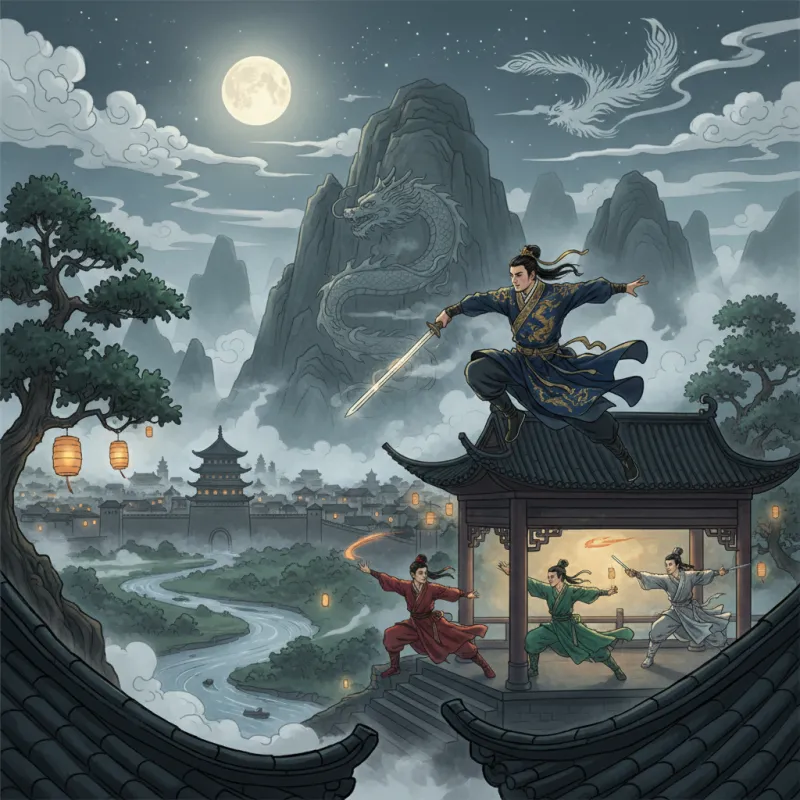
When Guo Jing stands atop the walls of Xiangyang, knowing the Mongol hordes will eventually breach his defenses, he doesn't flee. He doesn't bargain. He simply tightens his grip on his sword and prepares to die for a city that history tells us will fall anyway. This is the essence of Jin Yong's wuxia—not the fantasy of invincible heroes, but the tragedy of flawed human beings choosing honor over survival. For over half a century, Louis Cha's martial arts novels have captivated readers precisely because they refuse to offer easy answers or perfect victories.
The Revolutionary Depth of Jin Yong's Characters
What separates Jin Yong from his wuxia contemporaries isn't his fight choreography or his intricate plots—it's his refusal to write cardboard heroes. Take Yang Guo from The Return of the Condor Heroes (神雕侠侣, Shén Diāo Xiá Lǚ). He's arrogant, impulsive, and spends sixteen years obsessing over a woman who was technically his teacher. He's not particularly likable for much of the novel, yet readers find themselves devastated by his loneliness. Or consider Linghu Chong from The Smiling, Proud Wanderer (笑傲江湖, Xiào Ào Jiāng Hú), who drinks too much, refuses political power, and watches helplessly as the woman he loves marries someone else. These aren't the flawless paragons of earlier wuxia fiction—they're complicated people making questionable decisions in impossible situations.
Jin Yong's female characters deserve particular attention. Huang Rong isn't just intelligent—she's manipulative, using her wit to control situations and people. Zhao Min actively pursues Zhang Wuji despite social conventions, making the first move repeatedly. Ren Yingying runs a spy network while maintaining the facade of a gentle maiden. These women have agency, flaws, and desires that extend beyond supporting male protagonists. They scheme, they fail, they make morally ambiguous choices. In a genre traditionally dominated by male heroes, Jin Yong created women who shape the narrative rather than merely inhabiting it.
Martial Arts as Philosophy, Not Just Action
The kung fu in Jin Yong's novels operates on multiple levels simultaneously. Yes, there are spectacular fights—the battle at Bright Summit in The Heaven Sword and Dragon Saber (倚天屠龙记, Yǐ Tiān Tú Lóng Jì) spans chapters and involves dozens of masters. But the martial arts themselves embody philosophical principles. The Eighteen Dragon-Subduing Palms (降龙十八掌, Jiàng Lóng Shíbā Zhǎng) requires righteousness and straightforward thinking—which is why the honest Guo Jing masters it while the clever Yang Guo never fully does. The Nine Yin Manual (九阴真经, Jiǔ Yīn Zhēnjīng) can corrupt practitioners who lack proper moral foundation, turning a training manual into a test of character.
This connection between martial arts and personal cultivation draws directly from Daoist and Buddhist traditions, where physical discipline serves spiritual development. When Duan Yu in Demi-Gods and Semi-Devils (天龙八部, Tiān Lóng Bā Bù) accidentally absorbs others' internal energy, he gains power without understanding—and nearly destroys himself as a result. The message is clear: technique without wisdom is dangerous, power without virtue is corruption. Jin Yong uses martial arts as a metaphor for life itself, where mastery requires not just skill but moral clarity. For more on how these philosophical elements manifest in character development, see The Evolution of Heroism in Jin Yong's Novels.
The Jianghu: A World of Gray Morality
The jianghu (江湖, Jiānghú)—literally "rivers and lakes," but meaning the martial arts underworld—in Jin Yong's novels isn't divided into neat camps of good and evil. The "righteous" sects in The Smiling, Proud Wanderer are hypocritical, power-hungry, and willing to destroy innocent lives to maintain their reputations. Meanwhile, members of the "demonic" Sun Moon Holy Cult show loyalty, honor, and genuine affection. Yue Buqun, leader of the supposedly noble Huashan Sect, becomes the novel's true villain through his obsession with respectability and power.
This moral ambiguity reflects Jin Yong's understanding of Chinese history, particularly the turbulent 20th century he lived through. Written between 1955 and 1972, his novels subtly comment on political movements, ideological purity, and the cost of fanaticism. When orthodox sects unite to destroy heterodox practitioners, readers familiar with recent Chinese history recognize the pattern. The jianghu becomes a mirror for society itself—a place where noble rhetoric often masks selfish motives, and where outcasts sometimes embody truer virtue than the establishment.
Historical Tapestry and Cultural Memory
Jin Yong anchors his fantasies in specific historical moments, lending them weight and resonance. The Legend of the Condor Heroes (射雕英雄传, Shè Diāo Yīngxióng Zhuàn) unfolds during the Southern Song dynasty's desperate resistance against Mongol invasion. The Deer and the Cauldron (鹿鼎记, Lù Dǐng Jì) takes place during the Qing dynasty's consolidation of power over Han Chinese. These aren't arbitrary backdrops—they're integral to the stories' themes of loyalty, identity, and cultural survival.
The historical settings allow Jin Yong to explore questions of nationalism and ethnicity with nuance. Is Guo Jing, who was raised by Mongols, betraying his adoptive family by defending Song China? Should Han Chinese resist Manchu rule, or accept the Qing dynasty as legitimate? These questions had contemporary relevance when Jin Yong was writing, as China grappled with its identity in the modern world. By setting them in the past, he could examine them with a degree of safety—and universality. The struggles of his characters resonate across centuries because they address fundamental questions about belonging, duty, and the price of principle.
Romance and the Impossibility of Perfect Love
Jin Yong's romances are famously tragic, and deliberately so. Yang Guo and Xiaolongnü are separated for sixteen years. Linghu Chong loves Yue Lingshan, who marries someone else. Zhang Wuji can't choose between the women who love him, ultimately hurting them all. Even the relatively happy ending of Guo Jing and Huang Rong is shadowed by the knowledge that they'll die defending Xiangyang. This pattern isn't pessimism—it's realism about the cost of living according to one's principles in an imperfect world.
The romances also challenge traditional Chinese narratives about love and marriage. Characters choose partners based on genuine affection rather than family arrangement. Women initiate relationships and make their own choices, sometimes disastrously. The novels acknowledge sexual desire without being explicit, treating it as a natural part of human experience rather than something shameful. For a writer working in the conservative 1950s and 60s, this was quietly revolutionary. Jin Yong's couples struggle with jealousy, miscommunication, and incompatible values—the real obstacles to lasting love, rather than external villains or family opposition.
Legacy and Literary Achievement
Jin Yong's fifteen novels have sold over 300 million copies worldwide, been adapted into countless films and television series, and influenced generations of writers. But his literary achievement extends beyond popularity. He elevated wuxia from pulp entertainment to serious literature, incorporating classical poetry, Buddhist philosophy, and historical research into adventure narratives. His prose style, while accessible, draws on classical Chinese literary traditions, creating a bridge between high and popular culture.
Critics initially dismissed his work as commercial fiction, but scholarly reassessment has recognized his contributions to Chinese literature. His novels explore themes of identity, morality, and power with sophistication that rewards rereading. The martial arts serve as vehicles for examining human nature, the historical settings provide commentary on contemporary issues, and the characters embody the contradictions of trying to live ethically in a corrupt world. For readers interested in how Jin Yong's work fits into broader Chinese literary traditions, see Classical Chinese Literature's Influence on Modern Wuxia.
Why Jin Yong Still Matters
Reading Jin Yong today, decades after most of his novels were written, they remain startlingly relevant. The questions his characters face—how to maintain integrity in corrupt systems, whether loyalty to ideals justifies personal sacrifice, how to balance competing obligations—are timeless. His refusal to provide easy answers or perfect heroes makes the novels feel honest rather than dated. When Xiao Feng in Demi-Gods and Semi-Devils discovers his Khitan heritage and must choose between his Han Chinese upbringing and his ethnic identity, he's grappling with questions of belonging that resonate globally in our age of migration and mixed identities.
The enduring appeal of Jin Yong's wuxia lies in this combination of spectacular surface and philosophical depth. Readers come for the kung fu battles and stay for the moral complexity. They remember the romance and tragedy long after forgetting the specific techniques of the Eighteen Dragon-Subduing Palms. Jin Yong understood that the best adventure stories aren't escapes from reality—they're ways of examining reality from a different angle, where the stakes are life and death, and where characters must live with the consequences of their choices. In a world that still struggles with questions of justice, loyalty, and the cost of principle, his martial heroes remain relevant guides through the moral wilderness we all navigate.
Related Reading
- Alternative Endings Fans Wish Jin Yong Had Written
- The Enigmatic Hidden Techniques in Jin Yong’s Wuxia Novels Explored
- The Most Tragic Villains in Jin Yong's Novels