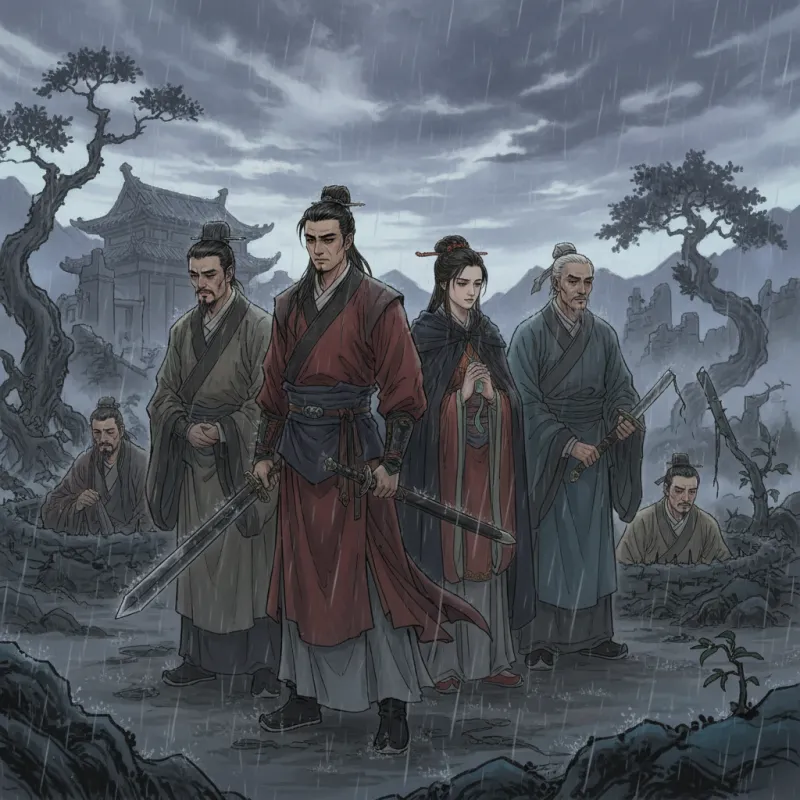
They say the road to hell is paved with good intentions, but in Jin Yong's novels, it's paved with broken hearts, shattered dreams, and a world that punishes vulnerability. His most devastating villains aren't born evil — they're sculpted by betrayal, twisted by obsession, and hardened by a universe that offers them nothing but cruelty in return for their humanity. These are the antagonists who make you pause mid-page, not in fear, but in uncomfortable recognition. Because deep down, you know: given the same circumstances, the same heartbreaks, the same impossible choices, you might have walked the same dark path.
Li Mochou: When Love Becomes a Poison
Li Mochou (李莫愁 Lǐ Mòchóu) from The Return of the Condor Heroes (神雕侠侣 Shén Diāo Xiálǚ) is perhaps Jin Yong's most heartbreaking creation. The "Scarlet Serpent Deity" (赤练仙子 Chìliàn Xiānzǐ) who murders entire families without blinking wasn't always a monster. She was once a young woman who loved completely, trusted absolutely, and was destroyed for it.
Her crime? Falling for Lu Zhanyuan (陆展元 Lù Zhǎnyuán), a man who promised her everything and delivered nothing but abandonment. When he chose another woman — someone more conventional, more acceptable to society — Li Mochou didn't just lose a lover. She lost her faith in human goodness itself. The Crimson Palm (赤练掌 Chìliàn Zhǎng) technique she uses to kill becomes a physical manifestation of her poisoned heart.
What makes her tragic isn't the body count. It's that she never stops loving him. Even decades later, even as she's murdering his wife's family, she's still singing that haunting verse: "Ask the world, what is love? That it binds life and death together" (问世间情为何物,直教人生死相许 Wèn shìjiān qíng wéi hé wù, zhí jiào rén shēngsǐ xiāng xǔ). She's not a villain who forgot how to love — she's a villain who never learned how to stop.
Qiu Qianren: The Coward Who Couldn't Escape Himself
Qiu Qianren (裘千仞 Qiú Qiānrèn) from The Legend of the Condor Heroes (射雕英雄传 Shè Diāo Yīngxióng Zhuàn) represents a different kind of tragedy — the tragedy of moral cowardice compounded until redemption becomes impossible. He's the Iron Palm Gang (铁掌帮 Tiězhǎng Bāng) leader whose single moment of weakness — killing Guo Jing's father — spirals into a lifetime of increasingly desperate evil.
The brilliance of Qiu Qianren's character is that he knows he's wrong. Unlike many villains who rationalize their actions, he's fully aware of his moral bankruptcy. He tries to hide from his guilt by pretending to be his twin brother, the monk Qiu Qianchi (裘千尺 Qiú Qiānchǐ). But you can't outrun yourself. Each new crime is an attempt to bury the previous one, until he's so deep in blood that the only way out is through more blood.
His final fate — genuinely becoming a monk and spending his remaining years in genuine repentance — is both redemption and punishment. He gets to live, but he has to live with full awareness of what he's done. For a man like Qiu Qianren, that might be worse than death.
Yue Buqun: The Gentleman Who Became a Monster
Yue Buqun (岳不群 Yuè Bùqún) from The Smiling, Proud Wanderer (笑傲江湖 Xiào Ào Jiānghú) is Jin Yong's most insidious villain because he shows how easily righteousness curdles into tyranny. The "Gentleman Sword" (君子剑 Jūnzǐ Jiàn) who leads the Huashan Sect (华山派 Huàshān Pài) starts with genuine ideals. He truly believes in orthodox martial arts, in proper conduct, in the importance of reputation and moral authority.
But somewhere along the way, the means become the end. His obsession with restoring Huashan's glory transforms from noble ambition into consuming hunger for power. The moment he decides to practice the Evil-Resisting Sword Manual (辟邪剑谱 Bìxié Jiànpǔ) — which requires self-castration — he crosses a line from which there's no return. Not because of the physical act, but because he's willing to sacrifice everything he claimed to value for the power he claimed to disdain.
What makes Yue Buqun truly tragic is that he never admits, even to himself, what he's become. He maintains the facade of righteousness even as he commits increasingly heinous acts. He's not a hypocrite who knows he's lying — he's a hypocrite who has convinced himself his lies are truth. In some ways, that makes him more pitiable than Li Mochou, who at least owns her darkness.
Murong Fu: The Prisoner of Ancestral Dreams
Murong Fu (慕容复 Mùróng Fù) from Demi-Gods and Semi-Devils (天龙八部 Tiānlóng Bā Bù) embodies the tragedy of living for a past you never experienced and a future you'll never achieve. Born into the remnants of the Yan Kingdom (燕国 Yān Guó) royal family, he's raised with a single purpose: restore the kingdom his ancestors lost centuries ago.
The cruelty of Murong Fu's situation is that his goal is impossible, and everyone knows it except him. The Yan Kingdom is gone. The world has moved on. But he can't move on, because his entire identity is built on this ancestral obligation. He sacrifices genuine love (Wang Yuyan's devotion), real friendship (Deng Baichuan's loyalty), and his own happiness for a fantasy.
His descent into madness at the novel's end — believing himself to be an emperor, playing pretend with children — is both pathetic and devastating. He finally gets his "kingdom," but only in delusion. Unlike other obsessed characters in Jin Yong's works, Murong Fu never even gets the satisfaction of a grand failure. He just... breaks.
Ding Chunqiu: The Student Who Destroyed His Teacher
Ding Chunqiu (丁春秋 Dīng Chūnqiū), also from Demi-Gods and Semi-Devils, represents the tragedy of betrayal — not as a single act, but as a corrupting force that poisons everything it touches. When he attacks his master Ding Chunqiu and throws him off a cliff, he doesn't just commit murder. He violates the most sacred bond in martial arts culture: the teacher-student relationship.
What makes Ding Chunqiu tragic isn't that he feels remorse (he doesn't), but that his betrayal traps him in a prison of his own making. He surrounds himself with sycophantic disciples who praise his every move, but he can never trust any of them — because he knows what students are capable of. He's created a world where genuine loyalty is impossible, where every relationship is transactional, where he's always looking over his shoulder.
His "Star Sect" (星宿派 Xīngxiù Pài) becomes a grotesque parody of a martial arts school, with disciples competing to flatter him most outrageously. It's simultaneously comic and tragic — he's achieved power and fame, but at the cost of ever experiencing genuine human connection again. He's the loneliest man in the jianghu (江湖 jiānghú), surrounded by people who would kill him if they thought they could get away with it.
Ouyang Feng: Madness as Mercy
Ouyang Feng (欧阳锋 Ōuyáng Fēng), the "Western Venom" (西毒 Xī Dú) from The Legend of the Condor Heroes, undergoes perhaps the most complete transformation of any Jin Yong villain. He starts as a calculating, ruthless martial artist who will do anything to win the title of "Greatest Martial Artist in the World" (天下第一 Tiānxià Dì Yī). But after practicing a corrupted version of the Nine Yin Manual (九阴真经 Jiǔ Yīn Zhēnjīng) backwards, he loses his memory and, paradoxically, finds a kind of peace.
The tragedy of Ouyang Feng is that he's more human after he goes mad than he ever was when sane. In his madness, he forgets his ambitions, his schemes, his need to prove himself superior to everyone. He develops a genuine, if confused, affection for Yang Guo (杨过 Yáng Guò), treating him like the son he never acknowledged (because Yang Guo is actually his nephew, the son of his brother and the woman Ouyang Feng loved).
When he finally regains his memory at the end of The Return of the Condor Heroes, it's not a triumph — it's a tragedy. He remembers everything he's done, everyone he's hurt, and the futility of his life's pursuits. His death, alone on Huashan Mountain after one final contest with Hong Qigong (洪七公 Hóng Qīgōng), is the death of a man who realizes too late that he wasted his entire life chasing the wrong things.
The Pattern: When the World Breaks You
What unites these tragic villains is that they're all responses to trauma, betrayal, or impossible circumstances. Li Mochou is what happens when love is weaponized against you. Qiu Qianren is what happens when one mistake compounds into a lifetime of evil. Yue Buqun is what happens when ideology becomes more important than humanity. Murong Fu is what happens when you're imprisoned by ancestral expectations. Ding Chunqiu is what happens when you destroy the bonds that make you human. Ouyang Feng is what happens when ambition consumes everything else.
Jin Yong understood something profound about villainy: most people don't choose to become monsters. They're pushed, step by step, choice by choice, until they look back and don't recognize themselves anymore. These villains are tragic not because we excuse their actions, but because we understand the path that led them there. They're cautionary tales about what happens when we let our wounds define us, when we prioritize pride over connection, when we refuse to let go of the past.
In the end, these villains are mirrors. They show us the darkness that exists in all of us — the capacity for cruelty when hurt, for obsession when disappointed, for self-deception when confronted with uncomfortable truths. Jin Yong's genius was making us look into that mirror and recognize ourselves, even as we recoil from what we see.
Related Reading
- The Most Complex Villains in Jin Yong Fiction
- The Greatest Villains in Jin Yong's Novels
- Villains of Jin Yong's Wuxia Novels: Complexity, Motives, and Legacy
- Jin Yong's Villains: Why the Bad Guys Are Often the Best Characters
- Yue Buqun: The Most Terrifying Hypocrite in Chinese Literature
- Unveiling the Wisdom and Philosophy in Jin Yong's Wuxia Novels
- Exploring Jin Yong's Wuxia Novels: Characters, Martial Arts, and Storylines
- Jin Yong's Writing Career: From First Novel to Final Retirement