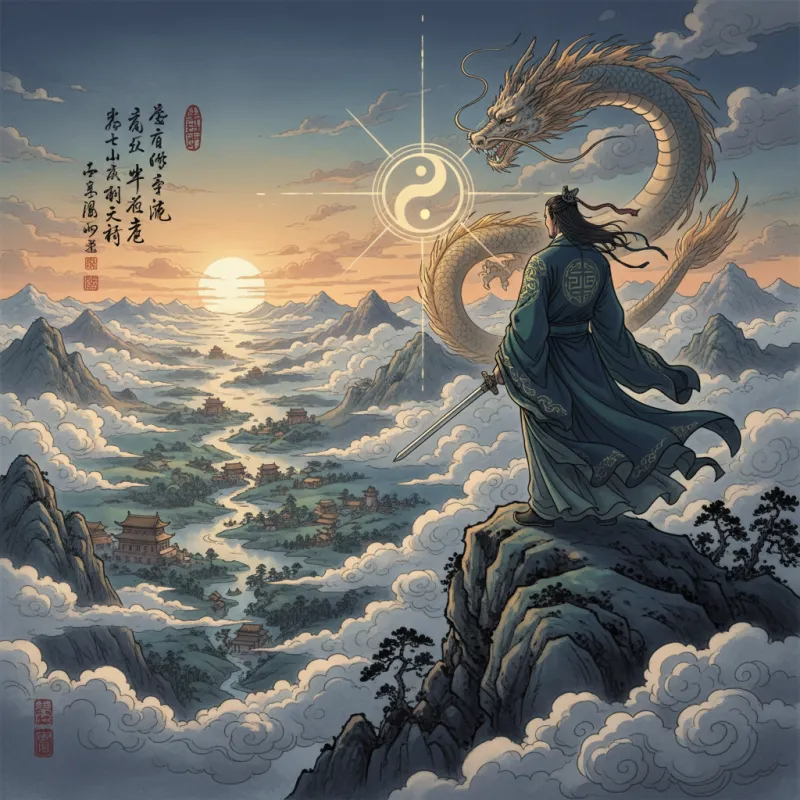
When Guo Jing stands atop the walls of Xiangyang, choosing certain death over abandoning his post, he embodies a question that haunts every Jin Yong novel: What does it mean to be righteous in a world where righteousness guarantees suffering? This isn't the sanitized heroism of Western fantasy—Jin Yong's wuxia (武侠, wǔxiá, "martial heroes") world operates on a different moral frequency entirely, one where the greatest warriors often die forgotten, where loyalty can be indistinguishable from foolishness, and where wisdom sometimes means accepting that there are no good choices.
Jin Yong, born Cha Leung-yung in 1924, wrote his fifteen novels between 1955 and 1972, a period when China was convulsing through the Great Leap Forward and Cultural Revolution. Yet his stories, set everywhere from Song Dynasty battlefields to Ming Dynasty monasteries, became the most widely-read Chinese fiction of the 20th century. This wasn't escapism—it was philosophy smuggled past censors in the guise of sword fights and romance. Every duel contains a debate; every quest conceals a koan.
The Paradox of Martial Virtue
The Chinese concept of wude (武德, wǔdé, "martial virtue") sits at the heart of Jin Yong's philosophical project, but he systematically deconstructs it across his novels. Traditional wuxia celebrated the xiayi (侠义, xiáyì, "chivalrous righteousness")—the wandering hero who rights wrongs with his sword. Jin Yong asks: what happens when righting one wrong creates three more?
Consider Xiao Feng from Demi-Gods and Semi-Devils (天龙八部, Tiānlóng Bābù, 1963). He's the most martially gifted character Jin Yong ever created, capable of killing with a gesture. He's also the most tragic, because his Khitan heritage makes him an enemy to the Han Chinese he's sworn to protect, and an outsider to the Khitan people he's supposed to lead. His suicide at the novel's end—driving a knife into his own chest to prevent a war—is presented not as noble sacrifice but as the only exit from an impossible ethical trap. Jin Yong is saying: sometimes the highest martial virtue is recognizing that martial virtue cannot solve the problem.
This connects directly to Buddhist philosophy, particularly the concept of wuxiang (无相, wúxiàng, "formlessness" or "non-attachment"). The greatest martial artists in Jin Yong's universe—Dugu Qiubai, the Sweeping Monk, Zhang Sanfeng—have all transcended technique itself. They've realized that the pursuit of ultimate martial arts is a form of attachment that must itself be abandoned.
Confucian Duty Versus Daoist Freedom
Jin Yong structures his novels around the tension between Confucian social obligation and Daoist individual liberation. This isn't abstract—it's the choice his protagonists face in every book.
Guo Jing in The Legend of the Condor Heroes (射雕英雄传, Shèdiāo Yīngxióng Zhuàn, 1957-59) is pure Confucian rectitude. He's not particularly bright, not especially talented, but he's loyal to the point of self-destruction. He spends the sequel, The Return of the Condor Heroes, defending Xiangyang against the Mongols for decades, knowing the city will eventually fall, knowing he'll die there. Jin Yong presents this as admirable and slightly absurd simultaneously. Guo Jing achieves a kind of immortality through his commitment to duty, but he also misses out on the freedom that characters like Linghu Chong enjoy.
Linghu Chong from The Smiling, Proud Wanderer (笑傲江湖, Xiào'ào Jiānghú, 1967) represents the Daoist counterpoint. He refuses to lead sects, rejects political power, and just wants to drink wine and play music with his friends. The novel's title itself is a reference to Daoist philosophy—the idea of laughing proudly while wandering the rivers and lakes (jianghu, 江湖), unattached to worldly concerns. Yet Jin Yong doesn't let him off easy either. Linghu Chong's refusal to engage with power structures allows those structures to harm people he cares about. His freedom comes at a cost paid by others.
The synthesis Jin Yong proposes isn't a compromise between these philosophies but an acceptance that the tension between them is permanent and productive. His wisest characters—like the monk Yideng in Condor Heroes or Zhang Wuji's adoptive father Xie Xun—have usually experienced both extremes and bear the scars of each.
The Illusion of Absolute Knowledge
Jin Yong was obsessed with epistemological uncertainty—the idea that what we think we know is always incomplete or wrong. This manifests in his treatment of martial arts manuals, which function as metaphors for knowledge itself.
The Nine Yin Manual (九阴真经, Jiǔyīn Zhēnjīng) appears across multiple novels as the ultimate kung fu text. But everyone who obtains it misunderstands it. Some read it backward and go insane. Others master only fragments and become unbalanced. The few who truly comprehend it—like Zhou Botong—realize it's not about the techniques at all, but about the philosophical principles underlying them. Jin Yong is making a point about how we approach knowledge: we want the cheat codes, the secret techniques, when wisdom requires understanding the system itself.
This extends to his treatment of historical truth. The Deer and the Cauldron (鹿鼎记, Lùdǐng Jì, 1969-72), his final and most subversive novel, features a protagonist, Wei Xiaobao, who can't do martial arts at all. He succeeds through luck, deception, and an intuitive understanding that all the grand historical narratives—Manchu versus Han, loyalty versus rebellion—are stories people tell themselves. The novel suggests that the legends we build around martial heroes are as fictional as the kung fu itself, and perhaps that's the point.
Love as Philosophical Laboratory
Western readers often skip the romance subplots in Jin Yong's novels, but they're where his philosophy becomes most concrete. Romantic relationships in his work are testing grounds for different approaches to attachment, desire, and suffering.
Yang Guo and Xiaolongnü in Return of the Condor Heroes (神雕侠侣, Shéndiāo Xiálǚ, 1959-61) represent romantic love as a form of Buddhist attachment that leads to suffering—they spend sixteen years separated, both in agony—but also as something that gives life meaning. Their reunion is one of the most famous scenes in Chinese literature, and it's philosophically ambiguous. Have they transcended suffering through their devotion, or have they simply endured it? Jin Yong doesn't say.
Contrast this with Duan Yu in Demi-Gods and Semi-Devils, who falls in love with every beautiful woman he meets. His serial infatuations are played for comedy, but they also illustrate the Buddhist concept of impermanence—his feelings are intense and genuine and completely temporary. By the novel's end, he's married to someone he barely noticed earlier, and he's content. The message: perhaps taking our passions less seriously is its own form of wisdom.
The most philosophically sophisticated romance is between Zhang Wuji and the four women who love him in The Heaven Sword and Dragon Saber (倚天屠龙记, Yǐtiān Túlóng Jì, 1961). Zhang Wuji's inability to choose between them isn't weakness—it's a recognition that each represents a different valid path through life, and choosing one means foreclosing others. His eventual choice of Zhao Min is presented as somewhat arbitrary, which is precisely Jin Yong's point about how we make life's major decisions.
The Corruption of Institutions
Jin Yong had a deeply cynical view of organized power, shaped by watching the Chinese Communist Party's transformation from revolutionary movement to authoritarian state. This cynicism permeates his treatment of martial arts sects, which function as microcosms of political organizations.
The Shaolin Temple appears in multiple novels as the most respected martial institution in the jianghu. It's also consistently shown to be corrupt, hypocritical, and willing to commit atrocities to maintain its reputation. In Demi-Gods and Semi-Devils, Shaolin monks murder Xiao Feng's family and then cover it up for decades. In The Smiling, Proud Wanderer, the orthodox sects are more vicious and power-hungry than the "demonic" ones they oppose.
Jin Yong's point isn't that individuals within these institutions are evil—many are sincere and well-meaning—but that institutions inevitably prioritize their own survival over their stated principles. The Wudang Sect, founded on Daoist principles of non-interference, becomes as politically entangled as anyone else. The Ming Cult in Heaven Sword and Dragon Saber, which starts as a persecuted religious minority, becomes oppressive the moment it gains power.
The only characters who maintain their integrity are those who remain outside institutional structures—the wandering heroes who owe allegiance to principles rather than organizations. This is Jin Yong's most subversive message, written during a period when the Chinese state demanded total loyalty: true righteousness requires independence from power.
The Wisdom of Incompleteness
Jin Yong's final novel, The Deer and the Cauldron, reads like a repudiation of everything he'd written before. Wei Xiaobao is cowardly, lecherous, illiterate, and incapable of martial arts. He succeeds where traditional heroes fail precisely because he doesn't believe in heroism. He's loyal to his friends but not to abstract principles. He serves the Qing emperor and the anti-Qing rebels simultaneously, seeing no contradiction.
This isn't nihilism—it's a mature philosophical position that Jin Yong arrived at after fifteen novels exploring righteousness, duty, and honor. Wei Xiaobao represents the wisdom of accepting human limitation and moral ambiguity. He's happy in a way that Guo Jing, for all his virtue, never is. He survives in a way that Xiao Feng, for all his power, cannot.
The novel suggests that perhaps the greatest wisdom is recognizing that we're all Wei Xiaobao—stumbling through life with incomplete information, mixed motives, and no clear answers. The difference is that Wei Xiaobao knows this about himself, while the traditional heroes maintain illusions of moral clarity that ultimately destroy them.
Jin Yong ended his career by suggesting that the entire wuxia genre, with its emphasis on martial supremacy and righteous heroism, might be a beautiful lie we tell ourselves. But he also suggested that beautiful lies might be necessary—that we need stories of Guo Jing defending Xiangyang and Xiao Feng sacrificing himself, even if we know that real life is more like Wei Xiaobao's chaotic improvisations. The wisdom isn't in choosing between the ideal and the real, but in holding both in mind simultaneously, understanding that each illuminates the limitations of the other.
Related Reading
- Jin Yong's Music: The Soundtracks That Made a Nation Cry
- The Top 10 Villains in Jin Yong's Novels
- The Allure of Jin Yong's Wuxia: Exploring Martial Arts, Characters, and Legendary Storylines