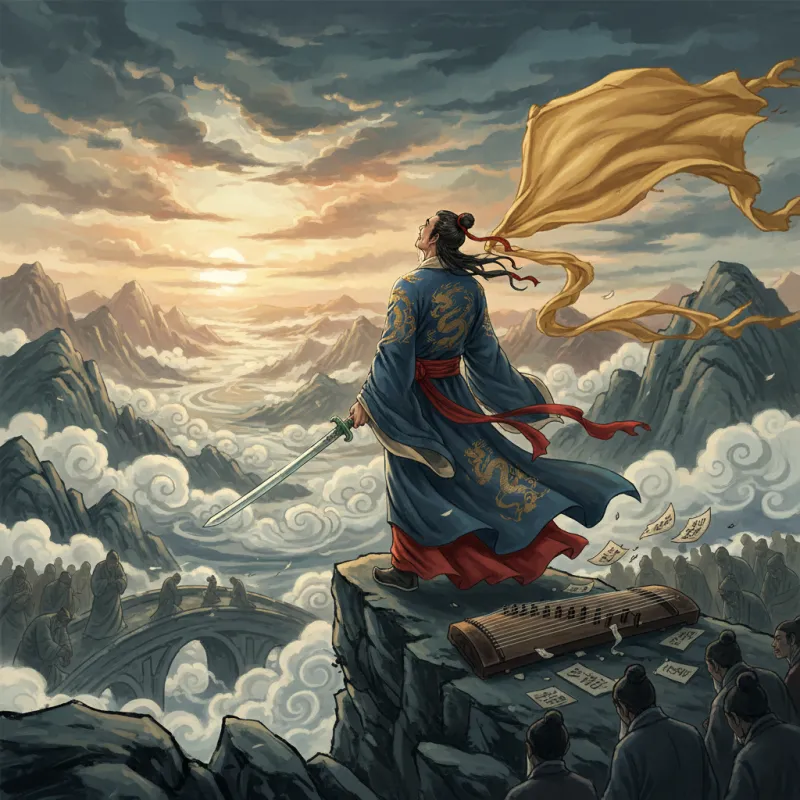
The first time you hear "铁血丹心" (Tiěxuè Dānxīn), you might not realize you're listening to the most important song in modern Chinese pop culture. But ask anyone over thirty from Hong Kong, Taiwan, or mainland China to hum a few bars, and watch their eyes light up. They won't just sing it—they'll tell you exactly where they were when they first heard it, which character they loved, and why the ending made them cry.
When Television Soundtracks Became National Anthems
Jin Yong's novels didn't just inspire television adaptations—they created an entirely new genre of music. Between 1976 and 2003, Hong Kong's TVB alone produced over a dozen Jin Yong series, and each one needed a theme song that could carry the emotional weight of a thousand-page novel into three minutes of melody. The composers who took on this challenge—Joseph Koo, James Wong, and others—weren't just writing TV themes. They were scoring the collective memory of a generation.
The phenomenon has no Western equivalent. Imagine if every Jane Austen adaptation produced a chart-topping ballad that people sang at weddings. Imagine if The Lord of the Rings theme was something your grandmother hummed while cooking dinner. That's what Jin Yong theme songs became: the background music to ordinary life, carrying with them all the weight of heroism, sacrifice, and impossible love that defines the wuxia genre.
The Song That Started Everything
In 1983, TVB's adaptation of The Legend of the Condor Heroes premiered with "铁血丹心" (Iron Blood, Loyal Heart), performed by Roman Tam and Jenny Tseng. The song opens with a question that every Jin Yong hero must answer: "依稀往夢似曾見,心內波瀾現" (Yīxī wǎng mèng sì céng jiàn, xīn nèi bōlán xiàn—"Vague dreams seem familiar, waves rise in the heart"). It's a duet where male and female voices circle each other, never quite meeting, trading lines about duty and desire like Guo Jing and Huang Rong trading blows with the Seven Freaks of Jiangnan.
What made "铁血丹心" revolutionary wasn't just its melody—though Joseph Koo's composition is genuinely brilliant, mixing traditional Chinese instruments with Western orchestration. It was how perfectly the lyrics captured the novel's central tension. Guo Jing must choose between personal happiness and national duty. Huang Rong must decide whether love is worth sacrificing her freedom. The song doesn't resolve this tension. It lives in it, the way the characters do, the way the readers do.
Roman Tam's voice carries the weight of righteousness—you can hear Guo Jing's stubbornness in every note. Jenny Tseng's voice is clever and playful, with an undercurrent of sadness that anyone who's read the novel will recognize as Huang Rong's understanding that this love story cannot have a simple happy ending. When they sing together in the chorus, their voices don't harmonize perfectly. They clash slightly, beautifully, the way the characters themselves clash throughout the novel.
The Return of the Condor Heroes and Impossible Love
If "铁血丹心" is about duty versus love, then "鐵血丹心" (Tiěxuè Dānxīn) from the 1983 Return of the Condor Heroes is about love that society says shouldn't exist at all. The theme song "始終有你" (Shǐzhōng Yǒu Nǐ—"Always Have You") by Susanna Kwan doesn't dance around the central taboo of Yang Guo and Xiaolongnü's relationship. It embraces it.
The lyrics are defiant: "誰能明白我,誰能明白你" (Shéi néng míngbái wǒ, shéi néng míngbái nǐ—"Who can understand me, who can understand you"). This isn't a song about star-crossed lovers hoping for society's approval. It's about two people who've decided that society's approval doesn't matter. You can hear it in Susanna Kwan's delivery—there's no pleading, no apology. Just certainty.
What's remarkable is how these songs became hits despite—or perhaps because of—their refusal to simplify the novels' moral complexity. Jin Yong's characters aren't simple heroes and villains, and the theme songs don't pretend they are. They're messy, conflicted, sometimes wrong, always human.
The Demi-Gods and Semi-Devils: When Tragedy Gets a Melody
The 1982 TVB adaptation of Demi-Gods and Semi-Devils gave us "兩忘煙水裡" (Liǎng Wàng Yānshuǐ Lǐ—"Both Forgotten in Mist and Water"), and if you want to understand why Jin Yong's novels make people cry, listen to this song. It's performed by Jenny Tseng, and it's about the impossibility of happiness in a world governed by karma and fate.
The title itself is a reference to Zhuangzi—the idea that true freedom comes from forgetting both self and other, dissolving into the natural world. But the song isn't peaceful. It's heartbreaking. Because the characters in Demi-Gods and Semi-Devils can't forget. They're trapped by their desires, their loyalties, their past lives. Duan Yu loves Wang Yuyan, who loves Murong Fu, who loves only his impossible dream of restoring his kingdom. Xiao Feng loves A'Zhu, and then she dies, and then he loves A'Zi, who isn't A'Zhu, and the whole thing is a cascade of misplaced affection and tragic timing.
Jenny Tseng's voice in this song is different from her performance in "铁血丹心." There's no playfulness here. Just resignation and a kind of terrible wisdom. The arrangement is sparse—mostly traditional instruments, with long pauses between phrases that feel like sighs. It's the sound of characters who know how their story ends and are walking toward that ending anyway.
The 1990s: When Mainland China Joined the Conversation
For years, Jin Yong theme songs were primarily a Hong Kong phenomenon. But in the 1990s, as mainland China began producing its own adaptations, the musical landscape shifted. The 1994 CCTV adaptation of The Legend of the Condor Heroes featured "鐵血丹心" performed by Liu Huan and Faye Wong—a mainland-Hong Kong collaboration that signaled something new.
Liu Huan brought a different vocal style—more operatic, more traditionally Chinese. Faye Wong, already a massive star, brought her characteristic ethereal quality. The result was a version of the song that felt both familiar and completely new. It wasn't better or worse than the 1983 version. It was a conversation between two eras, two regions, two interpretations of what Jin Yong's heroes sound like.
The 1997 TVB adaptation of The Smiling, Proud Wanderer gave us "滄海一聲笑" (Cānghǎi Yīshēng Xiào—"A Laugh in the Vast Ocean"), which became so iconic that it transcended its source material. Composed by James Wong and performed by Samuel Hui, it's less a love song and more a philosophy. The lyrics are about freedom, about laughing at the absurdity of martial arts politics, about being like water—formless, adaptable, impossible to pin down. It's the perfect theme for Linghu Chong, who spends the entire novel refusing to take anything seriously except the people he loves.
Why These Songs Endure
Walk into a Chinese karaoke bar today and you'll find dozens of Jin Yong theme songs in the catalog. Not just the famous ones—deep cuts from minor adaptations, Cantonese and Mandarin versions, covers by contemporary artists. People in their twenties who've never watched the original series still know the words. The songs have outlived the shows that spawned them.
Part of this is pure nostalgia—these songs are tied to childhood memories of watching television with family, of first understanding what it means to love something impossible, of learning that heroes don't always win. But it's more than nostalgia. These songs work because they do what Jin Yong's novels do: they take enormous, abstract concepts—duty, honor, freedom, fate—and make them feel personal and immediate.
When Roman Tam sings about iron blood and loyal hearts, you're not thinking about abstract patriotism. You're thinking about Guo Jing standing on the walls of Xiangyang, knowing he's going to die defending a city that will fall anyway, doing it because that's what heroes do. When Jenny Tseng sings about being forgotten in mist and water, you're thinking about every time you've loved someone who couldn't love you back, every time you've wanted something you couldn't have.
The Legacy: What Comes After
Modern Jin Yong adaptations still produce theme songs, but they rarely achieve the cultural penetration of the classics. The 2017 The Legend of the Condor Heroes had a perfectly fine theme song that nobody remembers. The 2021 The Smiling, Proud Wanderer tried to recreate the magic of "滄海一聲笑" and produced something that sounded like a video game soundtrack.
Maybe it's impossible to recreate that moment when television was new enough to be exciting but communal enough to create shared cultural touchstones. Maybe it's that the original songs were written by composers who understood that they weren't just scoring a TV show—they were translating literature into music, capturing the essence of novels that had already shaped Chinese culture for decades.
Or maybe it's simpler: those songs were written by people who loved Jin Yong's novels the way readers love them—completely, uncritically, with full awareness of their flaws and full commitment to their emotional truth. You can hear it in every note. These aren't professional composers doing a job. These are fans writing love letters to stories that changed their lives, hoping to create something that might change someone else's life in turn.
The songs worked. They're still working. Somewhere right now, someone is singing "铁血丹心" in a karaoke bar, and someone else is hearing it for the first time, and the cycle continues. That's what Jin Yong's enduring influence looks like—not just books on shelves, but songs in throats, melodies that carry stories across generations, three-minute distillations of thousand-page epics that make a nation cry.
Related Reading
- Poetry in Jin Yong's Novels: Classical Verse as Narrative Weapon
- The Xiao Ao Jianghu Theme Song: Music as Philosophy
- Musical Instruments in Jin Yong's Wuxia World
- The Iconic Soundtracks of Jin Yong TV Adaptations
- Wuxia Films for Beginners: Where to Start
- Jin Yong's Writing Career: From First Novel to Final Retirement
- The Definitive Jin Yong Martial Arts Power Ranking