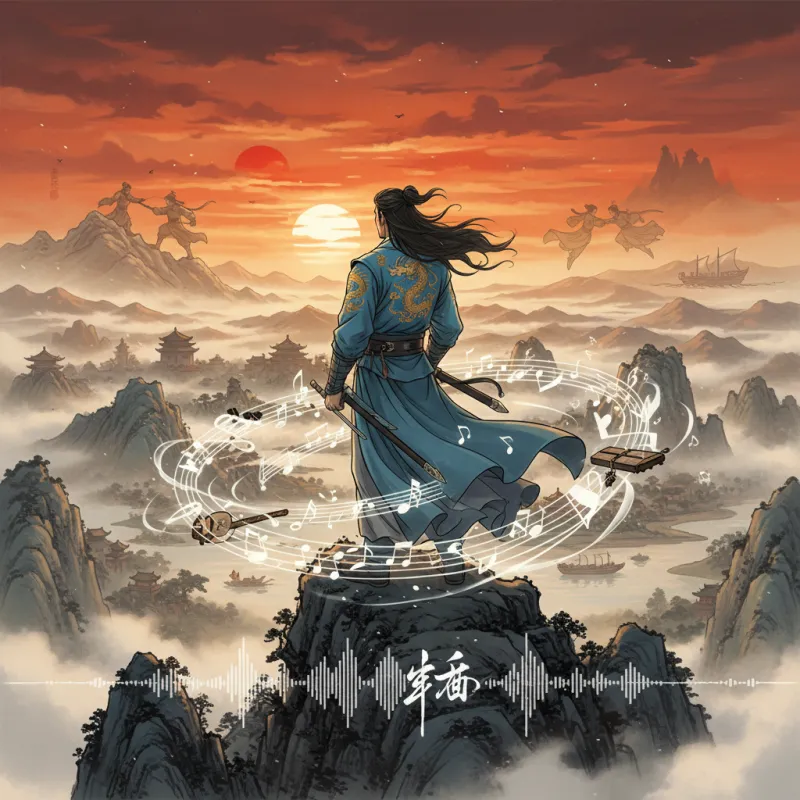
The first time you hear the opening notes of "Iron Blood and Loyal Heart" (鐵血丹心, Tiěxuè Dānxīn), something clicks. Even if you've never watched the 1983 Legend of the Condor Heroes, even if you don't speak Cantonese, the melody carries a weight that transcends language. It's the sound of heroism distilled into music — sweeping strings, a martial rhythm, and a vocal performance by Roman Tam that somehow captures both the vastness of the Mongolian steppes and the intimate bond between Guo Jing and Huang Rong. This isn't just a TV theme song. It's a cultural artifact that has outlived the show itself, becoming the definitive musical interpretation of Jin Yong's wuxia world.
The soundtracks of Jin Yong adaptations occupy a unique space in Chinese popular culture. They're not merely background music or promotional tools. They're standalone works of art that have shaped how entire generations imagine the jianghu (江湖, Jiānghú) — the martial arts world. When you think of Yang Guo's tragic romance, you hear "The Divinity of Love" (神鵰俠侶, Shéndiāo Xiálǚ). When you picture Linghu Chong's carefree wandering, you hear "A Laugh from the Sea" (滄海一聲笑, Cānghǎi Yīshēng Xiào). The music doesn't just accompany the stories; it becomes inseparable from them.
The TVB Revolution: When Cantopop Met Wuxia
The late 1970s and 1980s marked a perfect storm of talent and timing. Hong Kong's TVB was producing Jin Yong adaptations at an unprecedented pace, and Cantopop was entering its golden age. The station had access to the best composers in the industry — Joseph Koo (顧嘉煇, Gù Jiāhuī), who would become synonymous with Jin Yong music, and lyricists like James Wong (黃霑, Huáng Zhān), whose words could capture the philosophical depth of Jin Yong's novels in a four-minute song.
"Iron Blood and Loyal Heart" from the 1983 Condor Heroes set the template. Joseph Koo's composition married traditional Chinese musical elements with Western orchestration. The result was something that sounded both ancient and modern, Chinese and universal. Roman Tam's performance added another layer — his voice had a roughness that suggested weathered heroes and hard-won wisdom. When he sang "依稀往夢似曾見" (Yīxī wǎng mèng sì céng jiàn — "Vaguely, past dreams seem familiar"), you believed he'd lived through the Song Dynasty battles himself.
The success wasn't accidental. Joseph Koo understood that Jin Yong's novels weren't just adventure stories. They were meditations on loyalty, sacrifice, and the cost of living by a code in a chaotic world. His music reflected that complexity. The themes were memorable enough to hum, but sophisticated enough to reward repeated listening. They worked as pop songs on the radio and as emotional anchors in the shows.
The Anthem of Rebellion: "A Laugh from the Sea"
If "Iron Blood and Loyal Heart" defined heroic righteousness, then "A Laugh from the Sea" from the 1990 Swordsman film defined something more subversive. Written by James Wong and performed by Samuel Hui, Xu Guanjie, and Wong himself, the song captures Linghu Chong's philosophy perfectly — the rejection of orthodox martial arts politics in favor of personal freedom and wine-soaked camaraderie.
The genius is in the simplicity. The melody is based on a traditional Chinese pentatonic scale, giving it an ancient, almost folk-song quality. The lyrics are deceptively straightforward: "滄海一聲笑,滔滔兩岸潮" (Cānghǎi yīshēng xiào, tāotāo liǎng'àn cháo — "A laugh from the sea, surging tides on both shores"). But the meaning runs deeper. It's about laughing at the absurdity of power struggles, at the pretensions of the orthodox sects, at the very idea that anyone can control the jianghu. The song became an anthem for anyone who felt constrained by social expectations — which, in 1990s Hong Kong facing the handover to China, was a lot of people.
The song's influence extended far beyond the film. It's been covered countless times, used in everything from political protests to wedding celebrations. It appears in character analysis discussions as the musical embodiment of Linghu Chong's character. When you hear it, you don't just think of the character — you think of a whole philosophy of life.
The Mandarin Shift: Taiwan's Emotional Depth
While Hong Kong dominated the 1980s, Taiwan's adaptations in the 1990s and 2000s brought a different musical sensibility. The shift from Cantonese to Mandarin changed more than just the language. Taiwanese productions favored a more overtly emotional, sometimes melodramatic approach. The music reflected this — sweeping ballads that wore their hearts on their sleeves.
The 2001 Demi-Gods and Semi-Devils adaptation featured "Tian Long Ba Bu Zhi Duan Yu" (天龍八部之段譽, Tiānlóng Bābù Zhī Duàn Yù) by Hu Ge, which became a massive hit. The song captured Duan Yu's romantic idealism — his belief in love despite constant rejection, his adherence to Buddhist principles in a violent world. The production values were lush, with full orchestration that would have been impossible in earlier TVB productions.
The 2003 Return of the Condor Heroes gave us "Tian Xia Wu Shuang" (天下無雙, Tiānxià Wúshuāng — "Unparalleled Under Heaven") by Elva Hsiao. The song's modern pop production divided fans. Some felt it was too contemporary, too divorced from the wuxia aesthetic. Others argued it captured Yang Guo and Xiaolongnü's love story perfectly — a romance so intense and unconventional that it needed music that broke the rules too. The debate itself shows how seriously fans take these soundtracks. They're not just songs; they're interpretations of beloved stories, and every choice matters.
The Mainland Era: Spectacle and Nostalgia
When mainland China began producing big-budget Jin Yong adaptations in the 2010s, the music changed again. These productions had resources that dwarfed earlier versions — full orchestras, famous pop stars, elaborate music videos. The 2017 Legend of the Condor Heroes featured music by Tan Xuan, with theme songs performed by major stars like Zhang Jie.
But something was lost in the upgrade. The music was technically impressive, but it often lacked the raw emotional power of the earlier adaptations. It was too polished, too calculated. The songs felt like they were designed by committee to appeal to the broadest possible audience. They worked as promotional tools, but they didn't embed themselves in cultural memory the way "Iron Blood and Loyal Heart" or "A Laugh from the Sea" had.
There are exceptions. The 2021 Demi-Gods and Semi-Devils featured "Tian Nü San Hua" (天女散花, Tiānnǚ Sàn Huā — "Heavenly Maiden Scattering Flowers") by Zhou Shen, whose ethereal voice brought something genuinely new to Jin Yong music. The song captured the Buddhist themes of the novel — the idea of letting go, of scattering attachments like flower petals. It suggested that mainland productions might be finding their own musical voice, distinct from the Hong Kong and Taiwan traditions.
Why These Songs Endure
The best Jin Yong soundtracks work because they understand what the novels are really about. They're not just martial arts adventures. They're stories about people trying to live with honor in a dishonorable world, about love that transcends social boundaries, about the price of loyalty and the cost of revenge. The music that endures captures these themes without spelling them out. It works on an emotional level that bypasses rational analysis.
There's also the nostalgia factor, but it's more complex than simple sentimentality. These songs are tied to specific moments in Chinese cultural history. "Iron Blood and Loyal Heart" reminds people of 1980s Hong Kong — a time of economic boom and cultural confidence. "A Laugh from the Sea" evokes the anxiety and defiance of the pre-handover period. The Taiwan ballads recall a different era of cross-strait cultural exchange. The songs are time capsules, carrying not just memories of the shows but memories of who people were when they first heard them.
The Modern Challenge: Can New Adaptations Compete?
Every new Jin Yong adaptation faces an impossible task: creating music that can stand alongside the classics. It's not just about writing a good song. It's about capturing lightning in a bottle, creating something that will resonate for decades. The odds are against it. The cultural landscape has fragmented. There's no longer a shared musical language the way Cantopop provided in the 1980s or Mandopop in the 1990s. Audiences are more diverse, more critical, more attached to the versions they grew up with.
But maybe that's okay. Maybe the point isn't to replace the classics but to add new layers to the tradition. Each generation gets to interpret Jin Yong's stories through its own musical lens. The 1980s had Joseph Koo's orchestral grandeur. The 1990s had James Wong's philosophical wit. The 2000s had Taiwan's emotional intensity. The 2020s are still figuring out their sound, but it will be shaped by contemporary Chinese music's global ambitions and technological possibilities.
The Soundtrack as Canon
Here's what's remarkable: for many fans, these soundtracks have become part of the Jin Yong canon itself. They're not just adaptations of the novels; they're extensions of them. When readers imagine scenes from the books, they hear the music. The songs have shaped how people understand the characters and themes. Yang Guo is inseparable from the melancholy melodies associated with him. Linghu Chong is defined as much by "A Laugh from the Sea" as by anything in The Smiling, Proud Wanderer.
This is rare in adaptation history. Usually, the source material remains primary, and adaptations are secondary. But Jin Yong's soundtracks have achieved something close to equal status. They're parallel texts, offering their own interpretations and insights. A complete understanding of Jin Yong's cultural impact requires engaging with both the novels and the music they inspired.
The next time you hear those opening notes of "Iron Blood and Loyal Heart," pay attention to what happens around you. Watch how people react. Listen to how they hum along, even if they haven't thought about the show in years. That's the power of these soundtracks — they're not just music. They're shared cultural memory, emotional touchstones, and proof that sometimes, an adaptation can become as important as the thing it adapts. In the jianghu of Jin Yong adaptations, the music isn't background. It's a character in its own right, and one of the most memorable at that.
Related Reading
- The Xiao Ao Jianghu Theme Song: Music as Philosophy
- Jin Yong's Music: The Soundtracks That Made a Nation Cry
- Poetry in Jin Yong's Novels: Classical Verse as Narrative Weapon
- Musical Instruments in Jin Yong's Wuxia World
- Exploring Jin Yong's Wuxia Novels: Characters, Martial Arts, and Storylines
- Exploring the Intricate Sects within Jin Yong's Iconic Wuxia Novels
- The Art of Duels in Jin Yong's Wuxia Novels: A Journey Through Martial Valor