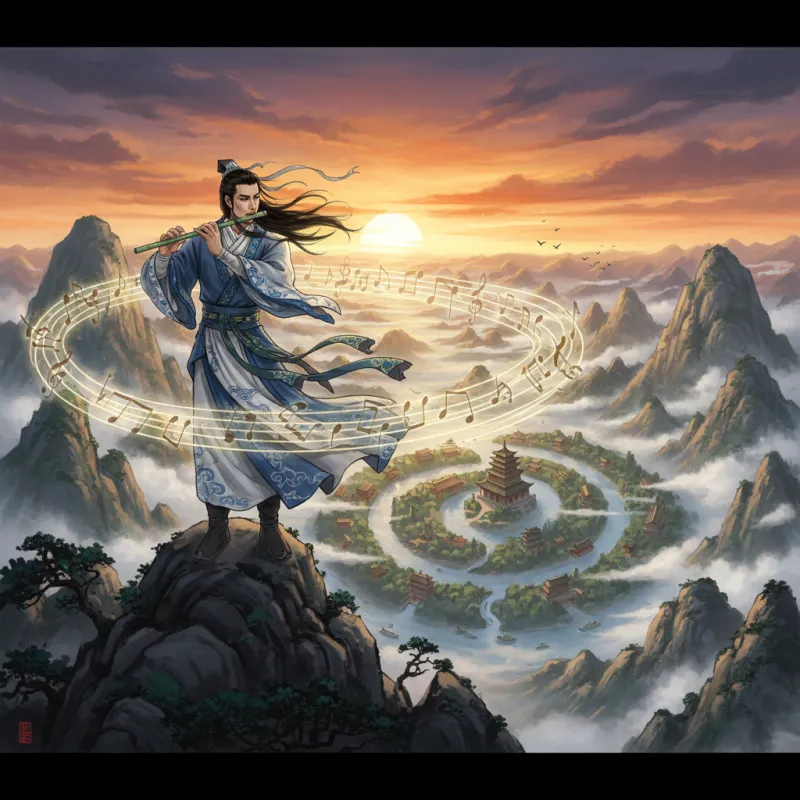
When Liu Zhengfeng and Qu Yang die together in The Smiling, Proud Wanderer, their blood mingles on the ground — but their final gift to the world isn't revenge or a secret manual. It's a song. The 笑傲江湖曲 (Xiào Ào Jiānghú Qǔ, "Xiao Ao Jianghu Song") represents something Jin Yong rarely allows his characters to achieve: transcendence of the jianghu's endless cycles of violence through pure artistic expression. This isn't background music. It's philosophy rendered in melody, a radical argument that beauty and friendship can exist outside the suffocating boundaries of sect loyalty and moral orthodoxy.
Two Men, Two Instruments, One Vision
Liu Zhengfeng (刘正风 Liú Zhèngfēng) plays the qin (琴), the seven-stringed zither associated with Confucian scholars and refined gentlemen. Qu Yang (曲洋 Qǔ Yáng) plays the xiao (箫), the vertical bamboo flute with its haunting, melancholic voice. One man belongs to the Hengshan Sword Sect (衡山派 Héngshān Pài), a pillar of martial orthodoxy. The other serves as an elder of the Sun Moon Holy Cult (日月神教 Rìyuè Shénjiào), the novel's stand-in for everything the "righteous" sects claim to oppose. By every rule of the jianghu, these men should be mortal enemies. Instead, they became the closest of friends, united by their shared love of music.
Their collaboration on the Xiao Ao Jianghu song took years. They met in secret, risking everything — reputation, position, even their lives — to create something beautiful together. The composition itself is technically demanding, requiring perfect synchronization between qin and xiao, each instrument completing the other's phrases in a musical conversation that mirrors the friendship between its creators. Jin Yong describes the piece as capturing the essence of 逍遥 (xiāoyáo) — carefree wandering, the Daoist ideal of moving through the world unburdened by conventional attachments.
The Philosophy of Freedom in Sound
The song's title, 笑傲江湖 (Xiào Ào Jiānghú), literally means "laughing proudly in the jianghu" or "smiling proud wanderer." But Jin Yong loads these four characters with layers of meaning that reverberate throughout the novel. To "laugh proudly" isn't arrogance — it's the ability to maintain inner freedom and joy despite external chaos. It's what Linghu Chong (令狐冲 Línghú Chōng), the novel's protagonist, struggles to achieve throughout his journey: the capacity to remain true to himself while the martial world tears itself apart over power and orthodoxy.
The music itself, as Jin Yong describes it, moves between moods with fluid grace. Sometimes it's as vast and free as wind over mountains. Other times it carries notes of melancholy, acknowledging the price of freedom in a world that demands conformity. The qin and xiao don't compete — they dance together, each voice distinct yet harmonious. This musical structure mirrors Jin Yong's ideal of how people from different backgrounds should interact: maintaining individual identity while creating something greater through genuine connection.
Compare this to the Sunflower Manual, which demands practitioners sacrifice their very humanity for power. Or consider the Nine Swords of Dugu, which Linghu Chong masters — a technique that emphasizes formlessness and adaptation, much like the improvisational quality of the Xiao Ao Jianghu song. Jin Yong consistently suggests that the highest achievements, whether in martial arts or music, come from transcending rigid systems.
The Bloody Price of Beauty
Liu Zhengfeng's retirement ceremony becomes a massacre. When he announces his intention to leave the martial world and pursue music full-time, the orthodox sects — led by the hypocritical Songshan Sect (嵩山派 Sōngshān Pài) — demand he sever ties with Qu Yang. Their reasoning? Association with the "demonic cult" taints his righteousness. Liu refuses. The result is carnage: his family slaughtered, his students killed, his own body mutilated. Qu Yang arrives too late to save him, and the two friends die together, their final moments spent not in revenge but in passing their musical legacy to Linghu Chong.
This scene is Jin Yong at his most scathing. The so-called righteous sects reveal themselves as petty tyrants who cannot tolerate anything that challenges their authority. They claim to uphold justice, but they murder an old man and his family because he dared to befriend someone from the wrong group. The Xiao Ao Jianghu song becomes a silent accusation: here is beauty, here is genuine human connection, and you destroyed it in the name of orthodoxy.
The manuscript of the song, written in blood and passed to Linghu Chong, becomes a physical reminder of what the jianghu's factional violence costs. Every time Linghu Chong plays it with Ren Yingying (任盈盈 Rèn Yíngyíng) — herself the daughter of the Sun Moon Holy Cult's leader — they're not just making music. They're honoring Liu and Qu's memory, proving that their vision of transcending sectarian hatred wasn't naive idealism but a genuine possibility.
Linghu Chong: The Reluctant Inheritor
Linghu Chong never wanted to be a revolutionary. He's a drunk, a troublemaker, a man who just wants to live freely without the burden of sect politics. Yet he becomes the inheritor of the Xiao Ao Jianghu song, and with it, the responsibility of embodying its philosophy. His journey throughout the novel is essentially learning to live up to the song's ideals: maintaining inner freedom, refusing to be bound by orthodox thinking, choosing friendship and love over power and position.
When Linghu Chong plays the song with Ren Yingying, their musical partnership mirrors Liu and Qu's friendship. He's from the orthodox Huashan Sect (华山派 Huàshān Pài), she's from the demonic cult — yet their music together is perfect. Jin Yong makes the parallel explicit: the next generation has a chance to succeed where the previous one was destroyed. But only if they're willing to reject the jianghu's poisonous tribalism.
The song also connects to Linghu Chong's mastery of the Dugu Nine Swords. Both require the practitioner to abandon fixed forms and respond spontaneously to the moment. Both emphasize freedom over rigid technique. The difference is that the Nine Swords is still a martial art, still a tool of violence, however elegant. The Xiao Ao Jianghu song offers something beyond violence entirely — a way of being in the world that doesn't require defeating anyone.
Music as Resistance
In Jin Yong's jianghu, everyone is obsessed with martial arts manuals, secret techniques, and ultimate power. The Xiao Ao Jianghu song stands as a rebuke to this entire value system. Liu and Qu didn't compose it to gain power or defeat enemies. They created it because beauty matters, because friendship matters, because there should be something in life beyond the endless cycle of revenge and sectarian warfare.
This makes the song a form of resistance. Not violent resistance — Liu and Qu aren't revolutionaries trying to overthrow the martial world's power structures. But they refuse to accept that those structures should define the totality of human experience. By creating art together across factional lines, they assert that individual human connection is more important than group loyalty. In a world where the Five Mountains Sword Sects Alliance demands absolute conformity and the Sun Moon Holy Cult enforces brutal discipline, this is a radical claim.
The song's survival, passed down through Linghu Chong and Ren Yingying, suggests that this form of resistance can endure. The orthodox sects killed Liu Zhengfeng, but they couldn't kill what he created. The music lives on, and with it, the possibility of a different way of being in the jianghu.
The Unfinished Melody
Jin Yong never fully describes the Xiao Ao Jianghu song's melody. We know it's beautiful, we know it requires qin and xiao in perfect harmony, we know it captures the spirit of carefree wandering. But the actual notes remain unwritten, existing only in the imagination of readers and in the various musical adaptations that have emerged since the novel's publication.
This incompleteness feels deliberate. The song represents an ideal that can never be fully captured or codified. The moment you write down exact rules for freedom, you've destroyed it. The moment you create an orthodox interpretation of the Xiao Ao Jianghu song, you've betrayed everything it stands for. By leaving the melody undefined, Jin Yong ensures that each generation must discover its own version of what it means to laugh proudly in the jianghu, to maintain inner freedom in a world that demands conformity.
Liu Zhengfeng and Qu Yang died for their friendship and their art. But their song survives, carried forward by two young people who refuse to let sectarian hatred define their lives. In a novel full of betrayal, hypocrisy, and violence, the Xiao Ao Jianghu song remains a fragile but persistent reminder that beauty and genuine human connection are possible — if we're brave enough to reach across the boundaries that divide us.
Related Reading
- Jin Yong's Music: The Soundtracks That Made a Nation Cry
- The Iconic Soundtracks of Jin Yong TV Adaptations
- Musical Instruments in Jin Yong's Wuxia World
- Poetry in Jin Yong's Novels: Classical Verse as Narrative Weapon
- Best and Worst Jin Yong Adaptations: A Definitive Guide
- Exploring the Rich Tapestry of Jin Yong's Wuxia Novels: Characters and Martial Arts
- Xiao Longnü: The Maiden Beyond the World