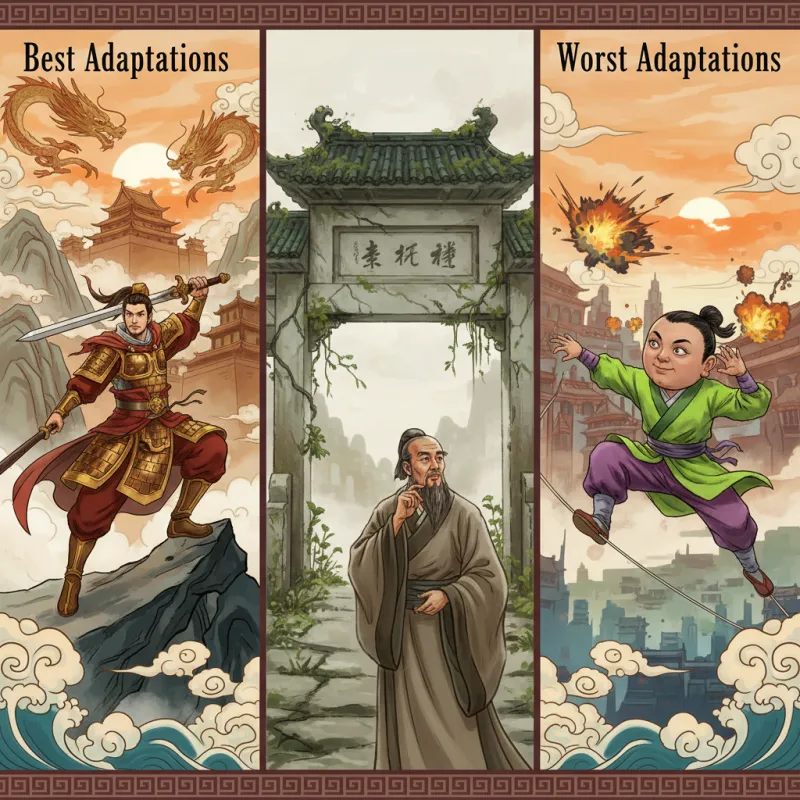
Picture this: You're settling in to watch what promises to be the definitive adaptation of The Return of the Condor Heroes (神雕侠侣 Shéndiāo Xiálǚ). The opening credits roll. Yang Guo appears on screen... and he's wearing eyeliner thick enough to stop a sword strike. Xiaolongnü looks like she raided a K-pop star's wardrobe. Within ten minutes, you're reaching for the remote. We've all been there. Jin Yong's fourteen novels have been adapted over 100 times, and the quality gap between the best and worst is wider than the chasm Yang Guo jumped across at Heartbreak Cliff.
The Gold Standard: When Everything Clicks
The 1983 TVB adaptation of The Legend of the Condor Heroes (射雕英雄传 Shèdiāo Yīngxióng Zhuàn) remains the benchmark against which all others are measured. Why? Because producer Jonathan Chik understood something fundamental: Jin Yong wrote about people first, martial artists second. Felix Wong's Guo Jing wasn't just slow-witted — you could see the gears turning in his head, the genuine confusion when faced with deception, the stubborn determination that made his eventual mastery believable. Barbara Yung's Huang Rong sparkled with mischief but never became a caricature. The chemistry was so natural that viewers forgot they were watching actors.
The 2003 mainland Chinese version of Demi-Gods and Semi-Devils (天龙八部 Tiānlóng Bābù) achieved something similar. Hu Jun's Qiao Feng carried the weight of a man caught between two identities without ever becoming maudlin. The production spent money where it mattered — on location shooting in Dali and the grasslands, on fight choreography that felt grounded despite the fantastical elements. When Qiao Feng died at Yanmen Pass, viewers wept not because of manipulative music cues but because they'd spent 40 episodes understanding exactly why he made that choice.
The Fatal Flaws: Where Adaptations Go Wrong
Bad Jin Yong adaptations fail in predictable ways. The most common mistake? Treating the source material as a loose framework rather than a carefully constructed narrative. The 2019 version of The Heaven Sword and Dragon Saber (倚天屠龙记 Yǐtiān Túlóng Jì) exemplifies this. The producers decided Zhang Wuji needed to be more "proactive" and "heroic," fundamentally misunderstanding that his indecisiveness with women and reluctance to lead are essential character traits, not flaws to be fixed. They turned a nuanced portrait of a man paralyzed by empathy into a generic wuxia protagonist.
Then there's the special effects trap. The 2017 The Legend of the Condor Heroes drowned in CGI. Every palm strike generated energy waves. Characters floated through the air like balloons. The problem isn't that Jin Yong's martial arts are realistic — they're not — but that good adaptations ground the fantastical in physical performance. When you can see the actor's muscles strain, when the choreography has weight and consequence, viewers suspend disbelief. When everything is digital, nothing matters.
Miscasting kills adaptations before they begin. The 2014 The Smiling, Proud Wanderer (笑傲江湖 Xiào'ào Jiānghú) cast Wallace Huo as Linghu Chong, and it was like watching someone play a violin with oven mitts. Huo is a fine actor, but Linghu Chong requires a specific energy — carefree, slightly dissolute, someone who'd rather drink than scheme. Huo played him as earnest and noble, completely missing the character's essential irreverence. Compare that to Chow Yun-fat's Linghu Chong in the 1984 TVB version, who seemed perpetually amused by the world's absurdity even while fighting for his life.
The Underrated Gems
Some excellent adaptations get overlooked because they weren't from major studios or didn't feature big stars. The 1976 Shaw Brothers film The Magic Blade (天涯·明月·刀 Tiānyá·Míngyuè·Dāo), based on Jin Yong's novel of the same name, is a masterclass in atmosphere. Director Chu Yuan understood that Jin Yong's jianghu (江湖 jiānghú, the martial arts world) is as much about mood as action — the fog-shrouded inns, the sense that danger lurks behind every smile, the way trust is the rarest commodity.
The 1994 film The East Is Red (东方不败 Dōngfāng Bùbài), while taking massive liberties with The Smiling, Proud Wanderer, succeeded by committing fully to its vision. Brigitte Lin's Dongfang Bubai became iconic not through faithful adaptation but through the filmmakers' willingness to explore the character's tragedy and transformation with operatic intensity. Sometimes respecting the spirit of Jin Yong means understanding when to diverge from the letter.
The Remake Curse
Why do so many remakes fail? Because they're made by people who grew up watching previous adaptations rather than reading the novels. The 2008 The Duke of Mount Deer (鹿鼎记 Lùdǐng Jì) felt like a remake of a remake, with Huang Xiaoming playing Wei Xiaobao as a collection of tics and mannerisms borrowed from earlier actors rather than finding the character fresh in the text. The result was exhausting — all surface energy with no core.
Successful remakes, like the 2001 The Legend of the Condor Heroes starring Li Yapeng and Zhou Xun, work because they ask "What would this story look like if we discovered it today?" rather than "How can we recreate what worked before?" Zhou Xun's Huang Rong was less overtly mischievous than Barbara Yung's but more psychologically complex, showing the calculation behind the playfulness. It wasn't better or worse than the 1983 version — it was different, and that difference justified its existence.
What Modern Adaptations Get Right (and Wrong)
Recent adaptations have production values that would have been unimaginable in the 1980s. The 2021 Word of Honor (山河令 Shānhé Lìng), while not directly based on Jin Yong, shows how modern productions can capture the essence of wuxia storytelling — the focus on character relationships, the moral complexity, the sense that the jianghu is a world with its own rules and codes. The cinematography is gorgeous without being distracting.
But modern adaptations often suffer from pacing issues. Streaming platforms want 50+ episodes to maximize engagement, so adaptations pad the story with invented subplots and extended reaction shots. The 2017 The Legend of the Condor Heroes took 52 episodes to tell a story the 1983 version covered in 59 episodes of 45 minutes each — and the older version felt tighter. More isn't always more. Jin Yong's novels have natural rhythms, and stretching them breaks the narrative flow.
The International Factor
As Jin Yong adaptations reach international audiences through streaming platforms, there's pressure to make them more "accessible" — which often means more action, less dialogue, simpler character motivations. This is a mistake. What makes Jin Yong's work endure isn't the fight scenes but the moral dilemmas, the exploration of loyalty and betrayal, the way characters are shaped by history and tradition. The best adaptations trust audiences to engage with complexity, whether they're in Hong Kong or Houston.
The 2008 film The Forbidden Kingdom, which attempted to introduce Jin Yong-style wuxia to Western audiences through Jackie Chan and Jet Li, failed precisely because it dumbed everything down. It treated wuxia as a genre of cool moves rather than a storytelling tradition with depth and nuance. Compare that to Crouching Tiger, Hidden Dragon, which wasn't based on Jin Yong but captured the emotional core of his work — the way martial arts mastery is inseparable from personal discipline and sacrifice.
The Verdict: What We Deserve
Jin Yong's novels have survived because they're about fundamental human experiences — love, loyalty, identity, the gap between ideals and reality. The best adaptations understand this. They know that when Guo Jing refuses to abandon Xiangyang, it's not just heroic posturing but a man choosing principle over survival. They know that Yang Guo's seventeen-year wait for Xiaolongnü only works if we see the obsession as both romantic and slightly unhinged. They know that Wei Xiaobao's success through shamelessness is funny because it's also a critique of how power actually works.
The worst adaptations treat Jin Yong as content to be exploited — a brand name that guarantees viewers regardless of quality. They hire pretty faces instead of actors who understand the characters. They add unnecessary romance subplots because focus groups said they wanted more kissing. They sand off the moral complexity because ambiguity doesn't test well.
We deserve better. Jin Yong spent decades crafting these stories, revising them multiple times to get the details right. The least adaptations can do is approach them with similar care. When they do — when casting, writing, directing, and production design all serve the story rather than their own agendas — the results are magical. When they don't, we get expensive mediocrity that insults both the source material and the audience's intelligence.
The good news? For every terrible adaptation, there's a great one waiting to be discovered. The 1983 Condor Heroes, the 2003 Demi-Gods, the 1994 East Is Red — these aren't just good Jin Yong adaptations. They're excellent television and film, period. They prove that wuxia can be popular without being dumb, that martial arts stories can explore serious themes without becoming pretentious, that you can honor tradition while making something fresh.
So the next time you're browsing for a Jin Yong adaptation, do your research. Check who's directing, who's cast, what the production values look like. Read reviews from people who've actually read the novels, not just watched previous adaptations. And if you start watching and it's terrible? Turn it off. Life's too short for bad wuxia, and Jin Yong's legacy deserves better than our hate-watching.
Related Reading
- Jin Yong on Screen: Why Every Adaptation Disappoints Someone
- Wuxia Films for Beginners: Where to Start
- The Best TV Adaptations of Jin Yong's Novels
- Jin Yong in Video Games: From DOS to Open World
- Jin Yong's Global Influence: How Wuxia Went Worldwide
- Musical Instruments in Jin Yong's Wuxia World
- The Humor of Jin Yong: Comedy in the Martial World
- Unveiling the Wisdom and Philosophy in Jin Yong's Wuxia Novels