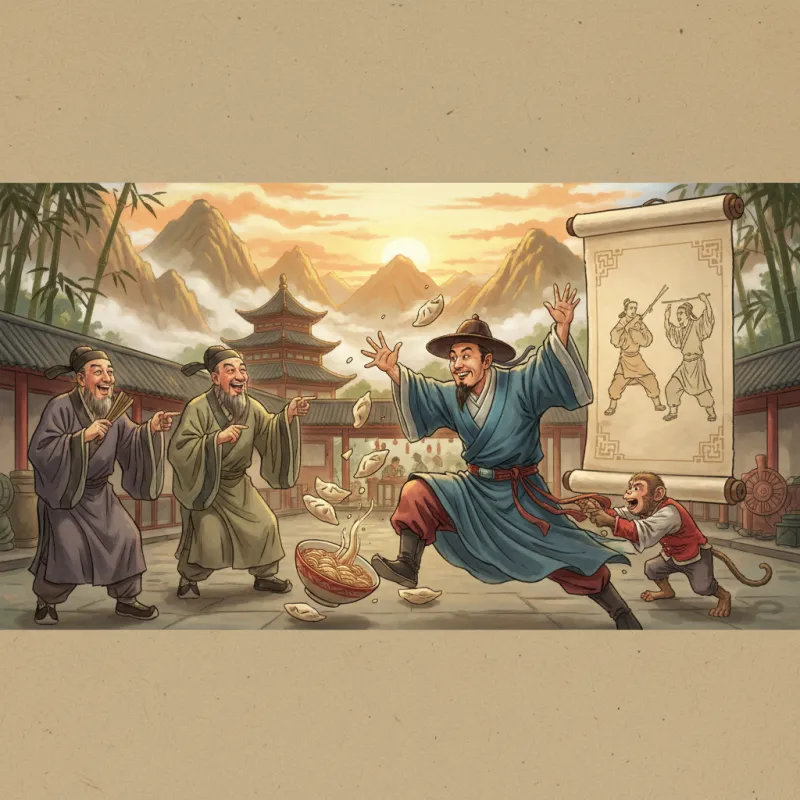
When Zhou Botong, one of the most formidable martial artists in the jianghu (江湖, jiānghú), gets trapped on Peach Blossom Island for fifteen years, he doesn't spend his time plotting revenge or perfecting deadly techniques. He teaches himself to write with both hands simultaneously—one hand writing normally, the other in mirror script—purely because he's bored. This is Jin Yong's genius in a nutshell: taking the conventions of wuxia fiction and injecting them with a humor so organic, so character-driven, that you forget you're reading what should be a deadly serious genre about honor, revenge, and martial supremacy.
The Architecture of Jin Yong's Comedy
Jin Yong (金庸, Jīn Yōng) didn't write funny novels. He wrote novels that contained multitudes, and humor was as essential to their structure as swordplay or romance. His comedy operates on multiple levels simultaneously: slapstick physical humor, verbal wit, situational irony, and—most devastatingly—dramatic irony where readers know something characters don't.
Consider The Legend of the Condor Heroes (射雕英雄传, Shèdiāo Yīngxióng Zhuàn). Guo Jing is famously slow-witted, and Jin Yong milks this for consistent comedy. But the humor isn't mean-spirited. We laugh with Guo Jing's earnestness, not at his stupidity. When he takes everything literally, when he practices martial arts with such dogged determination that he accidentally becomes brilliant, the comedy reinforces rather than undermines his heroism. His eventual mastery of the Eighteen Dragon-Subduing Palms (降龙十八掌, Jiàng Lóng Shíbā Zhǎng) is funnier and more satisfying because we've watched him struggle with concepts that others grasp instantly.
The contrast with Huang Rong couldn't be sharper. She's clever, manipulative, and constantly scheming—and Jin Yong makes her schemes entertaining rather than villainous. When she tricks Hong Qigong into teaching Guo Jing by cooking him elaborate meals, we're watching comedy of manipulation. The great beggar chief, who has tasted every delicacy in China, becomes a puppet to a teenage girl's culinary skills.
Zhou Botong and the Weaponization of Childishness
Zhou Botong (周伯通, Zhōu Bótōng), the Old Urchin (老顽童, Lǎo Wántóng), represents Jin Yong's most sustained comic creation. He appears across multiple novels, and his character never wavers: he is perpetually, incorrigibly, magnificently childish.
What makes Zhou Botong brilliant is that his childishness is not a weakness to be overcome. It's his defining strength. He invents the technique of Mutual Hands Combat (双手互搏, Shuāngshǒu Hùbó)—fighting as if he were two people—not through years of disciplined study but because he's bored and wants to play chess against himself. This is comedy that doubles as character development and plot device. The technique later becomes crucial to Guo Jing's development, meaning that a joke becomes a turning point in the hero's journey.
Zhou Botong's interactions with Ying Gu provide some of the most poignant comedy in Jin Yong's work. Here's a man who is over seventy years old, one of the Five Greats of the martial world, and he's essentially been grounded by his senior martial brother for decades. His response? He doesn't brood or plot revenge. He plays. He experiments. He turns imprisonment into an extended recess.
The tragedy underlying Zhou Botong's character—his role in Ying Gu's suffering, his genuine loneliness—makes the comedy richer. Jin Yong understood that humor and pathos aren't opposites. They're neighbors, and the best characters live in both houses.
Verbal Sparring as Martial Art
Jin Yong's dialogue crackles with wit, and his characters engage in verbal combat as intricate as their physical fights. The banter between Yang Guo and Xiaolongnü in The Return of the Condor Heroes (神雕侠侣, Shéndiāo Xiálǚ) operates on multiple levels—flirtation, genuine affection, and the awkwardness of their unconventional relationship.
But it's in The Smiling, Proud Wanderer (笑傲江湖, Xiào'ào Jiānghú) that Jin Yong's verbal comedy reaches its peak. Linghu Chong's interactions with Yue Buqun, his master, are masterclasses in dramatic irony. We know Yue Buqun is a hypocrite, a "gentleman sword" who is neither gentle nor honorable. Linghu Chong doesn't know this for most of the novel. His earnest attempts to please his master, his confusion at Yue Buqun's increasingly erratic behavior—this is comedy that makes you wince even as you laugh.
The Peach Valley Six (桃谷六仙, Táogǔ Liù Xiān) in the same novel represent pure verbal chaos. They finish each other's sentences, contradict themselves mid-thought, and engage in logic so circular it becomes its own form of martial art. Their dialogue is almost musical—a cacophony that somehow resolves into meaning. When they argue about whether to kill someone or save them, switching positions multiple times in a single conversation, Jin Yong is doing something sophisticated: he's showing how language itself can be a weapon, a defense, and a source of pure entertainment.
The Comedy of Mismatched Expectations
Jin Yong frequently deploys humor through the gap between reputation and reality. Characters built up as terrifying masters turn out to be eccentric, petty, or absurd. The revelation is always funnier because Jin Yong takes his time with the setup.
In Demi-Gods and Semi-Devils (天龙八部, Tiānlóng Bābù), Duan Yu's father, Duan Zhengchun, is introduced as a noble prince and skilled martial artist. Then we discover he's essentially a serial philanderer who has left a trail of women and illegitimate children across China. The comedy comes from watching this supposedly dignified figure constantly running into former lovers and their offspring, each encounter more awkward than the last. His wife's revenge—tracking down each woman and marking them with her distinctive technique—is both comic and satisfying.
The Beggar Clan (丐帮, Gàibāng) provides consistent comic relief across multiple novels while remaining genuinely formidable. The contrast between their ragged appearance and their sophisticated internal politics, between their begging bowls and their crucial role in defending China, is a running joke that never gets old. Hong Qigong, their chief, is one of the Five Greats—and he's obsessed with food to the point of abandoning his responsibilities for a good meal. This isn't character inconsistency. It's Jin Yong recognizing that people, even legendary heroes, contain contradictions.
Physical Comedy in a Genre of Grace
Wuxia fiction typically emphasizes the beauty and elegance of martial arts. Jin Yong does this too—his fight scenes are balletic and precisely choreographed. But he also isn't afraid to make martial arts funny.
Wei Xiaobao in The Deer and the Cauldron (鹿鼎记, Lùdǐng Jì) is Jin Yong's most sustained experiment in comic heroism. Wei Xiaobao has no martial arts skills. None. He survives through luck, cunning, and an absolute shamelessness that borders on genius. Watching him stumble through situations that would require incredible kung fu in any other wuxia novel is consistently hilarious. He defeats enemies by accident, seduces women through misunderstanding, and rises to power because everyone around him is too busy being honorable to notice his schemes.
The physical comedy in Wei Xiaobao's adventures is slapstick, but it's slapstick with purpose. Jin Yong is deconstructing the entire wuxia genre, asking: what if the hero wasn't heroic? What if he was a coward, a liar, and a cheat—and still somehow saved the day? The answer is comedy gold, and also a surprisingly effective critique of traditional heroism. For more on how Jin Yong subverts genre expectations, see The Anti-Hero in Jin Yong's Works.
Satire Disguised as Adventure
Jin Yong's humor often carries a satirical edge. He's not just entertaining readers; he's commenting on human nature, political systems, and the martial world itself.
The various martial sects in his novels are frequently ridiculous. They have elaborate hierarchies, ancient grudges over trivial matters, and rules that make no sense. The Huashan Sect's split into Sword Sect and Qi Sect in The Smiling, Proud Wanderer is essentially an academic dispute that has led to decades of bloodshed. Jin Yong is satirizing how institutions ossify, how ideological purity becomes more important than practical results, how people will die for principles they barely understand.
The obsession with martial arts manuals is another recurring comic element. Characters will kill, betray, and scheme for decades to obtain a manual that might make them slightly more powerful. The Nine Yin Manual (九阴真经, Jiǔ Yīn Zhēnjīng) drives the plot of multiple novels, and Jin Yong never lets us forget how absurd this is. It's a book. People are dying over a book. The comedy is dark, but it's there.
The Timing of Tragedy and Comedy
What separates Jin Yong from lesser writers is his understanding of timing. He knows when to be funny and when to be serious, and more importantly, he knows how to use one to enhance the other.
In The Return of the Condor Heroes, Yang Guo's sixteen-year separation from Xiaolongnü is genuinely tragic. But Jin Yong doesn't maintain a tragic tone for sixteen years of narrative time. He intersperses Yang Guo's grief with comic episodes, with new characters who provide levity, with situations that are absurd even as Yang Guo's pain remains real. This isn't tonal inconsistency. It's emotional realism. Life doesn't pause comedy for tragedy. They coexist, and Jin Yong's novels reflect this truth.
The final reunion between Yang Guo and Xiaolongnü is more powerful because we've laughed during their separation. The comedy hasn't diminished the tragedy; it's provided contrast, relief, and a reminder that life continues even in grief. For more on Jin Yong's handling of romance and separation, see Love and Longing in the Jianghu.
Why Jin Yong's Humor Endures
Jin Yong's comedy works because it's rooted in character rather than situation. His funny characters aren't funny because the plot requires comic relief. They're funny because that's who they are. Zhou Botong would be childish in any story. Wei Xiaobao would be a schemer in any context. The humor emerges organically from their personalities interacting with the world.
This is why Jin Yong's novels remain funny across translations, across cultures, across decades. Physical comedy is universal. Character-driven humor transcends language barriers. The gap between expectation and reality is funny in any context.
Modern wuxia adaptations often struggle with Jin Yong's humor. They either overplay it, turning subtle character comedy into broad slapstick, or they underplay it, treating the novels as purely serious works. The best adaptations understand that Jin Yong's humor isn't separate from his drama. It's the same thing, viewed from a different angle.
When you read Jin Yong, you're not reading adventure novels with occasional funny bits. You're reading a complete vision of human experience where comedy and tragedy, heroism and absurdity, wisdom and foolishness all coexist. The martial world isn't just a place of honor and revenge. It's also a place where a seventy-year-old man invents new martial arts because he's bored, where a beggar chief abandons his duties for good food, where the greatest heroes are sometimes the biggest fools.
That's not just funny. That's true.
Related Reading
- Wei Xiaobao: The Funniest Character in Chinese Literature
- The Funniest Moments in Jin Yong's Novels
- Jin Yong's Humor: The Comedy Hidden Inside the Tragedy
- Zhou Botong: The Old Urchin Who Never Grew Up
- Buddhism and Martial Arts: Spiritual Themes
- Wine Culture in Jin Yong's Wuxia World
- Exploring the Love Stories in Jin Yong's Wuxia Novels: Romance Amidst Adventure