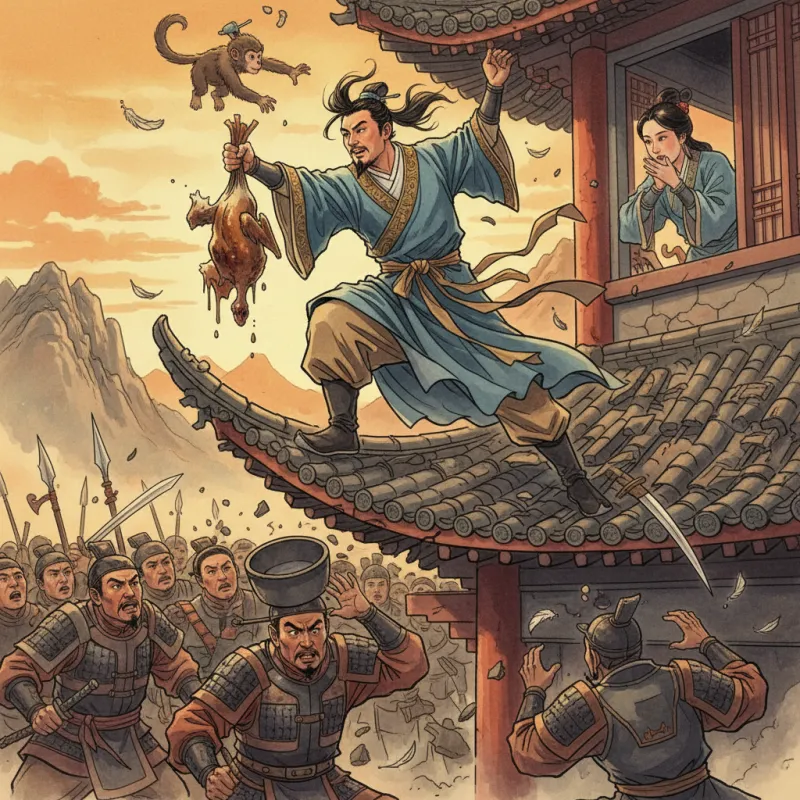
When Wei Xiaobao accidentally kicks the Qing Emperor Kangxi in the face during their first meeting, then compounds the disaster by calling him a "turtle's egg," most readers expect immediate execution. Instead, Kangxi laughs so hard he can barely breathe. This scene from The Deer and the Cauldron (鹿鼎记, Lù Dǐng Jì) captures something essential about Jin Yong that literary critics often miss: beneath the tragic grandeur and philosophical depth, he was one of the funniest novelists in Chinese literature.
The comedy in Jin Yong's wuxia novels isn't decorative. It's load-bearing architecture. Strip away the humor from The Deer and the Cauldron, and you lose half the novel's meaning. Remove the comic relief from The Legend of the Condor Heroes (射雕英雄传, Shè Diāo Yīngxióng Zhuàn), and Guo Jing's earnestness becomes unbearable. Jin Yong understood what Shakespeare knew: tragedy without comedy is melodrama, and comedy without stakes is mere entertainment.
The Spectrum of Jin Yong's Humor
Jin Yong deployed humor like a martial artist uses different weapons — each type suited to specific narrative purposes. His slapstick is pure physical comedy: Linghu Chong getting drunk and accidentally defeating enemies in The Smiling, Proud Wanderer (笑傲江湖, Xiào Ào Jiānghú), or Guo Jing's literal-minded responses to Huang Rong's flirtations. These moments provide visceral relief from the tension of life-and-death combat.
But his satire cuts deeper. The Beggar Clan's elaborate hierarchy in Demi-Gods and Semi-Devils (天龙八部, Tiān Lóng Bā Bù) — where beggars obsess over the number of bags they carry and engage in Byzantine political maneuvering — is a savage parody of bureaucratic China. The martial arts sects' endless debates about orthodoxy and heresy in The Heaven Sword and Dragon Saber (倚天屠龙记, Yǐ Tiān Tú Lóng Jì) mock religious and political dogmatism with surgical precision.
Then there's the irony, which Jin Yong wields like a hidden weapon. Yang Guo spends years perfecting martial arts to take revenge on Guo Jing, only to discover that Guo Jing is the one person in the jianghu (江湖, jiānghú) who genuinely cares about him. The greatest swordsman in The Smiling, Proud Wanderer is a castrated former monk. The most powerful martial artist in Demi-Gods and Semi-Devils is a Khitan prince who discovers he's actually Han Chinese — just as he's spent decades fighting for Khitan interests. These ironies aren't just plot twists; they're philosophical statements about identity, loyalty, and the absurdity of human conflict.
Wei Xiaobao: Comedy as Subversion
The Deer and the Cauldron, Jin Yong's final novel, represents his most sustained comic achievement. Wei Xiaobao (韦小宝, Wéi Xiǎobǎo) is the anti-hero who demolishes every wuxia convention Jin Yong spent forty years establishing. He can't fight. He has no martial arts skills whatsoever. He's a liar, a cheat, and a shameless opportunist. He serves both the Qing Emperor and the anti-Qing resistance simultaneously, betraying everyone and no one.
What makes Wei Xiaobao hilarious isn't just his roguish behavior — it's the gap between his complete unsuitability for the wuxia world and his inexplicable success within it. He defeats enemies through dumb luck, sexual charm, and an instinct for self-preservation that borders on genius. When serious martial artists engage in elaborate duels, Wei Xiaobao throws lime powder in their eyes. When heroes sacrifice themselves for abstract principles, Wei Xiaobao negotiates, compromises, and survives.
The comedy here is subversive in the deepest sense. Jin Yong spent decades writing about heroes who embody Confucian virtues — loyalty, righteousness, self-sacrifice. Wei Xiaobao embodies none of these, yet he's more likeable than most of Jin Yong's heroes and arguably more successful. He gets the girl — actually, he gets seven girls. He becomes fabulously wealthy. He retires young and lives happily ever after. The joke is on everyone who took the wuxia code too seriously, including Jin Yong's earlier protagonists. For more on unconventional heroes, see The Trickster Archetype in Jin Yong's Novels.
Zhou Botong and the Holy Fool Tradition
Zhou Botong (周伯通, Zhōu Bótōng), the "Old Urchin" from The Legend of the Condor Heroes, represents a different comic tradition: the holy fool who speaks truth through apparent nonsense. At seventy years old, Zhou Botong plays children's games, catches crickets, and refuses to take anything seriously — including his own status as one of the world's greatest martial artists.
His humor is liberating. In a world where everyone else is weighed down by grudges, obligations, and the burden of their reputations, Zhou Botong is free. He invents martial arts techniques while playing games. He befriends Guo Jing not because of any strategic calculation but because Guo Jing is willing to play with him. When trapped in a cave for fifteen years, he doesn't despair — he invents a technique for fighting himself and spends the time having fun.
The genius of Zhou Botong is that his childishness is actually wisdom. He sees through the pretensions and self-importance that trap other characters. When martial arts masters engage in deadly serious debates about technique and philosophy, Zhou Botong reveals that they're all just playing elaborate games. His laughter is enlightenment.
Satire as Social Criticism
Jin Yong's sharpest social criticism often arrives wrapped in comedy. The martial arts sects in his novels are transparently modeled on Chinese political and social institutions, and he mocks them mercilessly. The Shaolin Temple's obsession with orthodoxy and its tendency to produce rigid, dogmatic disciples satirizes both Buddhist institutions and Confucian education. The Beggar Clan's elaborate hierarchy parodies bureaucratic China's obsession with rank and status.
The Smiling, Proud Wanderer contains Jin Yong's most sustained political satire. The novel's martial arts world is consumed by a struggle between orthodox and unorthodox sects, with each side claiming moral superiority while engaging in identical behavior. The "orthodox" sects form alliances, betray each other, and commit atrocities — all while maintaining their righteous facade. The "unorthodox" sects are more honest about their amorality but no less vicious.
The comedy emerges from the gap between rhetoric and reality. Leaders give speeches about righteousness while plotting murders. Sects claim to uphold justice while pursuing naked self-interest. The joke is that everyone in the jianghu is playing the same game, but only some admit it. This satire resonated powerfully with readers in 1960s Hong Kong, where it was understood as commentary on both Communist China and Nationalist Taiwan — two regimes that claimed moral superiority while engaging in authoritarian repression.
The Comedy of Mismatched Couples
Jin Yong's romantic comedy deserves its own analysis. His novels are full of mismatched couples whose relationships generate both humor and pathos. Guo Jing and Huang Rong are the template: the earnest, literal-minded warrior and the clever, manipulative princess. Their courtship in The Legend of the Condor Heroes is genuinely funny, with Huang Rong constantly testing Guo Jing's devotion and Guo Jing failing to understand even her most obvious hints.
Yang Guo and Xiaolongnü in The Return of the Condor Heroes (神雕侠侣, Shén Diāo Xiá Lǚ) take the mismatched couple to extremes. Their relationship violates every social norm — she's his teacher, she's significantly older, they live together unmarried — and Jin Yong mines this for both comedy and tragedy. The humor comes from Yang Guo's complete inability to understand social conventions and Xiaolongnü's even more complete indifference to them.
The comedy in these relationships isn't just entertainment. It's Jin Yong's way of questioning social norms and exploring how love operates outside conventional frameworks. When society's rules seem absurd, comedy becomes a form of liberation. For more on Jin Yong's romantic relationships, see Love Across Social Boundaries.
Linguistic Humor and Wordplay
Jin Yong's humor often depends on linguistic playfulness that's difficult to translate. Character names are frequently jokes: Wei Xiaobao's name suggests "small treasure," which is ironic given his complete lack of conventional virtues. Yue Buqun (岳不群, Yuè Bùqún) in The Smiling, Proud Wanderer has a name that means "not part of the group," which is darkly ironic given his obsession with leading the orthodox martial arts alliance.
The novels are full of puns, double meanings, and linguistic misdirection. Characters misunderstand each other in ways that reveal deeper truths. Guo Jing's literal interpretations of figurative language expose the gap between martial arts rhetoric and reality. Wei Xiaobao's creative lying demonstrates how language can be weaponized by those without physical power.
This linguistic comedy is particularly effective in the original Chinese, where the tonal nature of the language and the visual nature of characters create opportunities for wordplay that don't exist in English. Jin Yong exploited these opportunities ruthlessly, creating layers of meaning that reward careful reading.
Why the Humor Matters
Jin Yong's humor isn't a break from the serious themes of his novels — it's how those themes achieve their full depth. The comedy humanizes characters who might otherwise be mere archetypes. It provides emotional relief that makes the tragedy more bearable and therefore more powerful. It allows Jin Yong to criticize social and political institutions without becoming didactic.
Most importantly, the humor embodies a philosophical stance. In a world of suffering, violence, and moral ambiguity, laughter is both a survival mechanism and a form of wisdom. Zhou Botong's playfulness, Wei Xiaobao's irreverence, and even Linghu Chong's drunken antics represent different ways of refusing to be crushed by the weight of existence.
Jin Yong understood that tragedy and comedy aren't opposites — they're two perspectives on the same reality. The greatest moments in his novels hold both simultaneously: Wei Xiaobao's comic adventures take place against the backdrop of the Qing conquest and the destruction of the Ming resistance. Zhou Botong's playfulness coexists with his genuine grief over lost love. The humor doesn't diminish the tragedy; it makes it bearable, and therefore more profound.
This is why Jin Yong's novels endure. They're not just martial arts adventures or historical romances. They're profound meditations on human nature that use every tool available — including comedy — to explore what it means to live in a world that's simultaneously tragic and absurd. The laughter and the tears are inseparable, and that's exactly how life feels.
Related Reading
- The Funniest Moments in Jin Yong's Novels
- Wei Xiaobao: The Funniest Character in Chinese Literature
- The Humor of Jin Yong: Comedy in the Martial World
- Zhou Botong: The Old Urchin Who Never Grew Up
- Love and Sacrifice in Jin Yong's World
- Exploring the Intricate Sects within Jin Yong's Iconic Wuxia Novels
- How the Condor Trilogy Connects: Characters, Weapons, and Secrets Across 155 Years