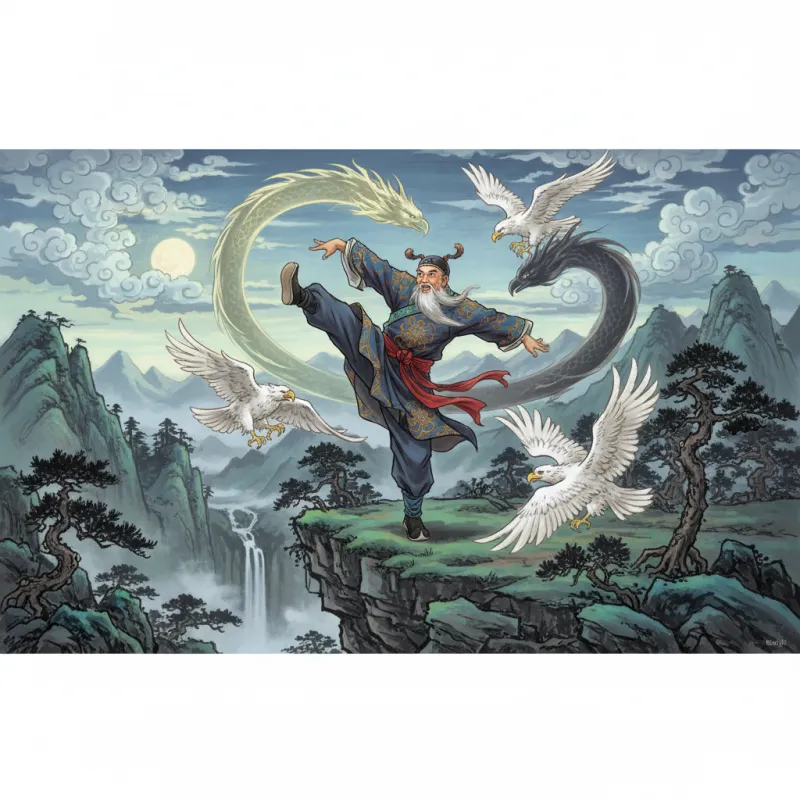
Picture this: A seventy-year-old man with white hair and a face full of wrinkles is lying on his back in a cave, kicking his legs in the air and giggling because he just invented a new way to fight with both hands doing completely different things. This is Zhou Botong (周伯通 Zhōu Bótōng), and he's not having a mental breakdown—he's having the time of his life. In Jin Yong's martial arts universe, where everyone is brooding about revenge, honor, or the fate of the nation, Zhou Botong stands alone as the man who simply refuses to take anything seriously, including himself.
The Quanzhen Sect's Greatest Embarrassment
Zhou Botong holds one of the most awkward positions in martial arts fiction: he's the junior martial brother (师弟 shīdì) of Wang Chongyang (王重阳 Wáng Chóngyáng), the founder of the Quanzhen Sect (全真教 Quánzhēn Jiào) and the undisputed champion of the first Huashan Sword Tournament (华山论剑 Huàshān Lùnjiàn). Think about that for a second. Your senior brother is literally the best fighter in the world, and you're... well, you're the guy who gets distracted by butterflies during meditation.
The Quanzhen Sect is supposed to be this austere Taoist order focused on internal cultivation and spiritual refinement. They have rules. Lots of rules. Zhou Botong breaks approximately all of them, not out of rebellion but because he genuinely forgets they exist. While his martial nephews like Qiu Chuji (丘处机 Qiū Chǔjī) and Wang Chuyi (王处一 Wáng Chǔyī) are trying to maintain the sect's dignity, their martial uncle is somewhere catching frogs or challenging random people to thumb-wrestling contests.
Fifteen Years in a Cave (And He Still Came Out Cheerful)
Here's where Zhou Botong's story gets genuinely dark before looping back to absurd. In The Legend of the Condor Heroes (射雕英雄传 Shèdiāo Yīngxióng Zhuàn), we learn that Huang Yaoshi (黄药师 Huáng Yàoshī), the Heretic of Peach Blossom Island, imprisoned Zhou Botong in a cave for fifteen years. The reason? Zhou Botong had an affair with Huang Yaoshi's wife, which indirectly led to her death during childbirth.
Fifteen years. In a cave. Alone. This should have broken him. This should have turned him into a bitter, revenge-obsessed villain like so many other Jin Yong characters who suffer far less. Instead, Zhou Botong spent his time inventing the technique of Mutual Hands Combat (双手互搏 shuāngshǒu hùbó)—a martial arts method where your left and right hands fight as if controlled by two different people—because he was bored and wanted someone to spar with.
Let that sink in. Most people would emerge from fifteen years of solitary confinement as psychological wrecks. Zhou Botong emerged with a new party trick and zero emotional baggage. The man is either enlightened or completely insane, and honestly, with Jin Yong's Taoists, it's often hard to tell the difference.
The Martial Arts Genius Who Doesn't Care About Martial Arts
Here's the thing that makes Zhou Botong simultaneously frustrating and fascinating: he's absurdly talented. He masters the Nine Yin Manual (九阴真经 Jiǔyīn Zhēnjīng)—the most coveted martial arts text in the entire series—by memorizing it once and then deliberately forgetting it because his brother told him it was dangerous. He invents Mutual Hands Combat, which becomes one of the most practical techniques in the series. He's one of the Five Greats (五绝 Wǔjué) of the martial world, standing alongside legends like Huang Yaoshi and his eccentric genius.
But unlike every other character who would kill for such abilities, Zhou Botong treats martial arts like a playground game. He doesn't want to be the best. He doesn't want to prove anything. He just wants to have fun. When Guo Jing (郭靖 Guō Jìng) becomes his sworn brother despite being sixty years younger, Zhou Botong is genuinely delighted—not because Guo Jing is the protagonist, but because now he has a new friend to play with.
This attitude makes him nearly impossible to manipulate, which is a superpower in Jin Yong's world where everyone is constantly scheming. You can't bait Zhou Botong with promises of power, revenge, or glory. The only way to control him is to trap him physically, and even then, he'll just invent new kung fu to pass the time.
The Psychology of Perpetual Childhood
What makes Zhou Botong work as a character—and why he's more than just comic relief—is that Jin Yong never explains why he's like this. There's no tragic backstory that broke his mind. No secret technique that stunted his emotional growth. He's just... like this. Always has been. Always will be.
In Taoist philosophy, there's the concept of returning to the state of an infant (复归于婴儿 fù guī yú yīng'ér)—achieving such complete naturalness that you shed all artificial social conditioning. Zhou Botong might be the only character in Jin Yong's works who actually achieves this, albeit in the most literal and inconvenient way possible. He has no ego to protect, no face to save, no dignity to maintain. When Huang Rong (黄蓉 Huáng Róng) tricks him repeatedly throughout Condor Heroes, he never holds a grudge. He just laughs and falls for the next trick.
Compare this to literally any other powerful martial artist in the series. Ouyang Feng's obsession with being the best drives him to madness. Hong Qigong (洪七公 Hóng Qīgōng) carries the weight of the Beggars' Sect. Even the "good" characters are burdened by duty, honor, and responsibility. Zhou Botong alone is free, and his freedom comes from his complete inability to take himself seriously.
The Old Urchin in Return of the Condor Heroes
Zhou Botong's role expands in The Return of the Condor Heroes (神雕侠侣 Shéndiāo Xiálǚ), where he's somehow become even more ridiculous with age. He spends much of the novel playing with a pair of jade bees, treating them like pets and having full conversations with them. When he finally emerges to help in the climactic battles, he's still more interested in showing off his new techniques than actually defeating enemies.
But there's a beautiful moment late in the series where Zhou Botong encounters Xiaolongnü (小龙女 Xiǎolóngnǚ) and recognizes in her the same emotional detachment he possesses—except hers comes from trauma and isolation, while his comes from... well, being Zhou Botong. It's one of the few times we see him display something like wisdom, even if he immediately undercuts it by challenging her to a game.
Why We Need More Zhou Botongs
In a genre obsessed with revenge cycles, honor killings, and the weight of jianghu politics, Zhou Botong is a radical act of resistance. He proves that you can be powerful without being serious, skilled without being prideful, and old without being bitter. He's the antidote to every grim, tortured martial arts master who's forgotten how to smile.
Jin Yong filled his novels with complex moral dilemmas and characters torn between competing loyalties. Zhou Botong exists outside all of that, not because he's stupid—he's actually quite clever when he wants to be—but because he's genuinely, authentically happy. In a world where martial arts mastery often comes at terrible personal cost, Zhou Botong got strong by playing games in a cave.
The Old Urchin reminds us that sometimes the most powerful thing you can do is refuse to grow up in the ways society demands. Keep your sense of wonder. Play more. Take yourself less seriously. And if someone locks you in a cave for fifteen years, invent a new kung fu style and come out laughing.
That's not childishness. That's enlightenment with better PR.
Related Reading
- Wei Xiaobao: The Funniest Character in Chinese Literature
- Jin Yong's Humor: The Comedy Hidden Inside the Tragedy
- The Funniest Moments in Jin Yong's Novels
- The Humor of Jin Yong: Comedy in the Martial World
- The Art of Duels in Jin Yong's Wuxia Novels: A Journey Through Martial Valor
- Jin Yong Novel Chronology: When Each Story Takes Place
- Exploring the Love Stories in Jin Yong's Wuxia Novels: Romance Amidst Adventure