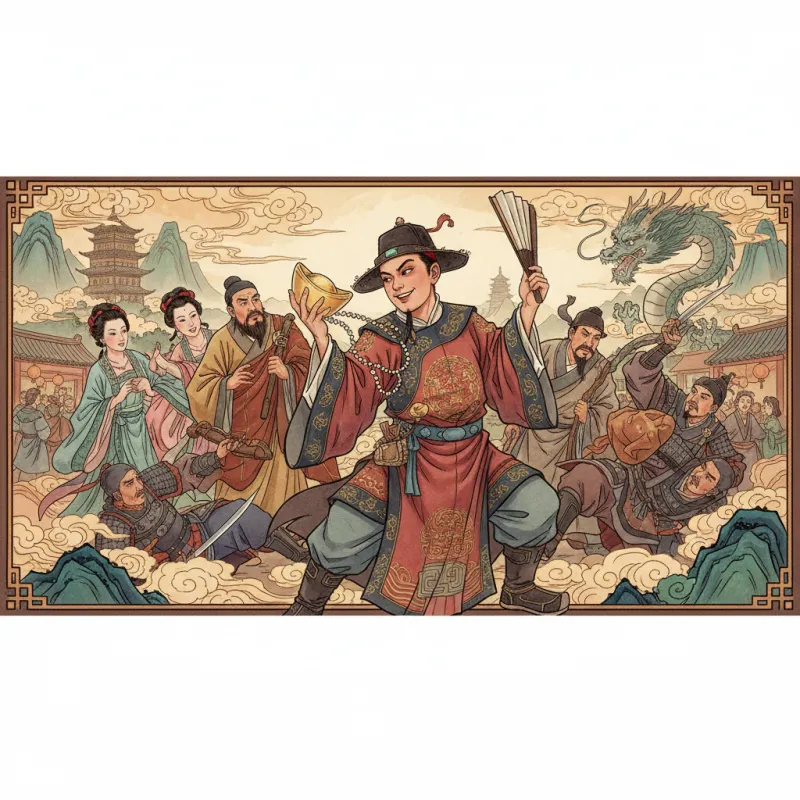
Picture this: a scrawny teenager who can't read, can't fight, and whose greatest skill is lying through his teeth somehow becomes the most powerful man in the Qing Empire, marries seven wives, and retires rich before he turns twenty. That's Wei Xiaobao (韦小宝 Wéi Xiǎobǎo), and he's not just funny — he's a comedic masterpiece that demolishes everything we thought we knew about heroes in Chinese literature.
The Brothel Kid Who Couldn't Throw a Punch
Wei Xiaobao grows up in the Lovely Spring Court (丽春院 Lìchūn Yuàn), a brothel in Yangzhou, raised by his mother — a prostitute who never bothered to tell him who his father was. While other Jin Yong (金庸 Jīn Yōng) protagonists are learning the Eighteen Dragon-Subduing Palms or mastering the Nine Yin Manual, Xiaobao is learning how to cheat at dice, pick pockets, and sweet-talk his way out of beatings. He's illiterate, cowardly, and has the martial arts ability of a wet noodle. In any other wuxia novel, he'd be comic relief. In The Deer and the Cauldron (鹿鼎记 Lùdǐng Jì), he's the hero.
This is Jin Yong's final novel, published in 1972, and it reads like he decided to burn down everything he'd built over the previous two decades. Every other protagonist — Guo Jing's righteousness, Yang Guo's passion, Linghu Chong's integrity — gets replaced by a kid whose moral compass spins like a broken weather vane. And somehow, it works. Xiaobao isn't just funny because he's incompetent; he's funny because he's honest about being incompetent, and he turns that incompetence into his greatest weapon.
The Art of Failing Upward
Wei Xiaobao's entire life is a masterclass in failing upward. He accidentally kills a eunuch, steals his identity, and ends up serving the Kangxi Emperor (康熙帝 Kāngxī Dì) — one of China's greatest rulers — as a personal companion. He can't fight, so he uses lime powder, kicks to the groin, and running away really fast. He can't read military strategy, so he just makes things up and somehow wins battles. He joins the Heaven and Earth Society (天地会 Tiāndì Huì), a rebel organization dedicated to overthrowing the Qing, while simultaneously being the Emperor's best friend. The comedy isn't just in what he does — it's in how he keeps getting away with it.
Take the scene where he's supposed to infiltrate the Shaolin Temple. Any other Jin Yong hero would disguise themselves as a monk, study Buddhist scripture, and blend in through discipline and skill. Xiaobao? He bribes his way in, gets drunk, accidentally starts a fire, and somehow still accomplishes his mission. Or when he's tasked with negotiating with the Russian Empire — he doesn't speak Russian, doesn't understand diplomacy, and spends most of the time trying to seduce the Russian princess. And yet, he succeeds. The universe seems to bend around Wei Xiaobao's sheer audacity.
Seven Wives and Zero Shame
If you want to understand Wei Xiaobao's comedic genius, look at his love life. Most Jin Yong heroes agonize over romance — torn between duty and desire, suffering through tragic separations, choosing between two women and making everyone miserable. Wei Xiaobao marries seven women and doesn't see what the problem is. He's not conflicted. He's not tortured. He just wants them all, and through a combination of luck, lies, and shamelessness, he gets them all.
His wives include a princess, a rebel leader, a martial arts master, and a Russian noblewoman. They all know about each other. Some of them hate each other. Xiaobao's solution? Keep them all in separate residences and hope they don't compare notes. When they do find out and confront him, he doesn't give some noble speech about love transcending boundaries — he just cries, begs for forgiveness, and promises to be better (he won't be). It's the anti-romance, and it's hilarious precisely because it's so honest about male fantasy without pretending to be anything else.
The contrast with someone like Duan Yu's romantic idealism couldn't be sharper. Duan Yu worships women from afar, writes poetry, and suffers beautifully. Wei Xiaobao just asks "Why not both?" and then adds five more.
The Humor of Historical Irreverence
The Deer and the Cauldron is set during the early Qing Dynasty, one of the most significant periods in Chinese history. The Manchu conquest, the consolidation of power, the tension between Han Chinese identity and Qing rule — these are serious, weighty topics. Jin Yong takes all of that gravitas and filters it through a protagonist who doesn't care about any of it. Wei Xiaobao isn't fighting for the restoration of the Ming Dynasty out of principle — he's in it because his friends are, and also because there might be treasure involved.
The Kangxi Emperor, historically one of China's most capable rulers, becomes Xiaobao's best friend and gambling buddy. They play dice, tell dirty jokes, and Xiaobao regularly lies to the Emperor's face. When Kangxi asks for advice on governing, Xiaobao makes things up based on stories he half-remembers from the brothel. And somehow, some of it actually works. Jin Yong is doing something radical here — he's taking the grand narrative of history and showing how much of it might have been driven by people who had no idea what they were doing.
This irreverence extends to martial arts culture itself. The novel is full of martial arts masters with impressive titles and legendary techniques. Wei Xiaobao defeats them by throwing lime powder in their eyes, or by having someone else fight for him, or by just talking until they get confused and give up. It's a systematic deconstruction of wuxia tropes, and it's funny because it exposes how absurd some of those tropes are when you think about them.
The Coward as Everyman
What makes Wei Xiaobao truly hilarious is that he's a coward, and he knows it, and he's fine with it. When danger appears, his first instinct is always to run. When he can't run, he begs. When begging doesn't work, he lies. Fighting is always the last resort, and even then, he fights dirty. There's a scene where he's surrounded by enemies, and instead of making a heroic last stand, he just starts crying and calling for his mother. It works — his enemies are so confused they let their guard down, and he escapes.
This cowardice is the source of endless comedy, but it's also what makes him relatable. Most of us aren't Guo Jing, willing to die for righteousness. Most of us aren't Yang Guo, brooding and passionate. Most of us, if we're honest, are closer to Wei Xiaobao — trying to get by, avoiding trouble when we can, and talking our way out of it when we can't. Jin Yong spent decades writing about heroes we could admire. In his final novel, he wrote about a hero we could actually be.
The comedy comes from recognition. When Xiaobao joins multiple organizations with conflicting goals and tries to keep them all happy, we laugh because we've all tried to please everyone and ended up pleasing no one. When he makes promises he has no intention of keeping, we laugh because we recognize the impulse. When he succeeds despite being completely unqualified, we laugh because we've all felt like impostors in our own lives.
The Satire Beneath the Laughter
But here's the thing — Wei Xiaobao isn't just funny. He's a devastating satire of power, loyalty, and traditional values. Every institution he encounters — the imperial court, the rebel societies, the martial arts world — is revealed to be just as corrupt, hypocritical, and self-serving as he is. The difference is that they pretend to be noble while doing it. Xiaobao doesn't pretend. He's openly selfish, openly opportunistic, and somehow that makes him more honest than everyone around him.
The Heaven and Earth Society talks about loyalty and righteousness while its members scheme against each other for power. The imperial court preaches Confucian values while engaging in brutal power struggles. The martial arts masters claim to uphold justice while nursing petty grudges and fighting over trivial matters. Wei Xiaobao navigates all of this by simply not believing in any of it. He's loyal to his friends because he likes them, not because of some abstract principle. He helps people when it's convenient and abandons them when it's not. And in Jin Yong's hands, this becomes a mirror held up to society itself.
This satirical edge is what elevates Wei Xiaobao from mere comic relief to genuine comedic genius. He's funny, yes, but he's funny in a way that makes you think. When he lies to the Emperor and gets rewarded for it, we laugh — but we also recognize something true about how power works. When he joins opposing factions and plays them against each other, we laugh — but we also see how ideology often matters less than personal interest.
The Legacy of Laughter
Jin Yong wrote The Deer and the Cauldron at the end of his career, and you can feel the freedom in it. He'd proven he could write tragic heroes, righteous heroes, conflicted heroes. Now he wanted to write someone who was none of those things. Wei Xiaobao is Jin Yong's final statement on heroism, and that statement is: maybe heroes are overrated. Maybe what we need is someone who can survive, adapt, and find joy in a complicated world without pretending to be something they're not.
The novel's humor has aged remarkably well. Modern readers, perhaps more cynical about traditional heroism than Jin Yong's original audience, find Wei Xiaobao even funnier now. He's the antihero before antiheroes became fashionable, the unreliable narrator who knows he's unreliable, the protagonist who succeeds by breaking every rule of protagonist behavior. In a genre built on honor, skill, and sacrifice, he offers dishonor, incompetence, and self-preservation — and somehow becomes the most memorable character in the entire Jin Yong canon.
Compare him to the philosophical depth of Zhang Wuji's indecision or the tragic nobility of Xiao Feng, and you realize what Jin Yong accomplished. He created a character who could stand alongside his greatest heroes not by matching their virtues, but by gleefully abandoning virtue altogether. Wei Xiaobao doesn't transcend his limitations — he weaponizes them. And in doing so, he becomes not just the funniest character in Chinese literature, but one of the most subversive.
Why We Keep Laughing
Decades after publication, Wei Xiaobao remains hilarious because he taps into something universal. We live in a world that demands we be competent, principled, and heroic. Wei Xiaobao is none of those things, and he's doing just fine. Better than fine — he's thriving. There's a deep, cathartic pleasure in watching someone succeed by being exactly who they are, flaws and all, without apology or pretense.
The comedy of Wei Xiaobao isn't just in the jokes or the situations — it's in the fundamental premise that maybe, just maybe, you don't need to be a hero to live a good life. You can be selfish, cowardly, and ignorant, and still find friendship, love, and success. You can fail at everything traditional heroes are supposed to be good at and still win. It's a radical message wrapped in comedy, and it's why Wei Xiaobao endures.
Jin Yong gave us heroes to admire for decades. Then, in his final novel, he gave us a scoundrel to love. And in doing so, he created the funniest character in Chinese literature — not despite Wei Xiaobao's flaws, but because of them. That's the joke, and it never gets old.
Related Reading
- The Funniest Moments in Jin Yong's Novels
- The Humor of Jin Yong: Comedy in the Martial World
- Jin Yong's Humor: The Comedy Hidden Inside the Tragedy
- Zhou Botong: The Old Urchin Who Never Grew Up
- How Jin Yong Changed Chinese Pop Culture Forever
- Jin Yong's Writing Style: What Makes It Timeless
- Exploring Jin Yong's Wuxia Novels: Characters, Martial Arts, and Storylines