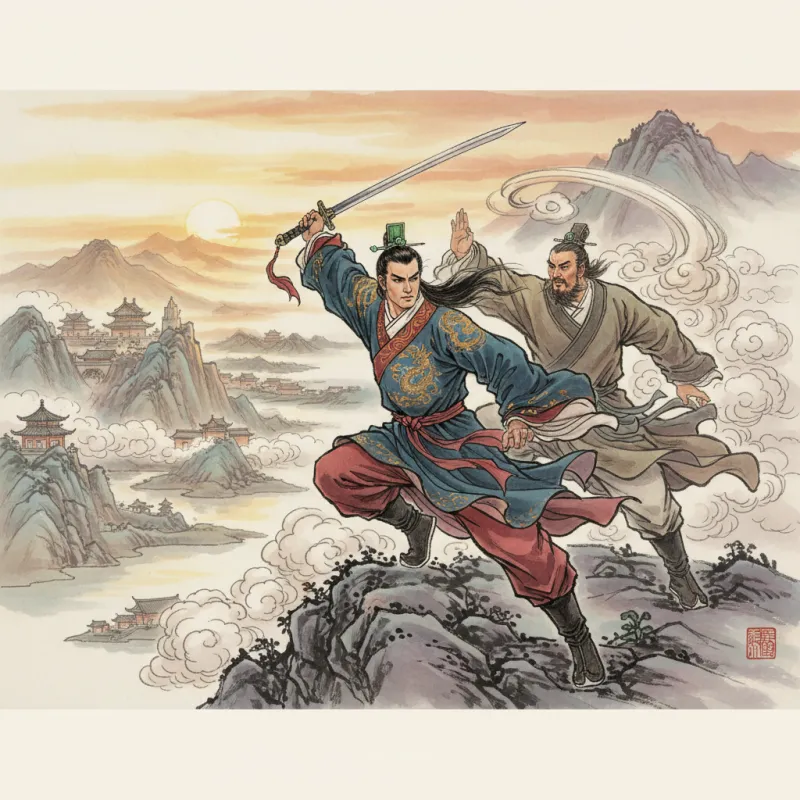
When Guo Jing stood atop the walls of Xiangyang, watching the Mongol hordes mass on the horizon, he wasn't just defending a city—he was embodying a philosophy of heroism that would resonate with readers for generations. This scene from The Legend of the Condor Heroes (射雕英雄传, Shèdiāo Yīngxióng Zhuàn) captures what makes Jin Yong's writing endure: it's never just about the action. It's about what the action means.
Louis Cha (查良镛, Chá Liángyōng), writing under the pen name Jin Yong (金庸, Jīn Yōng), published his fifteen wuxia novels between 1955 and 1972. Decades later, they remain the gold standard of martial arts fiction. But calling Jin Yong a "martial arts writer" is like calling Shakespeare a "playwright who wrote about Danish princes." It's technically true but misses the entire point.
Characters Who Contradict Themselves
Jin Yong's characters don't just develop—they contradict themselves, struggle with their own natures, and sometimes fail to become who they want to be. Take Wei Xiaobao from The Deer and the Cauldron (鹿鼎记, Lùdǐng Jì). He's a lying, gambling, womanizing conman with no martial arts skills whatsoever. He's also the protagonist of Jin Yong's final and arguably most subversive novel. Wei Xiaobao succeeds precisely because he lacks the rigid moral code that would doom a traditional hero. He's adaptable, pragmatic, and refreshingly honest about his own dishonesty.
Compare this to Yang Guo in The Return of the Condor Heroes (神雕侠侣, Shéndiāo Xiálǚ), who spends sixteen years nursing a broken heart and emerges as one of the most powerful martial artists in the jianghu (江湖, jiānghú)—the martial arts world. Yang Guo's obsessive love for his teacher Xiaolongnü would be creepy in lesser hands, but Jin Yong makes us understand the psychology of a young man raised without affection, desperate to hold onto the one person who showed him kindness.
The genius is that Jin Yong never tells us these characters are complex. He shows us through their choices. Qiao Feng in Demigods and Semi-Devils (天龙八部, Tiānlóng Bābù) discovers he's ethnically Khitan, not Han Chinese, and watches his entire identity collapse. His tragedy isn't just personal—it's political, exploring how ethnic identity and loyalty can tear a person apart. This was bold stuff for a writer working in 1960s Hong Kong, and it remains relevant today.
Historical Texture That Breathes
Jin Yong was a journalist and historian before he was a novelist, and it shows. His stories are anchored in specific historical moments: the Song dynasty's struggle against the Mongols, the Ming-Qing transition, the Qing dynasty's consolidation of power. But he doesn't just use history as wallpaper. He interrogates it.
The Book and the Sword (书剑恩仇录, Shūjiàn Ēnchóu Lù), his first novel, revolves around the legend that the Qianlong Emperor was actually Han Chinese, not Manchu. It's a conspiracy theory that Jin Yong uses to explore questions of legitimacy, identity, and what makes a ruler worthy of the throne. The historical Emperor Qianlong reigned from 1735 to 1796; Jin Yong's fictional version becomes a vehicle for examining the relationship between the Manchu rulers and their Han Chinese subjects.
The historical detail is meticulous but never pedantic. When characters in The Smiling, Proud Wanderer (笑傲江湖, Xiào'ào Jiānghú) discuss the political machinations of various martial arts sects, Jin Yong is really talking about power, orthodoxy, and how institutions corrupt themselves. The novel was published in 1967, during the Cultural Revolution, and its themes of ideological persecution and factional warfare weren't lost on contemporary readers.
This layering of meaning is what separates Jin Yong from mere historical fiction. You can read his novels as adventure stories, and they work perfectly well on that level. But there's always more happening beneath the surface.
Martial Arts as Philosophy
Jin Yong's martial arts aren't just cool fight scenes—though they are that too. They're expressions of philosophy, personality, and worldview. The martial arts techniques in his novels reflect the characters who practice them.
The Eighteen Dragon-Subduing Palms (降龙十八掌, Jiànglóng Shíbā Zhǎng) that Guo Jing masters are straightforward, powerful, and honest—just like Guo Jing himself. Meanwhile, the Sunflower Manual (葵花宝典, Kuíhuā Bǎodiǎn) in The Smiling, Proud Wanderer requires self-castration to practice, a grotesque metaphor for the sacrifices people make for power. Dongfang Bubai, who masters this technique, becomes neither fully male nor female, transcending gender categories in a way that's genuinely radical for a 1960s Chinese novel.
The Dugu Nine Swords (独孤九剑, Dúgū Jiǔ Jiàn) technique has no fixed forms—it's about understanding the principles behind all martial arts and exploiting their weaknesses. It's the martial arts equivalent of critical thinking. Linghu Chong, who learns this style, is similarly unconventional, refusing to be bound by orthodox thinking.
Jin Yong understood that how you fight reveals who you are. The obsessive, detail-oriented Huang Yaoshi creates the Jade Flute Swordplay, combining music and martial arts. The Buddhist monk Duan Yu in Demigods and Semi-Devils practices the Graceful Steps upon the Waves (凌波微步, Língbō Wēibù), a technique focused entirely on evasion because he refuses to harm others. Even his martial arts reflect his pacifist philosophy.
Romance That Hurts
Jin Yong's love stories are rarely happy, and when they are, happiness comes with a cost. The romance between Yang Guo and Xiaolongnü violates every social taboo—she's his teacher, she's sixteen years older, and their relationship is seen as incestuous by the standards of the jianghu. They get their happy ending, but only after sixteen years of separation and countless misunderstandings.
Guo Jing and Huang Rong in The Legend of the Condor Heroes seem like the perfect couple, but their story continues in The Return of the Condor Heroes, where we see them as middle-aged parents struggling with their rebellious godson Yang Guo. By The Heaven Sword and Dragon Saber (倚天屠龙记, Yǐtiān Túlóng Jì), we learn they died defending Xiangyang when the city finally fell to the Mongols. Their romance was real, but it didn't protect them from history.
The most devastating romance might be Qiao Feng and A'Zhu in Demigods and Semi-Devils. A'Zhu disguises herself as Qiao Feng's enemy, and he accidentally kills her before realizing who she is. It's a tragedy born from misunderstanding, disguise, and the fog of revenge—themes that Jin Yong returns to repeatedly. Love in his novels is powerful but rarely enough to overcome the forces of fate, politics, and human error.
Moral Ambiguity in a Genre of Heroes
Wuxia fiction traditionally deals in clear moral categories: righteous heroes versus evil villains. Jin Yong demolishes this binary. His most interesting characters exist in the gray areas.
Yue Buqun in The Smiling, Proud Wanderer begins as the respected leader of the Mount Hua Sect, a pillar of orthodox martial arts. Gradually, we discover he's a hypocrite who will do anything for power, including practicing the Sunflower Manual in secret. But Jin Yong makes us understand why Yue Buqun becomes what he becomes—the pressure of maintaining his sect's reputation, the fear of being surpassed by his students, the corrosive effect of ambition.
Conversely, characters we're supposed to see as villains often have compelling motivations. Ouyang Feng in The Legend of the Condor Heroes is one of the Five Greats, a martial arts master who practices poison techniques. He's ruthless and amoral, but he's also fiercely loyal to his nephew and driven by an unrequited love that has twisted him. By the sequel, when he's lost his memory and befriends Yang Guo, we see glimpses of who he might have been without his obsessions.
This moral complexity extends to the political factions in Jin Yong's novels. The "righteous" sects are often corrupt, hypocritical, and more concerned with reputation than justice. The "evil" sects sometimes have more honest and loyal members. Jin Yong is constantly asking: what makes someone righteous? Is it their stated principles or their actions?
Language That Sings
Jin Yong wrote in vernacular Chinese, but his prose has a rhythmic quality that echoes classical Chinese literature. He uses four-character phrases (成语, chéngyǔ) and poetic descriptions that give his writing a timeless quality. When he describes martial arts moves, the language itself becomes kinetic.
His chapter titles often come from classical poetry or Buddhist sutras, adding layers of meaning. The title Demigods and Semi-Devils comes from Buddhist cosmology, referring to eight classes of non-human beings. This frames the entire novel as a meditation on suffering and enlightenment, even as it delivers spectacular kung fu battles.
Jin Yong also has a gift for memorable names. Linghu Chong (令狐冲, Línghú Chōng) literally means "Linghu Rushes Forward," capturing his impulsive nature. Ren Yingying (任盈盈, Rèn Yíngyíng) has a name that suggests grace and abundance. These aren't just labels—they're character sketches compressed into two or three syllables.
The Revision Process
What many readers don't know is that Jin Yong extensively revised his novels over decades. The versions most people read today are the third revision, completed in the 1990s and early 2000s. He toned down some of the more problematic elements, refined the plotting, and added depth to secondary characters.
This commitment to revision is itself part of what makes his work timeless. Jin Yong treated his novels not as disposable genre fiction but as literature worth perfecting. He was his own harshest critic, willing to rewrite entire sections decades after initial publication.
Why It Still Matters
Jin Yong's writing endures because it operates on multiple levels simultaneously. You can read his novels as adventure stories and be completely satisfied. You can read them as historical fiction and learn about Chinese history. You can read them as philosophical texts exploring Buddhism, Taoism, and Confucianism. You can read them as political allegories. You can read them as character studies or romance or tragedy.
The themes in Jin Yong's work—loyalty versus justice, individual freedom versus social obligation, the corrupting nature of power, the pain of ethnic identity—remain relevant because they're fundamental human concerns. His characters feel real because they're contradictory, flawed, and struggling with problems that don't have easy answers.
In an era of franchise fiction and formulaic storytelling, Jin Yong's novels remind us that genre fiction can be literature. That martial arts stories can explore philosophy. That popular entertainment can also be art. His writing is timeless not because it's perfect—it's not—but because it's ambitious, humane, and willing to grapple with complexity.
When you read Jin Yong, you're not just reading about heroes and villains fighting in ancient China. You're reading about what it means to be human, to make choices, to live with consequences. That's why, fifty years after he wrote his last novel, we're still talking about Guo Jing on the walls of Xiangyang, still debating whether Wei Xiaobao is a hero or a scoundrel, still moved by Qiao Feng's tragedy. The martial arts may be fantasy, but the humanity is real.
Related Reading
- Jin Yong's Influence on Asian Pop Culture
- Jin Yong on Screen: The Best Film Adaptations
- Exploring the Enduring Legacy of Jin Yong's Wuxia Novels
- Jin Yong on Screen: Why Every Adaptation Disappoints Someone
- Nationalism and Identity in Jin Yong's Novels
- The Five Greats Explained: Understanding Jin Yong's Power Elite