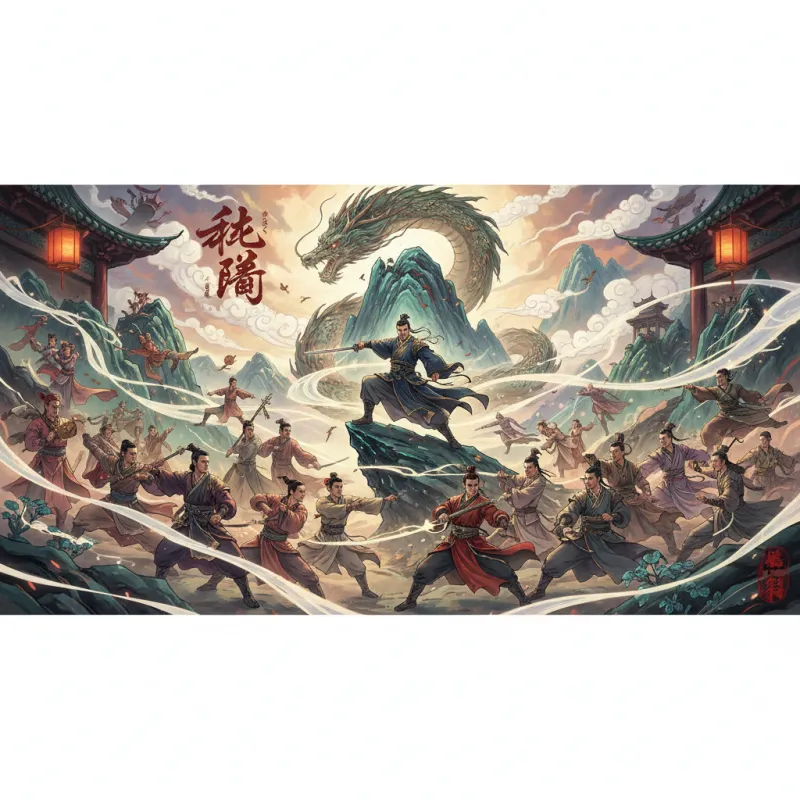
When Bruce Lee kicked down doors in Hollywood, when Crouching Tiger, Hidden Dragon swept the Oscars, when Korean dramas started weaving wuxia elements into modern romance—Jin Yong's fingerprints were all over it. The man born Louis Cha (查良鏞, Chá Liángyōng) in 1924 didn't just write martial arts novels; he created the DNA that would replicate across Asian entertainment for generations. His fifteen novels, written between 1955 and 1972, became the blueprint for how Asia tells stories about honor, love, and flying through bamboo forests.
The Wuxia Template That Conquered Asia
Before Jin Yong, martial arts fiction existed in serialized newspapers and pulp magazines, but it was fragmented, formulaic, often disposable. Jin Yong took this lowbrow genre and injected it with literary ambition. His The Legend of the Condor Heroes (射鵰英雄傳, Shèdiāo Yīngxióng Zhuàn, 1957) established patterns that became law: the underdog hero with mysterious parentage, the morally complex mentor, the impossible romance across enemy lines, the martial arts manual everyone's killing each other over. These weren't just plot devices—they were archetypes that seeped into every corner of Asian storytelling.
Walk into any Asian household with a TV, and you'll find Jin Yong adaptations. Hong Kong's TVB alone has produced over a dozen versions of his novels since the 1970s. Taiwan, mainland China, Singapore—everyone wanted their own Demi-Gods and Semi-Devils (天龍八部, Tiānlóng Bābù). But the influence didn't stop at faithful adaptations. Korean dramas like Iljimae and Warrior Baek Dong-soo borrowed his narrative structures wholesale. Japanese manga artists studied his fight choreography descriptions. Even Bollywood's Chandni Chowk to China tried (and failed) to capture that Jin Yong magic.
Cinema's Love Affair With Jin Yong
Hong Kong cinema in the 1980s and 90s was essentially a Jin Yong adaptation factory. Directors like King Hu, Chang Cheh, and later Wong Kar-wai understood that Jin Yong's novels were pre-visualized cinema—his action sequences read like storyboards, his dialogue crackled with subtext. The Shaw Brothers studio built their empire partly on Jin Yong properties, churning out films that defined the wuxia aesthetic: flowing robes, wire-work combat, tragic romance against sweeping landscapes.
But the real game-changer was Tsui Hark's approach in the 1990s. His Swordsman series and The East is Red took Jin Yong's The Smiling, Proud Wanderer (笑傲江湖, Xiào'ào Jiānghú) and cranked everything to eleven—more wire-work, more color, more operatic emotion. This wasn't your grandfather's wuxia; this was MTV-era martial arts. Suddenly, Jin Yong's stories could be psychedelic, surreal, postmodern. The novels were elastic enough to contain all interpretations.
Then came Ang Lee's Crouching Tiger, Hidden Dragon in 2000, which introduced Western audiences to wuxia through a Jin Yong-influenced lens. While not directly adapted from his work, the film's DNA—the forbidden romance, the martial arts philosophy, the gravity-defying combat—was pure Jin Yong. Michelle Yeoh's Yu Shu Lien could have walked straight out of The Book and the Sword (書劍恩仇錄, Shūjiàn Ēnchóu Lù). The film's success proved Jin Yong's narrative formulas were universal, not just regional.
Television's Endless Reinterpretations
If cinema gave Jin Yong spectacle, television gave him ubiquity. The 1983 TVB adaptation of The Legend of the Condor Heroes starring Felix Wong became the gold standard, watched by an estimated 1.5 billion people across Asia. That's not a typo. An entire generation grew up with Wong's Guo Jing (郭靖) as their moral compass, with Barbara Yung's Huang Rong (黃蓉) as the clever woman who could outsmart any man.
Every decade brings new adaptations, each reflecting its era's values. The 2003 mainland Chinese version of Demi-Gods and Semi-Devils was grander, more CGI-heavy, playing to nationalist sentiments. The 2017 version of The Legend of the Condor Heroes cast younger, prettier actors for the smartphone generation. Some purists scream sacrilege with each new version, but that's the point—Jin Yong's stories are elastic enough to be reinterpreted endlessly. They're like Shakespeare's plays; every generation needs to remake them in their own image.
Korean television borrowed heavily without always acknowledging the debt. The structure of Jumong, one of Korea's highest-rated historical dramas, follows the Jin Yong playbook: young hero, martial arts training montage, political intrigue, doomed first love, eventual triumph. The DNA is unmistakable to anyone who's read The Deer and the Cauldron.
Video Games and the Interactive Wuxia
Jin Yong's influence on Asian gaming is profound and often overlooked. In the 1990s, Taiwanese developers created Jin Yong Qunxia Zhuan (金庸群俠傳, Jin Yong's Heroes), a role-playing game that let players interact with characters from across his novels. It was crude by today's standards, but revolutionary in concept—a shared universe where Yang Guo could meet Wei Xiaobao, where players could learn the Eighteen Dragon-Subduing Palms (降龍十八掌, Jiàng Lóng Shíbā Zhǎng).
Modern games like Gujian Qitan and Sword and Fairy series don't directly adapt Jin Yong, but they're built on his foundation. The quest structures, the moral choices, the romance options, the martial arts progression systems—all Jin Yong. Even Ghost of Tsushima, a Japanese game made by American developers, uses narrative beats that Jin Yong popularized: the honorable warrior torn between duty and personal desire, the mentor's sacrifice, the final duel that's as much philosophical as physical.
Mobile games in China have generated billions from Jin Yong licenses. Tian Long Ba Bu Mobile reportedly earned over $1 billion in its first year. These aren't just games; they're interactive nostalgia, letting middle-aged fans relive the stories they grew up with, now with gacha mechanics and social features.
The Philosophical Underpinnings That Resonate
What makes Jin Yong's influence so durable isn't just his plots—it's his philosophy. His novels are soaked in Buddhist concepts of karma and suffering, Daoist ideas of balance and natural order, Confucian ethics of loyalty and righteousness. But he never preaches. His characters embody these philosophies through their choices and consequences.
Take Qiao Feng (喬峰) from Demi-Gods and Semi-Devils—a man who discovers his ethnic identity makes him an enemy to everyone he loves. His tragedy isn't just personal; it's a meditation on nationalism, identity, and the futility of ethnic hatred. These themes resonate across Asia, where questions of identity and belonging remain raw. Korean dramas exploring North-South division, Japanese anime dealing with outsider status, Chinese films about diaspora—they're all working through questions Jin Yong posed decades ago.
His female characters, too, broke molds that Asian pop culture is still trying to fully embrace. Huang Rong isn't just smart; she's smarter than the hero and knows it. Zhao Min (趙敏) from The Heaven Sword and Dragon Saber (倚天屠龍記, Yǐtiān Túlóng Jì) pursues the man she wants with aggressive confidence. These weren't the passive beauties of traditional Chinese literature; they were active agents with desires and schemes. Modern Asian dramas with "strong female leads" are often just catching up to what Jin Yong wrote in the 1960s.
The Untranslatable Genius
Here's the painful truth: Jin Yong's influence remains largely confined to Asia because his work is nearly untranslatable. The wordplay, the classical Chinese poetry woven into dialogue, the historical allusions—they don't survive the journey into English. When translators try, they produce technically accurate but spiritually dead prose. It's like translating Shakespeare into Mandarin; you can convey the plot, but the music is gone.
This linguistic barrier means Western pop culture has absorbed Jin Yong's influence secondhand, through films and shows that themselves are adaptations. The Matrix borrowed from Hong Kong wire-fu, which borrowed from Jin Yong. Game of Thrones shares his sprawling cast and moral ambiguity, but through independent evolution. The direct line of influence stops at the language barrier.
Yet even this limitation has shaped Asian pop culture's relationship with the West. Asian creators know they possess a literary tradition that's rich, complex, and largely unknown outside their region. This creates both pride and frustration—pride in having something uniquely theirs, frustration that it can't be fully shared. The result is a constant negotiation: how much to explain, how much to assume, how to make Jin Yong's world accessible without diluting it.
The Legacy That Won't Fade
Jin Yong died in 2018, but his influence shows no signs of diminishing. If anything, it's accelerating. Chinese streaming platforms are producing bigger-budget adaptations with international ambitions. The Longest Day in Chang'an, while not a Jin Yong adaptation, uses his narrative techniques—the ticking clock, the web of conspiracies, the hero caught between competing loyalties. The Untamed, based on a web novel, is essentially Jin Yong fanfiction that became a phenomenon, proving his templates still work on new generations.
The real test of Jin Yong's influence isn't in direct adaptations—it's in how thoroughly his narrative DNA has been absorbed. When a Korean drama features a training montage, when a Japanese anime has a wise old master with a dark past, when a Chinese film climaxes with a duel that's really about philosophy—that's Jin Yong. He didn't just influence Asian pop culture; he became its grammar, the underlying structure that creators use without even realizing it.
Younger Asian creators sometimes rebel against this influence, trying to write stories that don't follow the Jin Yong playbook. But even in rebellion, they're defined by what they're rebelling against. You can't escape your literary father by running away; his shadow just grows longer. And maybe that's okay. Maybe having a shared narrative tradition, a common language of storytelling, is what allows Asian pop culture to speak to itself across borders and generations.
The bamboo forests will keep swaying, the swords will keep singing, and somewhere, a young hero with mysterious parentage will begin a journey they don't yet understand. Jin Yong's world isn't just alive—it's the world Asian pop culture still inhabits, whether it admits it or not.
Related Reading
- Jin Yong's Writing Style: What Makes It Timeless
- Exploring the Enduring Legacy of Jin Yong's Wuxia Novels
- Jin Yong on Screen: The Best Film Adaptations
- Exploring the Rich Tapestry of Jin Yong's Wuxia Novels: Characters and Martial Arts
- The Martial Arts Ranking Debate: Who Is Actually the Strongest in Jin Yong?
- Four-Word Martial Arts Idioms from Jin Yong's Novels