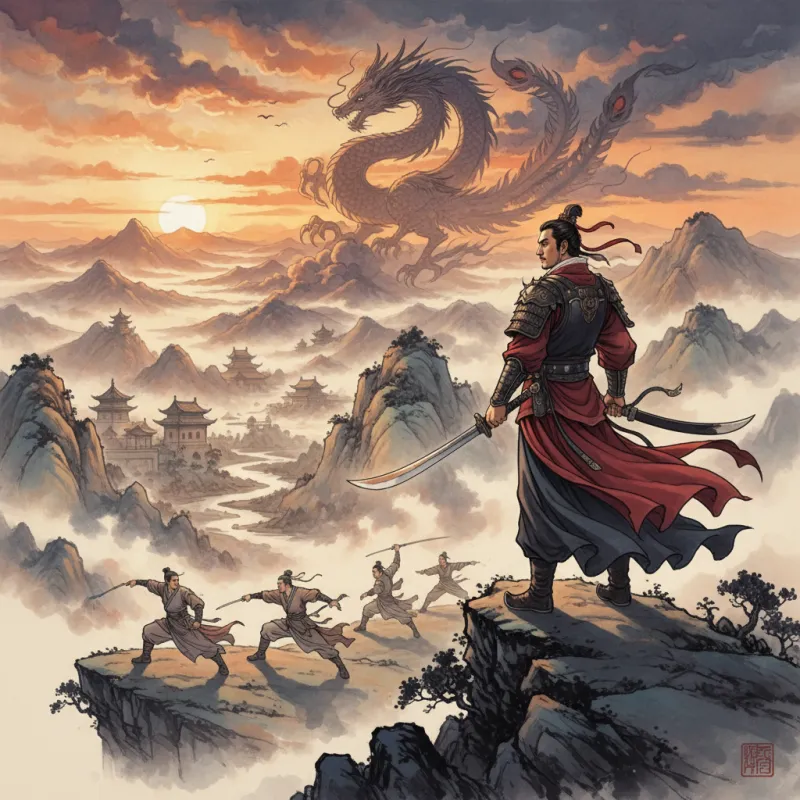
When Guo Jing stood atop the walls of Xiangyang, knowing the Mongol hordes would eventually breach them, he made a choice that would echo through Chinese literature for generations: duty over survival, righteousness over escape. This moment from The Return of the Condor Heroes (射雕英雄传, Shèdiāo Yīngxióng Zhuàn) encapsulates everything that makes Jin Yong's wuxia novels more than mere martial arts fantasies—they're profound meditations on what it means to live with honor in a world that often punishes it.
The Man Who Reinvented Wuxia
Louis Cha Leung-yung (查良镛, Chá Liángyōng), writing under the pen name Jin Yong (金庸, Jīn Yōng), didn't just write wuxia novels—he transformed the entire genre from pulp entertainment into serious literature. Between 1955 and 1972, he produced fifteen novels that have sold over 300 million copies worldwide, a figure that doesn't account for the countless pirated editions circulating throughout Asia. Born in 1924 in Haining, Zhejiang Province, during the tumultuous Republican era, Jin Yong witnessed firsthand the collapse of traditional Chinese society and the violent birth of modern China. This historical consciousness permeates every page of his work.
What sets Jin Yong apart from his predecessors like Huanzhulouzhu or contemporaries like Gu Long isn't just his storytelling prowess—it's his ability to weave genuine historical research, classical Chinese philosophy, and psychological depth into narratives that remain utterly gripping. His characters aren't cardboard cutouts performing impossible feats; they're flawed, conflicted individuals whose martial arts journeys mirror their moral and spiritual development.
Beyond Sword Fights: The Philosophical Depth
Jin Yong's novels operate on multiple levels simultaneously. On the surface, they're thrilling adventures filled with creative martial arts techniques—the Eighteen Dragon-Subduing Palms (降龙十八掌, Jiàng Lóng Shíbā Zhǎng), the Nine Yin Manual (九阴真经, Jiǔ Yīn Zhēnjīng), the Dugu Nine Swords (独孤九剑, Dúgū Jiǔ Jiàn). But dig deeper, and you'll find sophisticated explorations of Confucian ethics, Buddhist philosophy, and Daoist mysticism.
Take Demi-Gods and Semi-Devils (天龙八部, Tiānlóng Bābù), arguably his most philosophically complex work. The novel's three protagonists—Duan Yu, Xuzhu, and Qiao Feng—each represent different responses to fate and suffering. Qiao Feng's tragedy, discovering his Khitan heritage while serving as leader of the Han Chinese Beggars' Sect, explores questions of identity and belonging that resonate far beyond the Song Dynasty setting. His ultimate sacrifice on the Yanmen Pass isn't just heroic—it's a Buddhist meditation on the futility of ethnic hatred and the possibility of transcending tribal loyalties.
The novel's title itself references Buddhist cosmology, suggesting that all beings, whether gods or humans, remain trapped in the cycle of suffering. This isn't window dressing—it's the thematic foundation of the entire narrative. Jin Yong studied Buddhism seriously, and it shows in how he portrays characters like the monk Sweeping Monk, whose martial arts mastery stems not from ambition but from spiritual cultivation.
Historical Fiction as Cultural Memory
Jin Yong's genius lies partly in his strategic use of historical settings. He doesn't just drop fictional characters into random dynasties—he carefully selects periods of transition and conflict that allow him to explore timeless questions about loyalty, legitimacy, and cultural identity. The Deer and the Cauldron (鹿鼎记, Lùdǐng Jì), set during the Manchu conquest of China, uses the roguish Wei Xiaobao to interrogate the very concept of heroism in wuxia narratives. Wei Xiaobao isn't a traditional hero—he's a con artist, a womanizer, and a survivor who serves both the Qing Emperor and the anti-Qing resistance.
This moral ambiguity was revolutionary. By making his protagonist someone who explicitly rejects the rigid moral codes of traditional wuxia heroes, Jin Yong forced readers to question whether those codes were ever realistic or even desirable. The novel, his last, reads like a deconstruction of everything he'd built in his previous fourteen works.
Similarly, The Legend of the Condor Heroes (射雕英雄传, Shèdiāo Yīngxióng Zhuàn) and its sequels use the Mongol invasion of China to explore questions about resistance, collaboration, and what it means to be Chinese. Guo Jing, the simple-minded but righteous hero, embodies traditional Confucian values—loyalty, filial piety, righteousness. His eventual death defending Xiangyang (a historical event Jin Yong incorporated into his fictional universe) transforms him into a symbol of principled resistance against overwhelming odds.
Character Complexity and Moral Ambiguity
Jin Yong's characters refuse to be simple. Even his villains possess depth and occasionally sympathetic motivations. Ouyang Feng, the Western Venom, is driven mad by unrequited love and professional jealousy, but he's also capable of genuine affection for Yang Guo, whom he mistakes for his own son. Yue Buqun in The Smiling, Proud Wanderer (笑傲江湖, Xiào'ào Jiānghú) presents himself as a righteous sect leader while secretly pursuing the evil martial arts manual that will ultimately corrupt him—a perfect illustration of how the pursuit of power corrupts even those who claim noble intentions.
The female characters deserve special mention. Jin Yong's women aren't prizes to be won or damsels to be rescued—they're complex individuals with their own martial arts skills, moral codes, and desires. Huang Rong, the brilliant daughter of Peach Blossom Island's master, is arguably smarter than her husband Guo Jing and serves as his strategic advisor. Zhao Min in The Heaven Sword and Dragon Saber (倚天屠龙记, Yǐtiān Túlóng Jì) is a Mongol princess who pursues Zhang Wuji with determination and cunning, ultimately choosing love over loyalty to her family and nation.
Xiao Longnu from The Return of the Condor Heroes (神雕侠侣, Shéndiāo Xiálǚ) challenges conventional morality by entering a romantic relationship with her student Yang Guo, sixteen years her junior. Their love story, which scandalized readers when first serialized, ultimately argues for the primacy of genuine emotion over social convention—a radical position in the conservative 1950s.
The Jianghu as Parallel Society
The jianghu (江湖, jiānghú)—literally "rivers and lakes," but meaning the martial arts underworld—functions in Jin Yong's novels as an alternative society with its own rules, hierarchies, and moral codes. This parallel world allows him to explore political and social questions that might have been dangerous to address directly during his years writing in Hong Kong under British colonial rule.
The jianghu operates according to principles that often contradict official Confucian morality. Loyalty to one's master or sect can supersede loyalty to family or state. Personal honor matters more than legal justice. Revenge is not only acceptable but often obligatory. Yet Jin Yong consistently shows how these codes, while romantic, can lead to tragedy. The cycle of revenge that drives much of Demi-Gods and Semi-Devils ultimately destroys nearly everyone involved, suggesting that the jianghu's moral framework, however appealing, may be fundamentally flawed.
The relationship between the jianghu and official government varies across Jin Yong's novels, reflecting different historical periods and his evolving political views. In some works, like The Book and the Sword (书剑恩仇录, Shūjiàn Ēnchóu Lù), the martial artists are explicitly involved in anti-government resistance. In others, like The Deer and the Cauldron, the boundaries between jianghu and court become so blurred as to be meaningless.
Literary Technique and Narrative Innovation
Jin Yong's technical mastery often goes unrecognized by Western readers encountering his work in translation. His prose style evolved significantly over his career, from the relatively straightforward adventure narrative of The Book and the Sword to the intricate, multi-threaded plotting of Demi-Gods and Semi-Devils. He employs techniques borrowed from classical Chinese novels like Water Margin (水浒传, Shuǐhǔ Zhuàn) and Romance of the Three Kingdoms (三国演义, Sānguó Yǎnyì), including parallel storylines, recurring motifs, and the strategic revelation of information.
His martial arts descriptions deserve particular attention. Rather than simply describing fights, Jin Yong uses combat scenes to reveal character, advance plot, and explore philosophical concepts. The famous duel between Dugu Qiubai's sword techniques and various martial arts styles in The Return of the Condor Heroes isn't just exciting—it's a meditation on the relationship between technique and principle, form and essence. The progression from "sharp sword" to "soft sword" to "heavy sword" to "wooden sword" to finally "no sword" mirrors the Buddhist concept of progressive enlightenment.
Cultural Impact and Enduring Relevance
Jin Yong's influence on Chinese popular culture cannot be overstated. His novels have been adapted into countless television series, films, comics, and video games. Phrases from his books have entered everyday Chinese language. His characters are cultural touchstones—everyone knows Guo Jing's righteousness, Huang Rong's cleverness, Wei Xiaobao's roguishness, and Linghu Chong's free spirit.
But his legacy extends beyond entertainment. Jin Yong's novels have shaped how modern Chinese people think about their history, their cultural values, and their identity. His exploration of martial arts philosophy influenced not just literature but actual martial arts practice and theory. His nuanced portrayal of ethnic relations—showing both Han Chinese and "barbarian" characters as fully human—contributed to more sophisticated discussions about Chinese identity in an era of rising nationalism.
The novels also traveled beyond the Chinese-speaking world, influencing writers and filmmakers globally. Directors like Ang Lee and Zhang Yimou drew inspiration from Jin Yong's wuxia universe when creating films like Crouching Tiger, Hidden Dragon and Hero. Video game designers cite his work as foundational to the entire wuxia game genre.
The Question of Translation and Global Recognition
One persistent frustration for Jin Yong's admirers is his relative obscurity in the English-speaking world. Despite being one of the best-selling authors in human history, he remains largely unknown to Western readers. The translation challenges are significant—his prose is dense with classical Chinese allusions, his plots sprawling and complex, and his cultural context unfamiliar to non-Chinese readers.
Recent translation efforts, particularly Anna Holmwood and Gigi Chang's work on Legends of the Condor Heroes, have begun to change this. But the question remains whether Jin Yong's novels can ever achieve in English the cultural penetration they enjoy in Chinese. Perhaps they don't need to. His legacy is secure in the Chinese-speaking world, where his novels continue to be read by new generations, each finding their own meanings in his intricate tapestry of martial arts, history, and philosophy.
What's undeniable is that Jin Yong created a literary universe as rich and complex as Tolkien's Middle-earth or Martin's Westeros, but rooted in actual Chinese history and philosophy. His characters grapple with questions that remain urgent: How do we balance personal loyalty with broader ethical obligations? What does it mean to be heroic in a morally ambiguous world? Can love transcend social boundaries? How should we respond to injustice when the system itself is corrupt?
These questions ensure that Jin Yong's wuxia novels will continue to resonate long after the specific historical contexts that inspired them have faded from memory. His legacy isn't just a collection of entertaining stories—it's a profound exploration of what it means to live with honor, love with passion, and fight for justice in an imperfect world. That's why readers keep returning to the jianghu he created, finding in its rivers and lakes reflections of their own struggles and aspirations.
Related Reading
- Jin Yong's Writing Style: What Makes It Timeless
- Jin Yong on Screen: The Best Film Adaptations
- Jin Yong's Influence on Asian Pop Culture
- Exploring the Love Stories in Jin Yong's Wuxia Novels: Romance Amidst Adventure
- The Most Tragic Villains in Jin Yong's Novels
- Jin Yong's Greatest Characters: The Ones You Never Forget