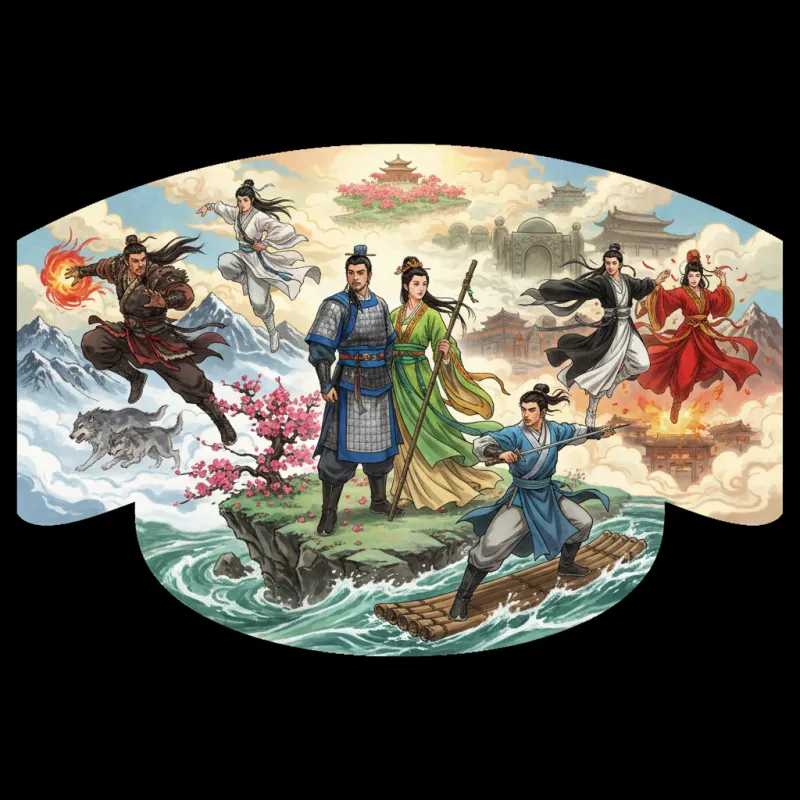
They say you never forget your first Jin Yong character. Mine was Yang Guo, the one-armed swordsman who spent sixteen years waiting for a woman who might never return. My friend's was Wei Xiaobao, the lying, scheming, utterly irredeemable con artist who somehow became a hero. Another swears by Linghu Chong, the drunk who mastered the Dugu Nine Swords. Ask a hundred readers, you'll get a hundred different answers — and that's exactly the point.
The Paradox of Memorable Characters
Jin Yong (金庸, Jīn Yōng) wrote fifteen novels over four decades, creating hundreds of characters. Yet certain ones lodge themselves in your memory like old friends you can't quite shake. Not because they're the most powerful — Dugu Qiubai barely appears on page, yet readers debate him endlessly. Not because they're the most virtuous — some of Jin Yong's most beloved characters are deeply flawed. They're memorable because they feel real in a way that transcends the wuxia (武侠, wǔxiá) genre itself.
Western literature has its Hamlet and Anna Karenina. Chinese readers have Guo Jing and Huang Rong, characters so vivid that people argue about their choices as if they were historical figures. "Would Guo Jing have defended Xiangyang if Huang Rong had asked him not to?" This is a real debate that happens in Chinese forums, seventy years after The Legend of the Condor Heroes was first serialized.
Guo Jing: The Stubborn Ox Who Became a Legend
Let's start with the obvious one. Guo Jing (郭靖, Guō Jìng) is slow. Not humble-brag slow, not "I'm actually a genius pretending to be dumb" slow. Actually, genuinely slow. He takes twice as long to learn martial arts as anyone else. He misses social cues. He speaks in simple sentences. In a genre that worships cleverness and quick wit, Jin Yong made his most heroic character borderline dim-witted.
And it works. It works because Guo Jing's limitations make his achievements meaningful. When he finally masters the Eighteen Dragon-Subduing Palms (降龙十八掌, Jiàng Lóng Shíbā Zhǎng), you've watched him practice each move hundreds of times. When he chooses to defend Xiangyang against the Mongol invasion, knowing it's hopeless, you understand it's not strategy — it's character. He simply cannot do otherwise.
The genius of Guo Jing is that he succeeds not despite his simplicity but because of it. He's loyal when cleverer men would hedge their bets. He's honest when lying would be easier. He keeps his word when breaking it would save his life. In Jin Yong's moral universe, these qualities matter more than intelligence. Guo Jing is the answer to every cynical reader who thinks nice guys finish last.
Wei Xiaobao: The Anti-Hero Who Shouldn't Work
Then there's Wei Xiaobao (韦小宝, Wéi Xiǎobǎo), who breaks every rule. He's a liar, a coward, a womanizer, and a con artist. He can't do martial arts. He has no loyalty to anyone except himself (and maybe his seven wives, on good days). He's the protagonist of The Deer and the Cauldron, Jin Yong's final novel, and he's utterly unforgettable precisely because he's everything a wuxia hero shouldn't be.
Wei Xiaobao survives through luck, charm, and shamelessness. He talks his way out of situations that would kill a normal person. He becomes best friends with the Kangxi Emperor by being entertaining. He joins the Heaven and Earth Society (天地会, Tiāndì Huì) not out of patriotic fervor but because it seemed like a good idea at the time. He's the id to Guo Jing's superego — and readers love him for it.
What makes Wei Xiaobao memorable isn't that he's funny (though he is). It's that he's honest about his dishonesty. He never pretends to be noble. He never has a sudden moral awakening. He remains himself from beginning to end — a survivor who happens to stumble into history. In a genre full of righteous heroes, Wei Xiaobao is refreshingly, hilariously human.
Yang Guo: The Rebel With Too Many Causes
Yang Guo (杨过, Yáng Guò) is the character who divides readers most sharply. Some find him insufferable — arrogant, self-pitying, obsessed with a woman who raised him. Others consider him Jin Yong's greatest creation — a character who transforms from bratty teenager to tragic hero to something beyond conventional heroism.
The controversy centers on his relationship with Xiaolongnü (小龙女, Xiǎolóngnǚ), his teacher-turned-lover. It's uncomfortable. It's meant to be. Jin Yong wrote Yang Guo as someone who refuses to follow society's rules, even when those rules make sense. He loves who he loves, consequences be damned. He loses an arm and becomes more dangerous. He spends sixteen years alone, waiting for a reunion that might never come.
What makes Yang Guo unforgettable is his capacity for transformation. He starts as an angry child, becomes a vengeful teenager, then a heartbroken young man, and finally — after sixteen years of solitude — something else entirely. The Yang Guo who returns at the end of The Return of the Condor Heroes has transcended his own story. He's no longer fighting for recognition or revenge. He's simply himself, complete and self-contained. That journey — from needy child to self-sufficient master — is one of Jin Yong's finest achievements.
Linghu Chong: The Drunk Who Understood Freedom
Linghu Chong (令狐冲, Línghú Chōng) shouldn't be a hero. He drinks too much. He's lazy. He has no ambition. He learns the Dugu Nine Swords (独孤九剑, Dúgū Jiǔ Jiàn) — one of the most powerful sword techniques in Jin Yong's universe — and uses it mainly to avoid responsibility. He's expelled from his sect, framed for murder, and nearly dies multiple times, usually because he was too drunk or too trusting.
Yet Linghu Chong embodies something essential: freedom. Not the freedom to do whatever you want, but the freedom to be yourself in a world that demands conformity. He refuses to join sects that would make him powerful. He rejects political games. He befriends outcasts and demons. When he finally becomes the leader of the Hengshan Sect (衡山派, Héngshān Pài), he does it his own way — unconventionally, chaotically, but genuinely.
Readers remember Linghu Chong because he represents the fantasy of living without compromise. He's the friend who never sold out, the artist who never went commercial, the person who stayed true to themselves even when it cost them everything. In a culture that often prioritizes duty over individuality, Linghu Chong is quietly revolutionary.
Huang Rong: Intelligence as a Superpower
Huang Rong (黄蓉, Huáng Róng) is smarter than everyone else in the room, and she knows it. She's the daughter of Huang Yaoshi (黄药师, Huáng Yàoshī), one of the Five Greats, and she inherited his genius for strategy, medicine, music, and manipulation. She can solve problems that stump martial arts masters. She can cook meals that make people weep. She can talk her way out of any situation.
What makes Huang Rong memorable isn't just her intelligence — it's how Jin Yong shows the burden of being the smartest person around. She's constantly managing other people's emotions, solving their problems, cleaning up their mistakes. She loves Guo Jing, but she also has to guide him through every complex situation because he simply doesn't see the angles she sees. It's exhausting.
The tragedy of Huang Rong is that her intelligence isolates her. She can predict what people will do, which means she's rarely surprised. She can manipulate outcomes, which means she's rarely challenged. Only with Guo Jing — simple, honest, predictable Guo Jing — can she relax and just be herself. Their relationship works because he offers her something her intelligence can't provide: simplicity. For more on their dynamic, see The Greatest Romances in Jin Yong's Novels.
The Characters You Can't Categorize
Then there are the ones who defy easy description. Qiao Feng (乔峰, Qiáo Fēng), the Khitan warrior caught between two peoples, who chooses death over betraying either. Ren Yingying (任盈盈, Rèn Yíngyíng), who runs the Sun Moon Holy Cult from the shadows while pretending to be a simple musician. Duan Yu (段誉, Duàn Yù), the Buddhist prince who accidentally becomes a martial arts master while trying to avoid violence.
These characters stick with you because they're contradictions that somehow cohere. They make choices that don't make logical sense but make perfect emotional sense. They grow in unexpected directions. They surprise you, even on rereading.
Why These Characters Endure
Jin Yong's greatest characters share one quality: they're specific. They're not "the hero" or "the villain" or "the love interest." They're Guo Jing, who will defend a city he knows he can't save. They're Wei Xiaobao, who will lie to everyone except himself. They're Yang Guo, who will wait sixteen years because he said he would.
This specificity makes them memorable. You can't swap them between stories. You can't replace Linghu Chong with Guo Jing — they'd handle every situation differently. Each character has their own logic, their own values, their own way of being in the world. They feel like people because Jin Yong wrote them as people, not as functions in a plot.
Seventy years after Jin Yong started writing, readers still argue about these characters. They debate whether Yang Guo's love for Xiaolongnü is romantic or problematic. They discuss whether Wei Xiaobao is a hero or a scoundrel. They wonder what Guo Jing would do in modern situations. These aren't academic exercises — they're the conversations you have about people who matter to you.
That's the test of a great character: they outlive their stories. They become part of the cultural conversation. They're the ones you never forget, even when you've forgotten the plot details, even when you can't remember which novel they're from. They're the reason people read Jin Yong in the first place — and the reason they keep coming back. For a deeper look at Jin Yong's character development techniques, check out How Jin Yong Creates Unforgettable Characters.
Related Reading
- The Top 10 Villains in Jin Yong's Novels
- Ouyang Feng: The Western Venom
- Unraveling the Heroes and Antiheroes of Jin Yong's Wuxia Novels
- Zhang Wuji: The Reluctant Leader
- Guo Jing: The Hero Who Proved Heart Matters More Than Talent
- Jin Yong in Translation: Lost and Found
- Exploring the Enigmatic Worlds of Jin Yong's Wuxia Novels
- Jin Yong's Writing Style: What Makes It Timeless