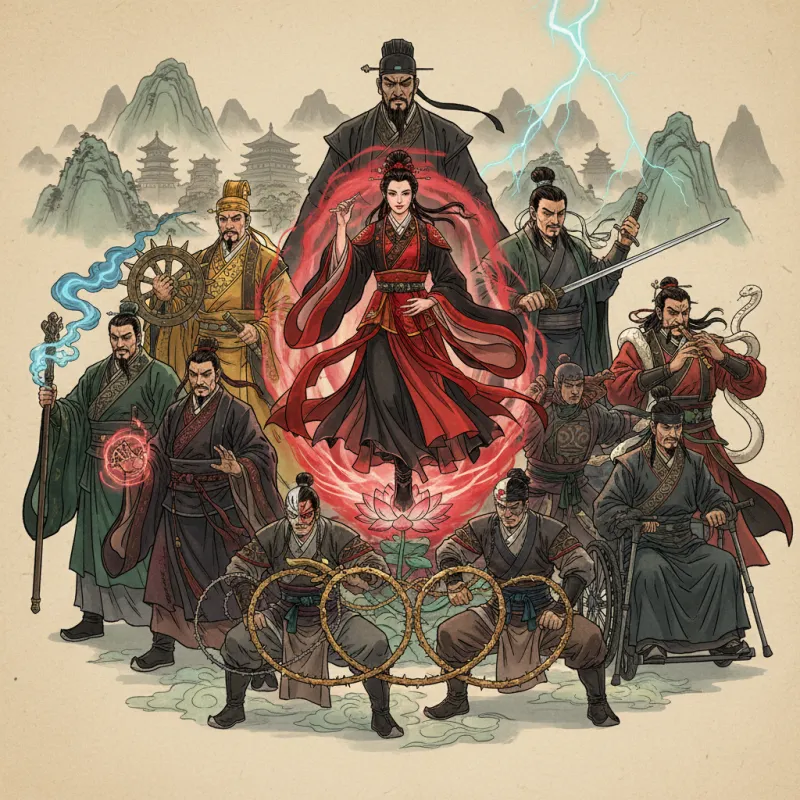
They say the mark of a great villain isn't how evil they are—it's how human they remain even at their worst. Jin Yong understood this better than perhaps any other wuxia novelist. His antagonists don't twirl mustaches or cackle maniacally. They love, they grieve, they justify their cruelty with logic that almost makes sense. Some seek revenge for genuine wrongs. Others are driven mad by techniques that promised power but delivered only suffering. A few are so charismatic you catch yourself rooting for them despite everything. Here are the ten villains who prove that in Jin Yong's world, the line between hero and monster is thinner than a sword's edge.
10. Ouyang Feng (欧阳锋, Ōuyáng Fēng) — The Tragedy of Western Poison
The White Camel Mountain master from The Legend of the Condor Heroes and The Return of the Condor Heroes starts as one of the Five Greats—already a villain, yes, but a magnificent one. His Toad Technique (蛤蟆功, Hámá Gōng) makes him nearly invincible. But Ouyang Feng's real danger isn't his martial arts; it's his willingness to sacrifice everything for supremacy.
When he practices the reversed Nine Yin Manual (九阴真经, Jiǔ Yīn Zhēnjīng) and loses his mind, something unexpected happens. The madman who once schemed and murdered becomes almost innocent, calling Yang Guo his son and showing genuine affection. Jin Yong forces us to ask: which version is more human—the calculating genius or the deluded madman who finally knows love? By the time Ouyang Feng dies on Mount Hua, you might find yourself mourning him.
9. Ding Chunqiu (丁春秋, Dīng Chūnqiū) — The Narcissist's Narcissist
The Star-Plucking Old Freak (摘星老怪, Zhāixīng Lǎoguài) from Demi-Gods and Semi-Devils is what happens when vanity becomes a martial art. He surrounds himself with disciples who do nothing but praise him—literally. They follow him around chanting his greatness while he poisons anyone who disagrees.
What makes Ding Chunqiu particularly despicable is his betrayal of his master, Wu Yazi. He doesn't just defeat the old man; he cripples him and leaves him to suffer for decades. This isn't about ideology or revenge—it's pure selfishness. Ding Chunqiu wants to be worshipped, and he'll murder anyone who reminds him he's not actually a god. He's the villain you love to hate because he has no redeeming qualities whatsoever. Even his martial arts are cowardly, relying on poison and sneak attacks rather than honest combat.
8. Yue Buqun (岳不群, Yuè Bùqún) — The Gentleman Hypocrite
Here's where Jin Yong's genius really shines. Yue Buqun from The Smiling, Proud Wanderer spends most of the novel as the respected leader of the Huashan Sect, called "Gentleman Sword" (君子剑, Jūnzǐ Jiàn). He speaks of righteousness and proper conduct. He seems like the moral center of the story.
Then the mask drops. Yue Buqun has been scheming all along, willing to castrate himself to practice the Evil-Resisting Sword Manual (辟邪剑谱, Bìxié Jiànpǔ), betray his disciples, and murder his way to power. What's terrifying isn't just his hypocrisy—it's how long he maintained the facade. He fooled everyone, including his own daughter. Yue Buqun represents every authority figure who preaches virtue while practicing vice, every leader who uses morality as a weapon while having none themselves. In some ways, he's more disturbing than openly evil characters because he shows how easily righteousness can be performed.
7. Qiu Qianren (裘千仞, Qiū Qiānrèn) — The Coward Who Found Redemption
The Iron Palm Water Glider (铁掌水上漂, Tiězhǎng Shuǐshàng Piāo) from The Legend of the Condor Heroes is fascinating because he's one of the few Jin Yong villains who genuinely transforms. Initially, he's a murderer working for the Jin dynasty, killing patriots and innocents alike. His Iron Palm technique has ended countless lives.
But after being defeated and humiliated, Qiu Qianren becomes a monk and eventually Reverend Yideng's disciple. His redemption arc is complicated—he doesn't suddenly become good, and his past doesn't vanish. Jin Yong suggests that even someone who's committed terrible acts can change, but the process is painful and incomplete. Qiu Qianren's inclusion on this list reminds us that villainy isn't always permanent, though the blood on your hands never fully washes away.
6. Gongsun Zhi (公孙止, Gōngsūn Zhǐ) — The Abuser in Paradise
The Valley Master of the Passionless Valley (绝情谷, Juéqíng Gǔ) in The Return of the Condor Heroes might seem like a minor villain compared to others on this list, but he represents something particularly vile: domestic evil. His valley is beautiful, seemingly peaceful, but Gongsun Zhi rules it through manipulation and abuse.
He keeps his wife Qiu Qianchi imprisoned at the bottom of a valley for years. He lusts after Xiaolongnü and tries to force her into marriage. He's willing to murder his own daughter when she becomes inconvenient. Gongsun Zhi is the villain who operates in private, whose cruelty is hidden behind walls and social respectability. Jin Yong understood that some of the worst evil happens not in dramatic battles but in homes and families, where power imbalances allow monsters to thrive.
5. Jiu Mozhi (鸠摩智, Jiūmózhì) — The Monk Who Wanted Everything
The Great Wheel Wisdom King (大轮明王, Dàlún Míngwáng) from Demi-Gods and Semi-Devils is a Tibetan monk who's supposed to have transcended worldly desires. Instead, he's obsessed with collecting martial arts techniques, particularly those from the Duan family of Dali. His Flame Saber technique (火焰刀, Huǒyàn Dāo) is formidable, but it's never enough.
What makes Jiu Mozhi compelling is his self-deception. He genuinely believes he's acting for righteous reasons, that his quest for martial supremacy serves Buddhism. He's not consciously hypocritical like Yue Buqun—he's deluded himself so thoroughly that he can't see his own corruption. When he finally loses his martial arts and achieves actual enlightenment, it's both ironic and moving. He had to lose everything he wanted to find what he needed.
4. Murong Fu (慕容复, Mùróng Fù) — The Prince of Nothing
From Demi-Gods and Semi-Devils, Murong Fu is obsessed with restoring the Yan kingdom that fell centuries ago. He's handsome, talented, and completely consumed by an impossible dream. His family's martial arts philosophy—using opponents' techniques against them—mirrors his character: he has no true self, only reflections of a glorious past that never really existed.
What makes Murong Fu tragic is that he sacrifices everything real for something imaginary. He betrays Wang Yuyan, who loves him devotedly. He abandons his principles. He eventually goes mad, playing emperor in his delusions. Jin Yong uses him to critique nationalism and nostalgia—the dangerous fantasy that we can resurrect dead kingdoms and lost glory. Murong Fu is the villain who destroys himself chasing ghosts, and he takes everyone who cares about him down too. His story connects to broader themes explored in Jin Yong's exploration of loyalty and betrayal.
3. Li Mochou (李莫愁, Lǐ Mòchóu) — The Woman Scorned
The Scarlet Serpent Deity (赤练仙子, Chìliàn Xiānzǐ) from The Return of the Condor Heroes is one of Jin Yong's most complex female villains. Abandoned by her lover Lu Zhanyuan, she becomes a serial killer who murders entire families. Her signature move is singing a haunting love poem while she kills, which is both beautiful and horrifying.
Li Mochou represents how betrayal can poison someone completely. She was once capable of love—her relationship with Lu Zhanyuan was genuine. But when he chose another woman, something broke inside her. Jin Yong doesn't excuse her murders, but he makes us understand them. In a society where women had few options and their worth was tied to marriage, abandonment could mean social death. Li Mochou chose literal death for others instead. Her final scene, dying while still singing that poem, is one of the most memorable in all of Jin Yong's works.
2. Xiao Yuanshan and Murong Bo (萧远山, 慕容博) — The Fathers of Tragedy
These two from Demi-Gods and Semi-Devils are paired because their rivalry drives much of the novel's tragedy. Both lost their wives in the same incident at Yanmen Pass. Both spent decades seeking revenge, manipulating events from the shadows, turning the martial world into their chessboard. Their sons—Xiao Feng and Murong Fu—pay the price for their fathers' obsessions.
What's remarkable is that both eventually become monks at Shaolin Temple, living side by side, their hatred transformed into something like understanding. But by then, the damage is done. Xiao Feng is dead. Murong Fu is insane. Countless others have died in their proxy war. Jin Yong uses them to show how revenge perpetuates itself across generations, how the sins of fathers become the suffering of sons. They're villains not because they're evil but because they couldn't let go, and their inability to forgive destroyed everything they loved.
1. Ren Woxing (任我行, Rèn Wǒxíng) — The Revolutionary Who Became a Tyrant
The former leader of the Sun Moon Holy Cult (日月神教, Rìyuè Shénjiào) in The Smiling, Proud Wanderer is Jin Yong's most sophisticated villain because he's barely a villain at all—at first. Imprisoned by his ambitious subordinate Dongfang Bubai, Ren Woxing seems like a victim. When Linghu Chong helps free him, he appears to be the righteous leader returning to restore order.
But Ren Woxing's name literally means "I do as I please," and that's exactly his philosophy. Once back in power, he's just as tyrannical as before, perhaps worse. His Star-Absorbing Technique (吸星大法, Xīxīng Dàfǎ) literally drains others' internal energy—a perfect metaphor for his leadership style. He uses people and discards them. He demands absolute obedience. He's charismatic and intelligent, which makes him more dangerous.
Ren Woxing represents the revolutionary who becomes the oppressor, the rebel who recreates the system he fought against. Jin Yong wrote this during the Cultural Revolution, and it's hard not to see political commentary. Power doesn't just corrupt—it reveals. Ren Woxing was always this person; he just needed the throne to show it. He's the ultimate Jin Yong villain because he makes you complicit: you root for his return, then realize you've helped restore a monster. That's the real horror—not that villains exist, but that we help them rise, mistaking charisma for virtue and strength for righteousness.
The Mirror of Villainy
Jin Yong's villains endure because they're not really villains—they're warnings. They show us what happens when ambition overrides compassion, when ideology matters more than people, when we can't forgive or let go. Some are tragic, some despicable, some almost sympathetic. But all of them are human, which is what makes them terrifying. We see ourselves in their choices, recognize the moments where they turned toward darkness. That's Jin Yong's genius: his villains don't come from another world. They come from the same impulses we all have, just followed to their logical, terrible conclusions. For more on how Jin Yong crafted unforgettable personalities, see the characters who defined a generation.
Related Reading
- Qiao Feng / Xiao Feng: The Tragic Hero Who Defined Wuxia
- Xiao Longnü: The Maiden Beyond the World
- Ouyang Feng: The Western Venom
- Jin Yong's Greatest Characters: The Heroes, Villains, and Everyone in Between
- Ren Yingying: Love and Freedom
- Peach Blossom Island: The Most Magical Location in Jin Yong's World
- Exploring the Enigmatic Worlds of Jin Yong's Wuxia Novels
- Jin Yong on Screen: Why Every Adaptation Disappoints Someone