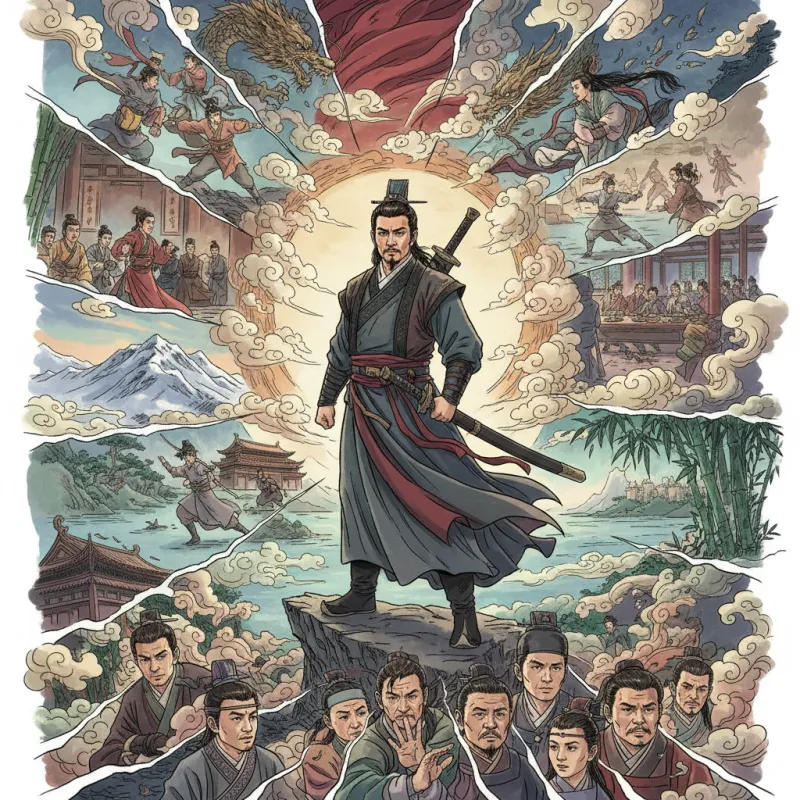
Picture this: It's 1983, and millions of Hong Kong viewers are watching TVB's The Return of the Condor Heroes. Andy Lau appears on screen as Yang Guo (楊過, Yáng Guò), and within minutes, the phone lines at TVB are jammed. Half the callers are praising the casting. The other half are threatening to boycott the series. Fast forward to 2006, and the exact same thing happens with Huang Xiaoming in the role. Then again in 2014 with Chen Xiao. The actors change, the technology improves, but the outrage remains constant. This isn't a bug in Jin Yong adaptations—it's a feature.
The Impossible Task of Casting Perfection
Jin Yong's novels have spawned over 100 film and television adaptations since the 1960s, and every single one follows the same pattern: announcement, casting controversy, premiere, disappointment. The cycle is so predictable you could set your watch by it. But here's what most people miss: the problem isn't that directors keep choosing the wrong actors. The problem is that there is no right actor.
When you read The Return of the Condor Heroes (神鵰俠侶, Shéndiāo Xiálǚ), Yang Guo exists in your imagination as a composite of descriptions, actions, and your own projections. He's "handsome but with a wild edge," "refined yet dangerous," "playful but capable of deep melancholy." Your brain fills in the gaps with faces from your own experience, cultural context, and personal preferences. A reader in 1960s Hong Kong imagined Yang Guo differently than a reader in 1990s Taiwan, who imagined him differently than a reader in 2020s mainland China.
The moment an actor appears on screen, that infinite possibility collapses into one specific face, one particular voice, one concrete physicality. And for most viewers, it's the wrong one. Not because the actor is bad, but because they're not your Yang Guo. They're someone else's.
The Compression Problem
But casting is just the beginning. The deeper structural problem is that Jin Yong's novels are fundamentally unfilmable in their complete form. Take Demi-Gods and Semi-Devils (天龍八部, Tiānlóng Bābù)—the novel runs over a million characters in Chinese, with three parallel protagonists, dozens of significant supporting characters, and a plot that spans decades and crosses multiple kingdoms. The 1997 TVB adaptation, widely considered one of the best, runs 45 episodes at 45 minutes each. That's about 33 hours of screen time to adapt a novel that takes 40-50 hours to read, and that's if you're a fast reader.
Something has to give. Usually, it's the internal monologues, the philosophical digressions, the careful character development that happens in quiet moments between action scenes. Jin Yong's novels are as much about the characters' internal transformations as their external adventures. Guo Jing (郭靖, Guō Jìng) in The Legend of the Condor Heroes (射鵰英雄傳, Shèdiāo Yīngxióng Zhuàn) doesn't just learn martial arts—he slowly, painfully develops from a simple-minded boy into a man who understands duty, sacrifice, and moral complexity. That transformation takes hundreds of pages of subtle shifts in his thinking and reactions.
On screen, you get a montage. Maybe two scenes of him looking thoughtful. Then suddenly he's wise. The destination is the same, but the journey—which is the whole point—is gone. As discussed in The Philosophy Behind Jin Yong's Martial Arts, the internal cultivation is inseparable from the external technique. When adaptations strip away the former to focus on the latter, they're not just simplifying—they're fundamentally changing what the story is about.
The Visual Paradox
Here's an irony: Jin Yong's martial arts scenes are incredibly visual in prose, yet they often disappoint on screen. When you read about Duan Yu (段譽, Duàn Yù) using the Lingbo Weibu (凌波微步, Língbō Wēibù) footwork technique, your imagination creates something impossible—he's simultaneously graceful and fast, his movements both visible and blur-like, somehow defying physics while remaining grounded in a kind of internal logic.
When you see it on screen, it's either a guy running in a slightly fancy way, or it's full wire-work that looks like a video game. The 1982 TVB version went for grounded realism and looked boring. The 2003 Zhang Jizhong version went for CGI-enhanced spectacle and looked cartoonish. Neither captured what readers felt when they read those scenes, because what readers felt was the idea of impossible grace, not any specific visual representation of it.
The best adaptations understand this and don't try to show everything literally. The 1983 The Legend of the Condor Heroes with Felix Wong as Guo Jing used relatively simple choreography but invested heavily in the emotional stakes of each fight. You cared about the outcome, so the fights felt important even when the moves themselves were straightforward. The 2017 The Legend of the Condor Heroes had far superior production values and more elaborate fight scenes, but many felt emotionally flat because the character development was rushed.
The Cultural Translation Problem
Jin Yong wrote for a specific audience: Chinese readers in Hong Kong and Southeast Asia in the 1950s-70s who understood the cultural references, historical context, and literary traditions he was drawing from. His novels are dense with allusions to classical poetry, historical events, Buddhist and Taoist philosophy, and traditional Chinese medicine. When Huang Rong (黃蓉, Huáng Róng) quotes a Tang dynasty poem, Jin Yong's original readers recognized it and understood the layers of meaning. Modern viewers, especially younger ones or international audiences, often don't.
Adaptations face an impossible choice: explain everything and kill the pacing, or explain nothing and lose the depth. Most split the difference and satisfy no one. The cultural gap has only widened over time. A 1983 Hong Kong viewer had a much closer connection to the traditional Chinese culture Jin Yong depicted than a 2024 mainland Chinese viewer, let alone an international one. The world Jin Yong wrote about—where scholars and martial artists shared a common cultural vocabulary, where honor codes were understood without explanation, where the relationship between the jianghu (江湖, jiānghú) and official society had clear rules—that world is increasingly foreign even to Chinese audiences.
The Fidelity Trap
You might think the solution is simple: just be faithful to the source material. Adapt it exactly as written. But this creates its own problems. The most "faithful" adaptations are often the most boring, because what works on the page doesn't always work on screen. Jin Yong's novels have a leisurely pace, with long stretches of conversation, internal reflection, and detailed descriptions of settings and techniques. Translate that directly to screen and you get something that feels slow and talky.
The 2003 Zhang Jizhong adaptations tried for maximum fidelity, keeping almost every plot point and character from the novels. The result was adaptations that ran 40-50 episodes and felt bloated. Casual viewers bounced off them. Hardcore fans appreciated the completeness but still complained about the casting, the visual effects, and the pacing. You can't win.
The most successful adaptations, paradoxically, are often those that take significant liberties. The 1994 The Smiling, Proud Wanderer (笑傲江湖, Xiào'ào Jiānghú) with Chow Yun-fat made major changes to the plot and characters, but it captured the spirit of the novel—the sense of freedom, the critique of power structures, the romance between Linghu Chong (令狐沖, Línghú Chōng) and Ren Yingying (任盈盈, Rèn Yíngyíng). Many fans consider it definitive despite its departures from the text.
The Generational Divide
Every generation claims the adaptations they grew up with are the best and everything since is inferior. People who watched the 1983 TVB Condor Heroes trilogy consider them untouchable classics. People who grew up with the 1990s adaptations think the 1980s versions look cheap and dated. Younger viewers find all the pre-2000 adaptations unwatchable due to production values.
This isn't just nostalgia, though nostalgia plays a role. It's that the adaptation you see first often becomes your definitive version. It shapes how you imagine the characters and world going forward. Every subsequent adaptation is judged against that first impression, and it's almost impossible for later versions to measure up. The first adaptation you see has the advantage of matching your imagination because it becomes your imagination.
This creates an impossible situation for new adaptations. They're not just competing with the source material—they're competing with decades of previous adaptations and the accumulated nostalgia and personal investment viewers have in them. The 2021 The Heaven Sword and Dragon Saber (倚天屠龍記, Yǐtiān Túlóng Jì) was technically accomplished and well-acted, but it was DOA for many viewers who had already decided the 2001 or 1986 or 1978 version was definitive.
Why We Keep Watching Anyway
So if every adaptation is doomed to disappoint, why do we keep watching them? Why do producers keep making them? Because despite everything, there's still value in seeing these stories brought to life. Even a flawed adaptation can offer moments of genuine magic—a perfectly cast supporting character, a fight scene that captures the spirit if not the letter of the novel, a piece of dialogue delivered with unexpected emotional weight.
And sometimes, an adaptation does something the novel couldn't. The visual medium can convey certain things—the beauty of a landscape, the chemistry between actors, the visceral impact of violence—more immediately than prose. The 1994 film Ashes of Time, loosely based on The Legend of the Condor Heroes, is barely recognizable as a Jin Yong adaptation, but it captures something essential about the melancholy and existential loneliness of the wuxia world that's harder to articulate in the novels.
More practically, adaptations introduce new generations to Jin Yong's work. Many readers came to the novels through adaptations, drawn in by a character or story they saw on screen. The adaptation might disappoint compared to the novel, but it serves as a gateway. And for international audiences who can't read Chinese, adaptations are often the only way to experience these stories at all, however imperfectly.
The Permanent Cycle
The cycle will continue. There will be new adaptations with bigger budgets, better effects, and different casting choices. Fans will complain. Some will watch anyway. A few will become beloved despite their flaws. Most will be forgotten. And through it all, Jin Yong's novels will remain, unchanged and unchanging, waiting for each new reader to imagine them fresh.
The disappointment isn't a failure of adaptation—it's proof that the source material is rich enough to sustain infinite interpretations, none of which can be definitive. Every adaptation disappoints someone because every adaptation makes choices, and every choice excludes other possibilities. That's not a bug. That's what adaptation is. The novels exist in a space of infinite possibility. Adaptations exist in the real world, where you have to choose one Yang Guo, one interpretation, one vision. And no single vision can contain everything Jin Yong created.
Maybe that's okay. Maybe the disappointment is part of the experience, a reminder that the novels themselves are what matter. The adaptations are just shadows on the cave wall—interesting shadows, sometimes beautiful shadows, but shadows nonetheless. The real story exists in the text and in your imagination. Everything else is just someone else's dream of it.
Related Reading
- The Best TV Adaptations of Jin Yong's Novels
- Jin Yong in Video Games: From DOS to Open World
- Jin Yong's Global Influence: How Wuxia Went Worldwide
- Best and Worst Jin Yong Adaptations: A Definitive Guide
- Wuxia Films for Beginners: Where to Start
- Peach Blossom Island: The Most Magical Location in Jin Yong's World
- The Greatest Villains in Jin Yong's Novels
- Eighteen Dragon-Subduing Palms: The Ultimate Technique