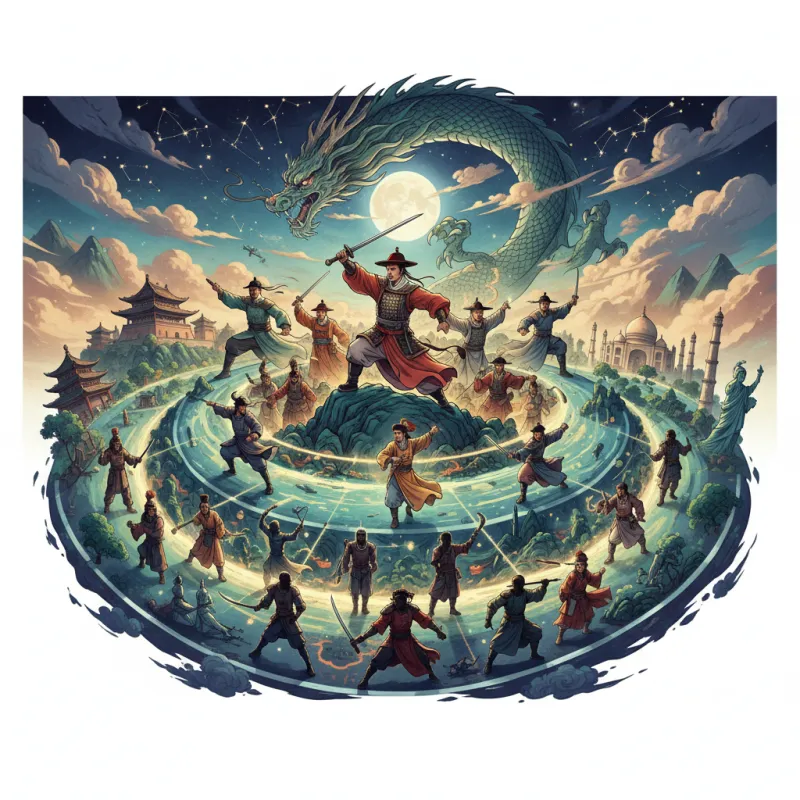
When Crouching Tiger, Hidden Dragon swept into Western theaters in 2000, audiences gasped at warriors gliding across bamboo forests and dueling on rooftops. Critics called it "magical realism." Chinese viewers called it Tuesday. What Ang Lee had done was bottle the essence of wuxia (武俠 wǔxiá) — the martial arts fantasy genre — and serve it to a global audience that had no idea they'd been craving it. And behind that craving, behind decades of flying swordsmen and honor-bound heroes, stood one man: Jin Yong (金庸 Jīn Yōng), whose fourteen novels didn't just define wuxia — they exported an entire worldview.
The Stealth Invasion: Jin Yong's Ideas Without His Name
Here's the paradox: Jin Yong is everywhere in global pop culture, yet most Western audiences have never heard of him. His influence operates like a cultural sleeper agent, embedded in everything from The Matrix to Game of Thrones to Avatar: The Last Airbender. When you see a training montage where the hero masters an impossible technique through discipline and suffering, that's Jin Yong's DNA. When you encounter a morally gray protagonist torn between loyalty and justice, that's his fingerprint. The concept of "cultivation" in Chinese fantasy — the idea that martial arts mastery is spiritual enlightenment — comes directly from his novels.
Consider The Legend of Condor Heroes (射鵰英雄傳 Shèdiāo Yīngxióng Zhuàn), published in 1957. Its protagonist Guo Jing is a simple, honest youth who becomes a martial arts master not through genius but through relentless effort and moral clarity. Sound familiar? That's Luke Skywalker. That's Frodo. That's every chosen-one-who-doesn't-feel-chosen in Western fantasy. Jin Yong wrote the template decades before George Lucas picked up a camera.
The difference is that Jin Yong's heroes exist in a world where martial arts isn't just combat — it's philosophy, medicine, politics, and poetry rolled into one. The martial arts systems in his novels operate on principles of qi (氣 qì), yin-yang balance, and Daoist cosmology. When Western creators borrow these elements, they often strip away the philosophical scaffolding, leaving only the aesthetic. We get the wire-fu without the worldview.
The Asian Media Wave: Riding Jin Yong's Coattails
The 1980s and 1990s saw Jin Yong's novels adapted into dozens of Hong Kong television series, which became the gateway drug for international audiences. TVB's 1983 version of The Legend of the Condor Heroes starring Felix Wong became a cultural phenomenon across Asia. In Thailand, Indonesia, Vietnam, and Korea, entire generations grew up watching these series, often dubbed into local languages. The shows were melodramatic, low-budget, and utterly addictive.
These adaptations did something crucial: they proved that wuxia could travel. The stories worked in different cultural contexts because Jin Yong's themes — loyalty, betrayal, the corruption of power, the cost of revenge — are universal. A Vietnamese teenager could root for Yang Guo in The Return of the Condor Heroes (神鵰俠侶 Shéndiāo Xiálǚ) just as passionately as a Hong Kong office worker, even if they understood the Confucian subtext differently.
By the time Crouching Tiger, Hidden Dragon arrived, Western audiences had been primed by decades of Asian cinema. John Woo's heroic bloodshed films, Jackie Chan's kung fu comedies, and anime like Dragon Ball (itself influenced by Chinese martial arts novels) had created an appetite for stylized action and honor-bound warriors. Jin Yong's influence was already there, filtered through multiple adaptations and reinterpretations.
Video Games: The Unexpected Ambassador
If you want to understand Jin Yong's global reach, look at video games. The Legend of Sword and Fairy series, Jade Empire, and countless Chinese RPGs draw directly from his novels. But the real breakthrough came with games that adapted his work for interactive media. The Jinyong Qunxia Zhuan (金庸群俠傳) series, starting in 1996, let players inhabit his universe, learning martial arts techniques and meeting characters from across his fourteen novels.
These games did something translations struggled with: they made Jin Yong's world experiential. You didn't just read about the Eighteen Dragon-Subduing Palms (降龍十八掌 Jiàng Lóng Shíbā Zhǎng) — you pressed buttons to execute them. You didn't just understand that martial arts sects had complex politics — you navigated those politics through dialogue trees and quest choices. The medium solved the accessibility problem that had plagued Jin Yong's international expansion.
More recently, games like Genshin Impact and Black Myth: Wukong have brought wuxia aesthetics to massive global audiences. While these aren't direct Jin Yong adaptations, they're built on the foundation he laid. The idea that a game can be both a power fantasy and a meditation on morality, that combat can be beautiful and meaningful — that's Jin Yong's legacy, even when his name isn't in the credits.
The Translation Problem: Lost in Language
Jin Yong's novels are notoriously difficult to translate. His prose is dense with classical Chinese allusions, poetry, and wordplay. Character names often carry thematic weight — Linghu Chong (令狐沖) from The Smiling, Proud Wanderer has a name that suggests both nobility and impetuousness. Martial arts techniques have poetic names that sound ridiculous in English: "Sorrowful Breeze Palm" or "Jade Maiden Swordplay" lose their gravitas when stripped of tonal nuance.
The first English translations, starting with Graham Earnshaw's 2018 version of The Book and the Sword (書劍恩仇錄 Shūjiàn Ēnchóu Lù), faced an impossible task. Do you prioritize literal accuracy or narrative flow? Do you explain every cultural reference or trust readers to infer? The result has been translations that feel either too academic or too simplified, never quite capturing the original's blend of action, philosophy, and emotional depth.
Compare this to the success of translated manga and light novels, which benefit from visual elements and shorter formats. Jin Yong's novels are doorstoppers — Demi-Gods and Semi-Devils (天龍八部 Tiānlóng Bābù) runs over a million characters in Chinese. Western readers accustomed to tight, fast-paced fantasy often bounce off the leisurely pacing and sprawling casts. The character development that makes Jin Yong's work profound can feel meandering to readers expecting Brandon Sanderson-style efficiency.
The Netflix Era: Wuxia's Second Wave
The streaming revolution has given Jin Yong's work new life. The Untamed (2019), based on a wuxia novel heavily influenced by Jin Yong, became a global phenomenon on Netflix, introducing millions of international viewers to the genre's conventions. Suddenly, Western audiences were learning terms like shifu (師父 shīfu, master), jianghu (江湖 jiānghú, the martial arts world), and xianxia (仙俠 xiānxiá, immortal heroes).
This has created an opening for Jin Yong's actual work. New adaptations are being produced with international audiences in mind, featuring higher production values and more accessible storytelling. The 2021 version of The Legend of the Condor Heroes on Viki attracted viewers who'd never heard of Jin Yong but were hungry for more content like The Untamed. The adaptation history shows how each generation reinterprets his work for contemporary audiences.
What's fascinating is how younger Chinese creators are remixing Jin Yong's ideas for global consumption. Novels like Grandmaster of Demonic Cultivation and Heaven Official's Blessing take his themes — loyalty, sacrifice, the burden of reputation — and update them with modern sensibilities around gender, sexuality, and power. These works are more easily translated because they're written with international audiences in mind, but they're standing on Jin Yong's shoulders.
The Philosophical Export: More Than Just Fights
Jin Yong's deepest influence isn't in fight choreography or plot structures — it's in his moral universe. His novels ask: What does it mean to be a hero in a corrupt world? Can you maintain your principles when everyone around you is compromising? Is revenge justice or poison? These questions resonate across cultures because they're fundamentally human.
Take The Smiling, Proud Wanderer (笑傲江湖 Xiào'ào Jiānghú), published in 1967 during the Cultural Revolution. On the surface, it's about martial arts sects fighting for supremacy. Beneath that, it's a meditation on authoritarianism, orthodoxy, and the cost of nonconformity. Linghu Chong refuses to join any sect, preferring freedom to power. That story works in 1960s China, 1990s Hong Kong, and 2020s America because the tension between individual liberty and collective security is eternal.
Western fantasy has started absorbing this moral complexity. The grimdark movement in fantasy — think Joe Abercrombie or Mark Lawrence — shares Jin Yong's interest in flawed heroes and ambiguous conflicts. The difference is that Jin Yong never abandoned the possibility of redemption. His characters can be selfish, cruel, or weak, but they can also change. That's a more hopeful vision than much contemporary Western fantasy offers.
The Future: From Niche to Mainstream
Jin Yong died in 2018, but his influence is accelerating. As China's cultural soft power grows, his work is being positioned as a cornerstone of Chinese identity — the literary equivalent of kung fu or calligraphy. Government-backed initiatives are funding new translations and adaptations, aiming to make Jin Yong as recognizable globally as he is domestically.
But the real driver will be organic fandom. Online communities are translating his novels chapter by chapter, creating wikis, writing fan fiction, and producing video essays. Young readers discovering wuxia through The Untamed or Word of Honor are working backward to the source. They're learning that the tropes they love — the tragic romance, the found family, the master-student bond — all trace back to Jin Yong.
The question isn't whether Jin Yong will become a global literary figure. He already is — most people just don't know it yet. Every time a Western fantasy novel features a magic system based on internal energy cultivation, every time a film shows warriors fighting on water or walls, every time a story asks whether honor matters more than survival, Jin Yong's influence is there. The Chinese Shakespeare has gone global. We've just been reading him without realizing it.
Related Reading
- Jin Yong in Video Games: From DOS to Open World
- Best and Worst Jin Yong Adaptations: A Definitive Guide
- Jin Yong on Screen: Why Every Adaptation Disappoints Someone
- The Best TV Adaptations of Jin Yong's Novels
- Wuxia Films for Beginners: Where to Start
- Four-Word Martial Arts Idioms from Jin Yong's Novels
- Fan Debates That Have Lasted Decades
- Exploring the Rich Tapestry of Jin Yong's Wuxia Novels and Their Enduring Legacy