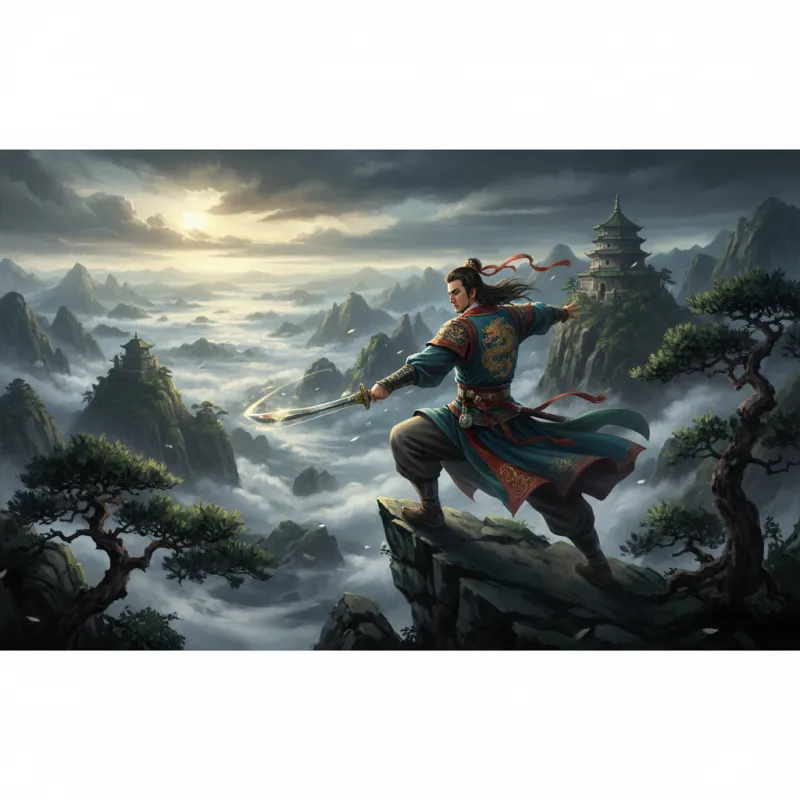
You're standing on a desert cliff, watching a swordsman who's forgotten why he kills. The wind howls. Someone offers him wine that erases memory. He drinks. This is Ashes of Time (东邪西毒 Dōng Xié Xī Dú, 1994), and it's probably the worst place to start your wuxia journey—but we'll get to that.
Wuxia (武侠 wǔxiá, "martial heroes") films are China's answer to Westerns, samurai films, and superhero movies rolled into one. They're about wandering swordsmen, impossible physics, blood oaths, and the kind of loyalty that gets you killed. Jin Yong's fourteen novels form the backbone of this tradition, adapted over 100 times since the 1950s. Some adaptations are masterpieces. Most are forgettable. A few are so bad they're offensive to the source material.
This guide will save you from wasting your time.
The Golden Rule: Start With Shaw Brothers
If you want to understand wuxia cinema, start with the Shaw Brothers studio in the 1960s and 70s. These films are colorful, theatrical, and unapologetically melodramatic. They're also the foundation for everything that came after.
Come Drink With Me (大醉侠 Dà Zuì Xiá, 1966) isn't a Jin Yong adaptation, but it's essential viewing. Director King Hu created the template: a woman warrior (Cheng Pei-pei) who fights like a dancer, villains who monologue before attacking, and fight choreography that treats combat as visual poetry. The film moves fast, looks gorgeous, and doesn't waste time explaining its world. You're thrown into the jianghu (江湖 jiānghú, the "rivers and lakes" world of martial artists) and expected to keep up.
After that, watch The Brave Archer series (射雕英雄传 Shè Diāo Yīngxióng Zhuàn, 1977-1982), adapted from Jin Yong's The Legend of the Condor Heroes. Yes, the special effects are dated. Yes, the acting is over-the-top. But these films capture something essential about Jin Yong's storytelling: the sprawling cast, the intricate martial arts schools, the way personal conflicts mirror larger historical events. Plus, you get to see the Seven Freaks of Jiangnan (江南七怪 Jiāngnán Qī Guài) in all their weird glory.
The New Wave: 1990s Hong Kong Cinema
The 1990s brought wire work, CGI, and directors who treated wuxia as high art. This is when things get interesting—and complicated.
Swordsman II (笑傲江湖之东方不败 Xiào Ào Jiānghú Zhī Dōngfāng Bùbài, 1992) takes Jin Yong's The Smiling, Proud Wanderer and does something audacious: it makes the villain the most compelling character. Brigitte Lin plays Dongfang Bubai (东方不败 Dōngfāng Bùbài, "Invincible East"), who castrates himself to master a forbidden martial arts manual and becomes something beyond male or female. The film is gorgeous, tragic, and completely unhinged. Director Ching Siu-tung choreographs fights like ballet—people fly through bamboo forests, fight on water, duel with needles and thread.
This is also when Jet Li enters the picture. His Fong Sai-yuk films (方世玉 Fāng Shìyù, 1993) aren't Jin Yong adaptations, but they showcase what made 90s wuxia special: humor, acrobatics, and fight scenes that defy physics without losing emotional weight. Li's best Jin Yong work is The Legend of the Swordsman (笑傲江湖 Xiào Ào Jiānghú, 1990), where he plays Linghu Chong (令狐冲 Línghú Chōng), a carefree swordsman caught in sect politics. The film balances comedy and tragedy better than most adaptations manage.
The Crossover Hit: Crouching Tiger, Hidden Dragon
Crouching Tiger, Hidden Dragon (卧虎藏龙 Wò Hǔ Cáng Lóng, 2000) isn't based on Jin Yong—it adapts Wang Dulu's novels—but it's the film that introduced Western audiences to wuxia. Director Ang Lee slowed everything down, made the wire work elegant rather than flashy, and centered the story on repressed desire rather than revenge.
The bamboo forest fight between Zhang Ziyi and Michelle Yeoh is justly famous. But what makes the film work is its restraint. Characters don't shout their feelings; they communicate through glances, through the way they hold a sword, through what they don't say. This is wuxia filtered through art house sensibility, and it works beautifully—even if purists complain it's too slow, too Western, too focused on romance over martial arts philosophy.
If you like Crouching Tiger, you'll probably enjoy Hero (英雄 Yīngxióng, 2002) and House of Flying Daggers (十面埋伏 Shí Miàn Mái Fú, 2004), Zhang Yimou's visually stunning contributions to the genre. Just know that these films prioritize aesthetics over storytelling. They're beautiful, but they lack the narrative complexity of Jin Yong's best work.
The Modern Era: Mainland China Takes Over
After 2000, mainland China became the dominant force in wuxia production, with bigger budgets and more CGI. The results are mixed.
The Banquet (夜宴 Yè Yàn, 2006) transplants Hamlet into a wuxia setting. It's ambitious, gorgeous, and ultimately hollow—proof that throwing money at a genre doesn't guarantee quality. The fight choreography by Yuen Woo-ping is excellent, but the film can't decide if it wants to be Shakespeare or Shaw Brothers.
Better is Dragon (武侠 Wǔxiá, 2011), which deconstructs the genre by asking: what if a retired martial artist just wants to live a normal life? Donnie Yen plays a papermaker in a remote village who's forced to reveal his skills when detectives investigate a killing. Director Peter Chan uses forensic analysis and slow-motion to show exactly how wuxia combat would work anatomically. It's clever, violent, and surprisingly moving.
For Jin Yong adaptations specifically, the 2017 film The Final Master (师父 Shīfu) isn't based on his work but captures his themes better than most official adaptations: the cost of mastery, the politics of martial arts schools, the way violence perpetuates itself. It's brutal, elegant, and doesn't waste a single frame.
What to Avoid (For Now)
Skip Ashes of Time until you've watched at least five other wuxia films. Wong Kar-wai's 1994 meditation on The Legend of the Condor Heroes is brilliant, but it's also deliberately opaque, non-linear, and more interested in mood than plot. Characters speak in riddles. The timeline jumps around. You need to know the source material to appreciate what Wong is doing—and even then, you might hate it. (I love it, but I watched it after reading the novel three times and seeing four other adaptations.)
Also avoid most TV series for now. Yes, the 2003 Demi-Gods and Semi-Devils (天龙八部 Tiānlóng Bā Bù) is beloved, and the 2017 The Legend of the Condor Heroes is faithful to the novel. But these series run 40-50 episodes. They're commitments. Start with films that give you the essence of wuxia in two hours, then graduate to the longer formats if you're hooked.
And please, skip the 2021 The Legend of the Condor Heroes: The Cadaverous Claws. It's a cash grab with terrible CGI and actors who clearly haven't read the source material. Some adaptations are so bad they make you angry on Jin Yong's behalf.
The Viewing Order That Actually Works
Here's my recommended path:
- Come Drink With Me (1966) - Learn the language of wuxia cinema
- The Brave Archer (1977) - See Jin Yong adapted traditionally
- Swordsman II (1992) - Experience peak Hong Kong wuxia
- Crouching Tiger, Hidden Dragon (2000) - Understand the crossover appeal
- Dragon (2011) - See the genre deconstructed
After these five, you'll know if wuxia is for you. If you're hooked, dive into the TV series, explore the Shaw Brothers catalog, and finally tackle Ashes of Time. If you're not hooked, at least you've seen some of the best action choreography in cinema history.
Why This Matters
Jin Yong's novels have sold over 300 million copies. His characters—Guo Jing (郭靖 Guō Jìng), Yang Guo (杨过 Yáng Guò), Wei Xiaobao (韦小宝 Wéi Xiǎobǎo)—are as recognizable in Chinese culture as Sherlock Holmes or Harry Potter in the West. The films and TV series based on his work have shaped how multiple generations understand heroism, loyalty, and the cost of violence.
But more than that, wuxia films are just incredibly fun. Where else can you watch someone fight with a guqin (古琴 gǔqín, a seven-string zither), duel on rooftops, or master a technique by studying ancient scrolls in a cave? The genre takes itself seriously without being self-serious. It understands that spectacle and substance aren't opposites.
Start with the films above. Read the novels if you can—Jin Yong's writing style rewards close attention, and the adaptations make more sense when you know what they're adapting or subverting. Explore the different martial arts schools that appear across the stories. And remember: the best wuxia films aren't about the fights. They're about why people fight, what they're willing to sacrifice, and whether mastery is worth the cost.
Now go watch Come Drink With Me. The jianghu is waiting.
Related Reading
- Jin Yong's Global Influence: How Wuxia Went Worldwide
- Jin Yong in Video Games: From DOS to Open World
- The Best TV Adaptations of Jin Yong's Novels
- Best and Worst Jin Yong Adaptations: A Definitive Guide
- Jin Yong on Screen: Why Every Adaptation Disappoints Someone
- The Greatest Villains in Jin Yong's Novels
- The Nine Yin Manual: Most Coveted Martial Arts Text
- Love and Sacrifice in Jin Yong's World