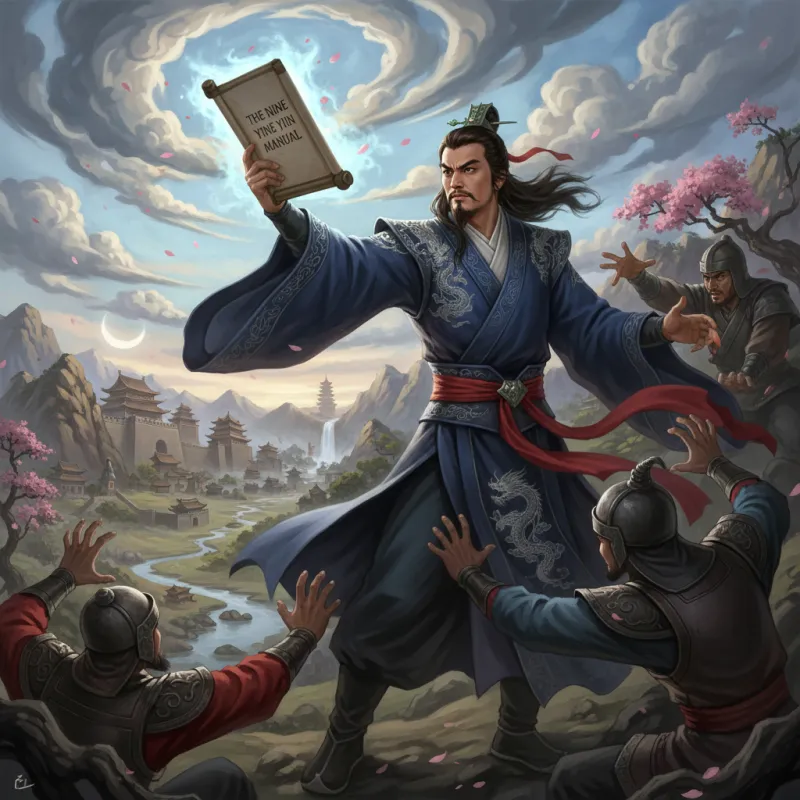
The blood-soaked pages of a single manuscript have sparked more duels, betrayals, and deaths in Jin Yong's wuxia universe than any sword or fist technique ever could. The Nine Yin Manual (九陰真經, Jiǔ Yīn Zhēnjīng) isn't just another martial arts text—it's the forbidden fruit that exposes the darkest impulses of even the most righteous heroes, a mirror reflecting whether a warrior's heart is truly pure or merely pretending to be.
A Manual Born from Genius and Tragedy
The Nine Yin Manual first appears in The Legend of the Condor Heroes (射鵰英雄傳, 1957-1959), but its backstory reaches back centuries within Jin Yong's fictional timeline. According to the lore, the manual was compiled during the Song Dynasty by Huang Shang (黃裳), a brilliant scholar-official who had no martial arts background whatsoever. After being tasked by Emperor Huizong to suppress the Mingjiao (明教), Huang found himself hunted by vengeful martial artists. In desperation, he dove into the Daoist canon, extracting martial principles from Taoist philosophy and creating what would become the most complete martial arts system ever recorded.
Here's what makes Huang Shang's achievement remarkable: he wasn't a martial artist trying to document techniques—he was a philosopher reverse-engineering combat theory from spiritual texts. The manual doesn't just teach you how to fight; it rewrites your understanding of qi (氣) circulation, internal energy cultivation, and the relationship between mind and body. It's the difference between a cookbook and a treatise on molecular gastronomy.
What's Actually Inside the Manual
Jin Yong never gives us the full contents—that would ruin the mystique—but through various novels, we piece together what the Nine Yin Manual contains. The text is divided into two volumes, with the upper volume focusing on internal energy cultivation (內功, nèigōng) and the lower volume detailing specific techniques and applications.
The most infamous technique is the Nine Yin White Bone Claw (九陰白骨爪, Jiǔ Yīn Báigǔ Zhǎo), a terrifying skill that allows practitioners to crush skulls and rip through flesh with their bare hands. But here's the twist: this technique appears only in the fraudulent version of the manual, added by someone who fundamentally misunderstood the text's philosophy. The real Nine Yin Manual emphasizes healing and protection as much as combat—it includes the Nine Yin Healing Chapter (九陰療傷篇) and techniques for reversing meridian damage.
Other documented techniques include the Soul-Shifting Method (移魂大法), the Heart-Destroying Palm (摧心掌), and perhaps most importantly, the manual's approach to internal energy cultivation, which forms the foundation for nearly every advanced skill in Jin Yong's universe.
The Manual as Narrative Engine
What makes the Nine Yin Manual brilliant from a storytelling perspective is how Jin Yong uses it to test character. In The Legend of the Condor Heroes, we watch different characters interact with the same text and produce wildly different results. Guo Jing (郭靖), our earnest but slow-witted protagonist, memorizes portions of it but lacks the cunning to fully exploit its power. Zhou Botong (周伯通), the Old Urchin, deliberately forgets the manual's contents to avoid temptation, though he's already absorbed its principles. Mei Chaofeng (梅超風) and her husband steal an incomplete version and create the horrifying White Bone Claw, becoming monsters in the process.
The manual doesn't corrupt people—it amplifies what's already there. When Huang Yaoshi (黃藥師) studies it, he integrates its principles into his own heterodox martial arts without losing himself. When Ouyang Feng (歐陽鋒) practices from a deliberately reversed version (thanks to Guo Jing's sabotage), he goes mad but also becomes terrifyingly powerful. The same knowledge, filtered through different hearts and minds, produces saints and demons.
The Manual Across Multiple Novels
Jin Yong brings the Nine Yin Manual back in The Return of the Condor Heroes (神鵰俠侶, 1959-1961), where it's become almost a background element—the previous generation's obsession that the new heroes have moved beyond. Yang Guo (楊過) encounters it but isn't particularly interested; he's too busy developing his own Melancholy Ecstasy Palm (黯然銷魂掌). This narrative choice is deliberate: Jin Yong is showing us that true martial arts mastery isn't about possessing the "best" manual but about understanding yourself.
By the time we reach The Heaven Sword and Dragon Saber (倚天屠龍記, 1961), set in the Yuan Dynasty, the Nine Yin Manual has become legendary history. Zhang Wuji (張無忌) learns the Nine Yang Manual (九陽真經) instead—a text created specifically to counter the Nine Yin Manual's techniques, though ironically, both manuals share the same philosophical foundation. They're yin and yang, two sides of the same coin, which is very much the point.
Why Everyone Wants It (And Why They Shouldn't)
The Nine Yin Manual represents the ultimate shortcut—decades of martial arts training compressed into a single text. But Jin Yong repeatedly demonstrates that shortcuts corrupt. The characters who benefit most from the manual are those who don't need it: people like Guo Jing, who has already built a solid foundation through years of honest training, or Zhou Botong, who's already achieved martial enlightenment through his own path.
Compare this to the Sunflower Manual, another legendary text in Jin Yong's universe. Where the Sunflower Manual demands a horrifying physical sacrifice, the Nine Yin Manual's price is more subtle—it tests your character, your discipline, your ability to wield power without being consumed by it. In some ways, that makes it more dangerous. A manual that requires castration at least warns you upfront what you're getting into.
The Manual's Real-World Inspirations
Jin Yong drew inspiration from actual Daoist texts when creating the Nine Yin Manual. The emphasis on qi circulation, the integration of philosophy with technique, the idea that martial arts and spiritual cultivation are inseparable—these concepts come straight from Daoist internal alchemy (內丹, nèidān) traditions. Historical texts like the Huangting Jing (黃庭經, Yellow Court Classic) and various Daoist meditation manuals influenced Jin Yong's conception of how a "complete" martial arts system would function.
The Song Dynasty setting is also significant. This was a period when Neo-Confucianism was synthesizing Buddhist and Daoist ideas into new philosophical frameworks. Huang Shang, as a scholar-official, would have been steeped in this intellectual environment, making his creation of the manual from Daoist texts historically plausible within Jin Yong's fictional framework.
What the Manual Teaches Us About Jin Yong's Philosophy
Ultimately, the Nine Yin Manual is Jin Yong's meditation on knowledge, power, and moral character. The manual itself is neutral—neither good nor evil. It's a tool, and like any tool, its moral value depends entirely on who wields it and for what purpose. This reflects Jin Yong's broader humanistic philosophy: there are no shortcuts to virtue, no techniques that can replace genuine moral cultivation.
The most powerful martial artists in Jin Yong's novels aren't those who possess the best manuals or the most devastating techniques. They're the ones who understand themselves, who've integrated their martial arts with their character, who've achieved what the Chinese call "unity of knowledge and action" (知行合一, zhī xíng héyī). The Nine Yin Manual can give you power, but it can't give you wisdom—and in Jin Yong's universe, wisdom always trumps power in the end.
The manual's greatest lesson isn't written in its pages at all. It's written in the stories of everyone who sought it: that the journey matters more than the destination, that character is destiny, and that the most dangerous enemy isn't the martial artist with the deadliest technique—it's the one who's mastered themselves.
Related Reading
- The Five Greats Explained: Understanding Jin Yong's Power Elite
- Six Meridian Divine Sword: Invisible Blade
- The Timeless Appeal of Jin Yong's Wuxia Novels: Martial Arts, Characters, and Storylines
- The Enduring Legacy of Jin Yong’s Wuxia Novels: Characters, Martial Arts, and Cultural Influence
- The Most Tragic Villains in Jin Yong's Novels
- Jin Yong on Screen: The Best Film Adaptations
- Zhou Botong: The Old Urchin Who Never Grew Up